Americans love trains.
From grandfathers to little kids to great artists like Edward Hopper, when an American sees a train or hears its rhythmic clickety clack and mournful whistle, it stirs something deep in the soul.
It is for this reason that so many Christmas trees in America are not complete without a toy train set choo-chooing around its base.
There is a good reason for this universal train fandom.
Trains upgraded not just human mobility but human consciousness itself.
On the macro scale, the economic, social, and military impact of trains was epoch shifting. Railroads enabled industrial-scale commerce by transporting goods, raw materials, and agricultural products rapidly across vast regions. Cities expanded and national economies integrated as migration and commuting became practical on an unprecedented scale.
On the less positive side of things, trains allowed the mobilization of millions of troops and enormous equipment and vast quantities of supplies, making industrialized warfare possible. World War I, with its meticulously timed troop movements, and World War II, with its global supply chains and strategic relocations, would have been impossible without rail networks.
But trains also changed the individual as well.
Before their invention, most people traveled by foot, horse, or boat, covering only a few thousand miles in a lifetime. With trains, ordinary people could traverse continents in days instead of half a year, experiencing motion without effort in carriages that resembled living rooms.
This created a novel psychological sensation: speed and distance became tangible while passengers remained comfortably inert, observing the world rush past.
Trains also democratized what was once only a luxury for elites. Before trains, only Cleopatra was borne through space luxuriating on a couch. But after the golden spike was nailed down connecting the transcontinental railroad, all American men and women could enjoy the same experience from NY to LA in less than a week instead of most of a year.
Even a hobo, a homeless American with literally no money at all, could join in on the incredible dreamlike wonder of being carried through time and space at fifty miles an hour by hopping a freight.
Trains have also elevated something as mundane as the daily commute to work. Writers like John Cheever made bank opining on the mystery and power of the Westchester to Manhattan commuter train experience as did Liam Neeson in the action thriller, The Commuter.
Plane travel, on the other hand, is obviously much faster; yet, it lacks the romance of trains. There is mostly nothing to look at beyond the thick cloud-covered windows. It is mind crushingly crowded. People puke. Your ears hurt. You can hardly move around. And you certainly can’t wander off to a bar car to light a cigarette for a mysterious blonde.
Sure, it can get you to LA from NY mere hours. But to perform this trick, you must be trapped with unruly passengers in a flying bus with shuttered windows for several hours. And not just your average bus either, but one that at any moment, if something goes wrong, will give you unwanted insight into what an old minivan feels like when it is dropped into a car crusher. It is more akin to several hours of fear and claustrophobia than something interesting to look forward to.
Cars, too, have their utility. Yet, who has to drive them? You do. With the exception of being a taxi driver, the possibility for interesting adventure, action, or meeting a new person is quite limited. Can a driver on I-95 elegantly sip a martini like Cary Grant as he chats up a femme fatale? Can a nurse stuck in traffic on the Jersey Turnpike get into a thrilling shootout with thugs like Charles Bronson in Death Wish?
Compare these nasty and brutish modes of transport to the timeless romance of trains.
Riding a train often feels like flying in a dream.
The world blurs past the window as if the landscape is both distant and intimately close, and the rhythmic clatter of wheels becomes a hypnotic heartbeat. Time compresses: cities, rivers, and forests pass in moments that would take days on foot, yet the traveler remains seated, weightless in comfort. There is a surreal detachment, a feeling of gliding through the world while remaining part of it, reminiscent of dreamlike flight.
This sensation mirrors the philosopher Schopenhauer’s notion of the sublime: the mind witnesses vastness and power without being crushed by it, lifted above ordinary effort, free to contemplate the immensity of life and the possibilities that stretch endlessly ahead.
Trains awaken the imagination. The mournful call of a train in the dark, speeding across the land, seems to whisper of unseen stories, hidden destinies, and possibilities yet to be realized. In their motion, the thrill of adventure, the allure of mystery, and the quiet poetry of life in motion is evoked.
Trains do not merely move people; they transform the human experience, making them—out of all the symbols of our modern age—the most romantic, thrilling, and delightful.
That is why it is no wonder that many of our classic noir and thriller films revolve around them.
With all that said, I would now like to present to you ten popular train-centered films for you to rekindle your romance with the iron horse.
All aboard!
*
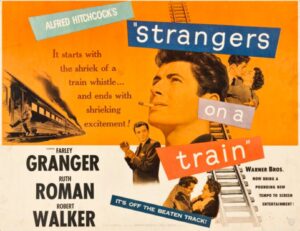
Strangers on a Train (1951)
Hitchcock’s classic psychological thriller about two men who meet on a train and conspire to “swap” murders.

The Lady Vanishes (1938)
Another Hitchcock film; a mystery that unfolds almost entirely on a European train, complete with disappearances and espionage.
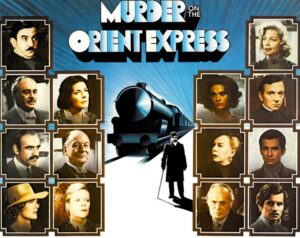
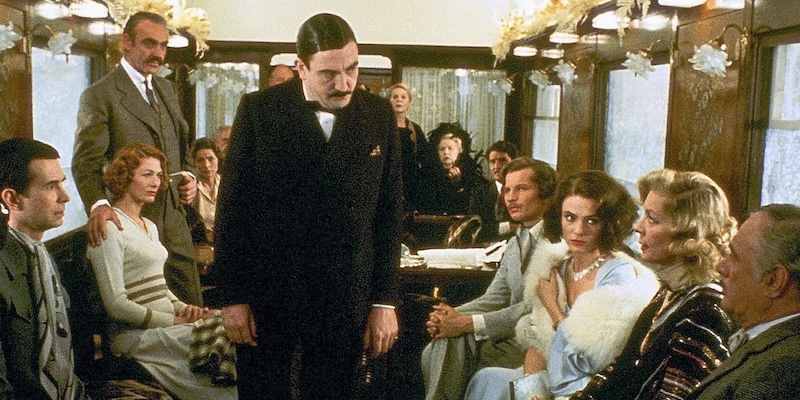
Murder on the Orient Express (1974)
Based on Agatha Christie’s novel; a murder mystery set aboard the luxurious Orient Express.
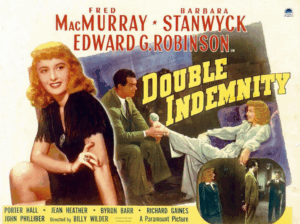
Double Indemnity (1944)
Classic film noir with a murder plot that features a pivotal scene on a train, adding suspense and tension.
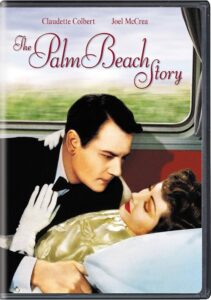
The Palm Beach Story (1942)
A fast-talking screwball comedy in which a financially struggling inventor’s wife hops a train from NY to Palm Beach.

The Train (1964)
Wartime thriller starring Burt Lancaster: French Resistance fights to stop Nazis from stealing French art via train.

Runaway Train (1985)
Tense action movie about convicts trapped on a speeding train with no brakes.
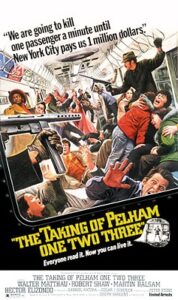
The Taking of Pelham 123 (1974)
Crime thriller about a New York City subway train hijacking; a tense, iconic film later remade in 2009.
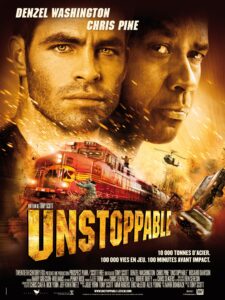
Unstoppable (2010)
Action-thriller about an unmanned freight train carrying hazardous cargo and the effort to stop it.

The Girl on the Train (2021)
Mystery-thriller about a woman who becomes entangled in a murder plot after witnessing suspicious activity from a train.

Von Ryan’s Express (1965)
WWII action-thriller starring Frank Sinatra, featuring Allied POWs escaping on a German train across Italy.
***