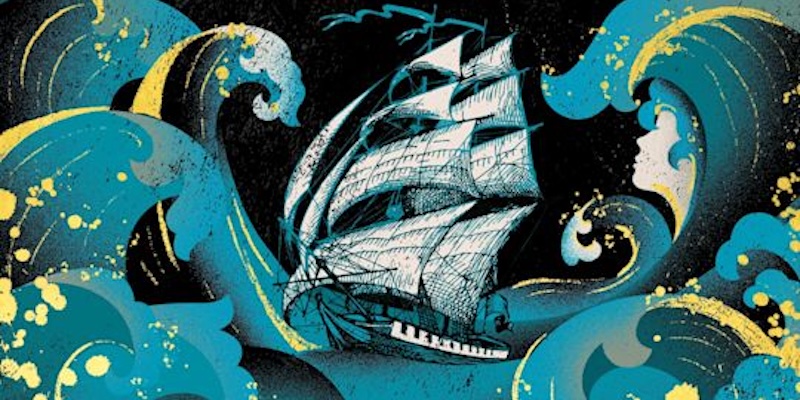
Most places crimes are committed are either seedy, mundane or a combination of the two. But when it comes to crimes committed at sea, historically it’s the opposite. Whether it is the unpredictability of the ocean, its representation of freedom or the adventurous spirit of those who make their living on the high seas, the smugglers, pirates and mutineers of the seventeenth, eighteenth, and early nineteenth centuries often strike us as inherently romantic.
I drew on this sense of romance when writing my debut novel, The Sea Child, in which a young widow with a mysterious, magic-tinged past becomes entangled in the schemes of a group of seafaring smugglers—and with their enigmatic captain. One of the things I discovered during my research was that in Cornwall, England where the novel is set, a large chunk of the population supported smuggling. Not surprising, perhaps, when a tax of over one-hundred percent on many basic goods coupled with widespread poverty made smuggling seem justifiable.
Mutinies similarly can be understandable as, looking back, we sympathize with sailors rising against the tyrannical Captain Bligh of HMS Bounty. Piracy, on the other hand, is less easy to excuse, but the sheer audacity of many pirates during the Age of Sail well makes up for this and allows us to romanticize away.
So get yourself a tot of rum and let’s get underway with eight cracking reads about smugglers, pirates and mutineers.
*
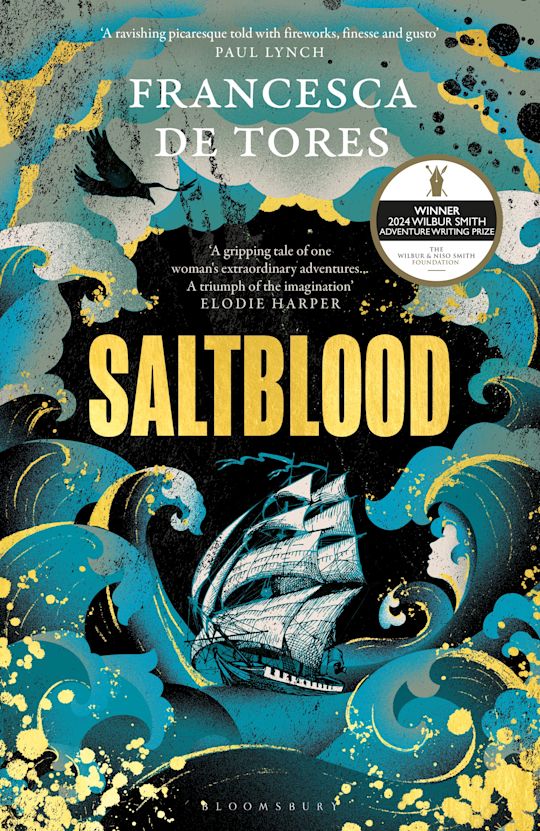
Francesca De Tores, Saltblood
In a rented room outside Plymouth in 1685, a daughter is born as her half-brother is dying. The children’s mother decides Mary will become Mark so she can continue to collect her son’s inheritance money. Told in lyrical prose, Saltblood follows Mary’s existence as a boy, which eventually leads her to become a sailor on a Royal Navy ship and after that, a pirate.
Inspired by real-life pirate Mary Read and with part of the story centered around Mary’s sailing with famous pirates Jack Rackham and Anne Bonny, there is plenty of excitement and swashbuckling in this wonderful debut novel.

Daphne Du Maurier, Frenchman’s Creek
One of the classics of pirate as well as Cornish literature, Frenchman’s Creek is the intensely romantic story of Dona St Columb, who escapes London’s Restoration Court and her landowner husband in search of freedom and adventure. In Cornwall, along the spectacularly beautiful Helford River Dona meets pirate captain Jean Benoit Aubery, who is mostly referred to as ‘The Frenchman’ throughout the novel, and finds the adventure she’s looking for aboard his ship.
A departure from the more suspenseful novels Du Maurier is known for such as Rebecca and My Cousin Rachel, Frenchman’s Creek holds a charm all its own and is worth reading for the stunning descriptions of the Cornish landscape alone, if not for the adventure and captivating romance.

Susanna Kearsley, The Rose Garden
After Eva loses her movie star sister, she returns to Cornwall where they spent their childhood summers, planning to/ in order to scatter her sister’s ashes. But the house Eva used to stay at as a child, Trelowarth, turns out to be a portal between our modern time and the eighteenth century, when smuggler brothers Jack and Daniel Butler lived there.
Soon, Eva is caught up in the brothers’ lives and finds herself falling for Daniel. As if their smuggling operation doesn’t put them enough at risk already, the brothers are also involved in the Jacobite cause, and danger eventually arrives at their (and Eva’s) door. Steeped in smuggling history, this deliciously romantic timeslip novel is a must-read for those who enjoy historical fiction set in Cornwall’s colorful past.

David Grann, The Wager: A Tale of Shipwreck, Mutiny and Murder
The only nonfiction work on my list (I could add loads, but wanted to focus mainly on fiction), The Wager reads like a novel, with as much high-seas adventure, excitement and drama as any Patrick O’Brian book. David Grann’s descriptions of life on a British warship in the eighteenth century have been compared to the Aubrey-Maturin series by O’Brian and the stakes are impossibly high in this tale of shipwreck, mutiny and survival, making this an absolute page-turner.
It is also a tale of meritocracy, snobbery, and perseverance which means this story from three hundred years ago is relevant and engaging today.

Michael Crichton, Pirate Latitudes
Pirate Latitudes is a classic pirate yarn. Posthumously published, it opens in 1665 Port Royal, Jamaica, where Captain Charles Hunter assembles a roughneck crew to commandeer enemy ship El Trinidad, a Spanish galleon carrying gold. Making ample use of all the pirate tropes, Pirate Latitudes features sword fighting, naval battles, shipwrecks and even an attack by a sea monster!
An interesting aspect is the difference between privateering and straight-up pirating in the novel but in any case, it doesn’t get much more “arr, me hearties!” than this.

Ernest Hemingway, To Have and Have Not
The odd one out on this list in terms of time period, Hemingway’s To Have and Have Not is set in the 1930s and follows the story of Harry Morgan, a charter boat captain who runs fishing trips between Key West and Cuba. When the Depressions puts an end to his fishing charter business, Harry is forced to search for alternative ways to support his family, whom he loves deeply. He ends up smuggling contraband rum from Cuba to Florida and encounters danger, shoot-outs and serious moral struggles along the way.
Told in Hemingway’s signature sparse prose, To Have and Have Not is an intimate exploration of one man’s desire to be there for his family and the lengths to which he will go to support them. Ultimately it is also a love story between Harry and his wife Marie, whose relationship is rendered with all the subtleness and depth of a classic Hemingway novel.

Tricia Levenseller, Daughter of the Pirate King
Alosa, seventeen-year-old daughter of the pirate king, holds her own in the swashbuckling world of her father. Sent on a mission to retrieve an ancient hidden map that forms the key to a legendary treasure trove, she allows herself to be captured by her enemies in order to search their ship. Cue pirate action, romantic entanglement and a hint of the supernatural.
Alosa is a tough and witty main character who doesn’t mind getting her hands dirty as the story progresses. The first book in a series, Daughter of the Pirate King, is a hugely enjoyable adventure on the high seas.

S. Thomas Russell, Under Enemy Colors
Last but certainly not least, S. Thomas Russell’s Under Enemy Colors is a seafaring tale in the tradition of Hornblower and Jack Aubrey. Set in the late eighteenth century, it’s the story of Charles Saunders Hayden, an ambitious young lieutenant born to an English father and a French mother.
Thanks to lack of connections, Hayden finds himself assigned to HMS Themis, a frigate under the command of the cruel and cowardly Josiah Hart. With a captain as committed to terrorizing his sailors as to avoiding enemy warships, Hayden finds himself caught between his superior and a crew increasingly bent on mutiny.
In a way this is as much a crime novel as an Age of Sail story, as a sizeable portion of the book is devoted to the court martial following the crew’s eventual mutineering. High-paced, full of action and with a dash of romance too, Under Enemy Colors is a first-rate seafaring read.
***