In April 1986, somebody started a fire in one of the restricted book stacks of the Los Angeles Central Library. The resulting destruction and damage to over one million books – and the years of repair and restoration – inspired Susan Orlean’s 2018 best-seller The Library Book, though the arsonist was never arrested, and the case remains officially unsolved.
That blazing destruction is not the only crime to have happened at this much-loved library, which recently began celebrations for its 100th anniversary by revealing the contents of a century-old time capsule.
Aside from the fire, perhaps the most infamous visitor to the library was Richard Ramirez, the serial killer known as “The Night Stalker.” In August 1985 he came in and visited History & Genealogy.
There he asked librarian Glen Creason where he could find books on astrology and torture. Unfazed, Creason directed him to the correct department and thought little more about the young man with rotten teeth who wore a Jack Daniel’s t-shirt, though he later admitted to being rather unnerved by his very “dead-dark eyes, which were like a dog who is growling, ready to bite you.”
A few days later, Creason saw a newspaper photo of a man in that same t-shirt being arrested: it was Ramirez, and his terrifying 17-month reign of burglaries, assaults and murders across San Francisco and Los Angeles was over.
Ramirez had stayed at the nearby Cecil Hotel just off Skid Row, even allegedly dumping bloody clothes in their dumpsters. Scouring the library’s online Los Angeles Times archives for my Gourmet Ghosts alternative guides to LA history and crime revealed that the Cecil had long been a vortex for sin.
A decade before Ramirez, 32-year-old Vaughn Orrin Greenwood killed nine men – many of them homeless – in barely two months. Nicknamed the “Skid Row Slasher,” Greenwood’s preyed on men from around that area, and used the Central Library grounds as a nighttime dump for several of his victims.
Pre-internet, the library used to get many requests from prisoners, and Creason recalls a notorious murderer who used to ask for maps to the neighborhood where he committed his crime. He also met a number of people who claimed to know who killed JFK or Elizabeth Short, aka The Black Dahlia, and that “they were some of the most driven people that we saw.”
Still the most famous crime in LA history, Short’s brutal murder happened in January 1947. She was last seen alive at the Biltmore Hotel, just across the street, and one of the most common requests at the library is for archive materials relating to her notorious case.
Speculation about her killer has been the subject of many books, including the recent Black Dahlia: Murder, Monsters and Madness in Midcentury Hollywood by William J. Mann, and there are nearly 100 photographs related to the investigation in the free-to-access online database of the library’s extensive photograph collection at https://tessa.lapl.org/
The site showcases Southern California life from 1850 onward, and includes the archives of the Valley Times (1946-1970) and the William Randolph Hearst-owned Los Angeles Herald Examiner (1920s-1989). Digitization of their millions of images is ongoing, and it’s an essential site for research or just to have fun and explore.
In the days before digitization however, patrons were trusted with the actual prints – and many related to the Black Dahlia case were stolen.
Another robbery happened in 1969, when part of a bronze sculpture called the Well of the Scribes disappeared following a renovation of the west lawn, where for decades it had welcomed people into the library.
For many years its fate was a mystery, but in 2019 a part of it was discovered in the Arizona town of Bisbee. Orlean’s book bought the loss back to light, and Alta magazine assigned a reporter to the case. Floyd Lillard, an Arizona antiques dealer, saw the article and looked again at the bronze panel in his store that he had bought on a hunch for $500 about 10 years earlier.
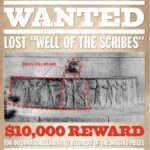
It was part of the Scribes, a circa 1926 sculpture by Lee Lawrie that is a large bronze basin with three panels depicting Pegasus bearing a torch and surrounded by writers from different cultures. Whoever took – and presumably separated – the pieces – didn’t work alone: it weighed more than 3,000 pounds.
In 2019 the recovered eastern panel was unveiled to the media, and it’s going to be on display as part of the 100th Anniversary. The central and western panels are still missing, and there’s a $10,000 reward for their safe return.
Moving away from robbery and violence, the Central Library also has some supernatural connections. The original 1984 Ghostbusters starring Bill Murray, Harold Ramis and Dan Ackroyd shot here in one of the storage areas for the opening elderly lady librarian scare.
Also, until recently the volunteers of LibraryCats.org were in the Maguire Gardens every night unofficially looking after the colony of feral black cats, who were all from the same family and lived in the hedges around the Hope Street entrance. These cats weren’t scary though, except to the rodents they kept at bay.
Sadly, the LA fires of early 2025 pushed hungry coyotes into downtown, and eventually the remaining half of the colony was rounded up and taken for medical treatment and adoption, a process that is still ongoing, and welcomes any donations. I still look behind the hedges when I visit, hoping to see a pair of wary eyes staring back at me.
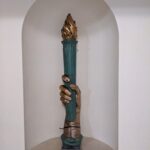
Finally, don’t be shocked if you find a severed arm on the second floor.
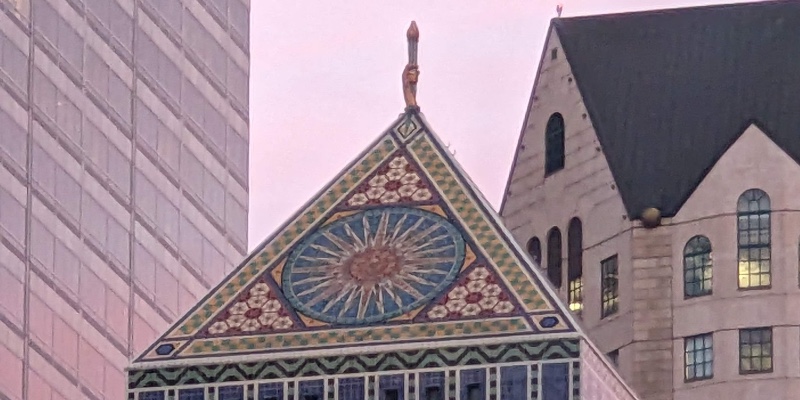
Look more closely and you’ll learn that it’s the original limb that held a torch and stood atop the mosaiced covered pyramid tower, which towers above the main entrance. The one there now is a replica, and both symbolize the Light of Learning.
The library has many Egyptian symbols and designs, reflecting the “King Tut” mania of the period, as well as Art Deco, Roman and Mediterranean styles. You’ll find sphinxes and snakes inside, and followers of astrology can look to the heavens up at Lawrie’s Zodiac Chandelier, which hangs in the magnificent rotunda, and is perhaps the most Instagrammed spot in the building.
I recommend to locals and tourists that they take a docent tour and discover the stories and secrets of the Central Library’s art and architecture, and look at the year’s schedule of celebrations at https://www.lapl.org/central100 with July 11 being the official birthday.