The following interview has been mildly condensed and edited for clarity.
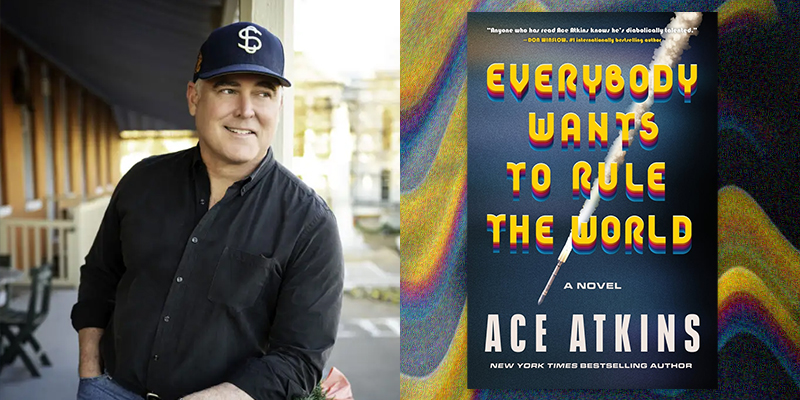
Ace Atkins’ latest, Everybody Wants to Rule the World, is drenched in ‘80s nostalgia and style. It centers on Peter Benett, a 14-year-old in 1985 Atlanta who suspects his mother’s new boyfriend is a Russian assassin. He enlists the help of a washed-up paperback writer and his drag queen buddy to help investigate as they find themselves emmeshed in an intricate web all tied to Reagan and Gorbachev’s upcoming meeting in Geneva. In what reads as a cross between le Carré and The Goonies, Atkins bathes his story in pop culture detail. As a fan, friend, and fellow Gen-Xer, I had fun time talking to Ace about the book and growing up in those times.
SCOTT MONTGOMERY: Where there any other songs you had in mind before you went for Tears For Fears?
ACE ATKINS: No, that was always the title, and it was the working title, too. This was one of those stories that I always wanted to write if I ever got a chance. Once I got into it and I started really working on the story, I knew it had to be to be Everybody Wants To Rule the World. I just couldn’t even think of a better title.
S.M.: Between your Nick Travers series and the Quinn Colson series, you wrote four historical crime novels. Was there a different challenge to writing something set in a period you grew up in?
A.A.: It was really a pleasure, because I didn’t have to do as much researching. I mean, when I wrote a book about 1930s Oklahoma, it took a quite a bit of digging into the files and historical records and that kind of thing. But that was the fun about writing this book about ‘80s Atlanta. I was there, I lived it. I was in the middle of all that stuff. Every little detail were things that came from my own life—the malls, the music, the clothes—except—or course— being hunted by KGB spies.
S.M.: I think we talked about being the same age before. I was 15, just like you, in 1985, and I was spot checking if any of the music or movie references that didn’t fit. There is a movie marquee that had six movies on it. One of them is Silverado, and I remembered that movie being out in the summer, while most of the others were fall releases. Then I realized this was the ‘80s when you had a movie, even if it wasn’t a blockbuster, stick around for six months or more.
A.A.: That’s the terrific thing about researching now. When I was writing my books that were based on a true crime, I had to go and pull the records and look at microfilm. But if I want to see what movies were playing at a specific theater in Atlanta, I pull that up online, which is a luxury to have that I didn’t have when I was writing my other books. But mostly I recalled being at that very theater and recalled what was playing.
S.M.: Looking back on that decade, how did you feel about growing up in it? I have to admit, I don’t have the best of memories.
A.A.: I think looking at it now 40-plus years on, it was a really good time in America, a really good time to be a kid. Pop culture was at its zenith as far as movies, music, television. There were so many great things that were happening. Also, being part of the MTV culture. I don’t think there’s anything that can compare to something like Live Aid, where you had teenagers around the globe, believing that they could make a change and help starving people in Africa. That’s such a foreign thing now, as we live in such a selfish time right. We were watching MTV because not only because we loved the music but we truly believed it was bringing about social change for the globe. Which it was.
We weren’t worried about being drafted. Vietnam was over. Of course, we did have the Cold War hanging over us, but that ended up just bringing us really great literature and great films.
S.M.: I admit when I look back on it, as I get older, the movies in the ’70s were better and the movies in the ’90s were better. But even stuff I used to make fun of like with Shakedown with Sam Elliot and Peter Weller, although still laughable, but I think “You know what? That movie’s got a personality today’s movies don’t.”
A.A.: And that’s a good way putting it. There was a lot of personality with those movies and a so much fun. Are the ’80s a better decade for film than, you know, great, gritty, realistic ’70s filmmaking? Well, probably not but it did bring us some great entertainment. I’m sitting here at my office, under a poster for the Falcon and the Snowman. I don’t think it could be made in the same way today with the weight of their performances and just everything that was going on at that time. And there’s another film that I saw in the theater in 1985 that really I thought was fantastic. It’s Target with Gene Hackman and Matt Dillon.
S.M.: Where Matt Dillon discovers his father is a CIA agent?
A.A.: Yeah. And I remember seeing it and initially sort of liking it, but then going back and watching it last year and really enjoying it. But, you know, the Cold War was everything in the mid ‘80s, we didn’t know it was coming to a close. To quote Brian Adams, it seemed it was going to last forever.
S.M.: My memory of this, and I wonder how much yours different from mine, I remember when Reagan came to power in 1980, Russia was the evil empire, and there were always movies, books, and even songs about nuclear annihilation or living in a world after that. One of the seminal books I remember reading was the comic book series Watchmen, which dealt with that, sure. As we got to when your book takes place, it felt like we were teetering on—could this possibly happen to where the problem could more or less get solved.
A.A.: I think about film like Red Dawn where the idea of the Soviets invading the U.S. made complete sense. When they try to remake Red Dawn, and then it’s North Korea, so silly. At the time, Red Dawn was completely plausible. It scared the shit out of me.
S.M.: It wasn’t even with just the spy and the action movies. Even sports movies. Rocky was fighting the Russians and whatever team we were supposed to root for took on the Russian or the East German team.
A.A.: They were the heavies. The only thing that made you feel a little bit safe is the idea of M.A.D., Mutually Assured Destruction, that goes back to War Games. Damn, what a great movie that is. There are no winners. This is a pointless game to play. The only outcome is total annihilation of both parties. That was the idea that we lived under for that entire decade.
It was a strange time, but we had this idea that maybe the Russians, their kids over there, are just like us. And I think that’s what MTV culture was all about. We all have this love of pop culture that’s going to save us.
A large part of the book, not to give too much away, deals with the idea of Reagan’s Star Wars program. I think, especially for somebody like Reagan, who saw in his lifetime early aviation to men landing on the moon, these incredible jumps in science…[to him] the idea of having lasers to shoot ballistic missiles from outer space was not a crazy idea. And so that was the other idea that we thought maybe was going to save us. This web of laser beams grid that was going be like a lock box over the United States.
S.M.: I thought you used that deftly for the plot device. In my review of the book, one thing you do with the decade is capture the macro of the politics really well with the micro, or semi micro, I guess you could say of the pop culture.
A.A.: This book has been baking quite some time. I joked about it on social media it’s been 40 years in the making, and it really has. This goes back to being a kid and 1983, ‘84, ‘85 wandering around these massive shopping malls and looking to see, you know, are there Russian spies making exchanges? Is somebody following me? The earliest stories that I was telling myself ended up forming this novel.
S.M.: And I think, to me, there were two kind of movies that ran a lot during the decade that you tap into. One of them was stories about normal Americans caught up in some espionage conspiracy with the Russians, like Jumpin’ Jack Flash.
A.A.: All those movies all played into this, Jumpin’ Jack Flash, Target. There was a kid’s movie called Cloak and Dagger with Elliot from E.T. and Dabney Coleman and the secret plans are put on a video game cartridge. I wanted it to feel like this was a was a book not written in present day, but was a book that was written at the time, that you would find this novel at a used bookstore in 1985. It felt like a film that came out on VHS, or something like that. That was very important to me.
S.M.: I think the other trope, which is also a really great reflection of the time, was usually the son, very rarely a daughter, saving mom from the bad boyfriend. I remember First Born was one with Christopher Collett and, once again, Peter Weller. And I remember in our actual lives it seemed it seemed a lot of our friends were children of divorce.
A.A.: Oh, yeah, absolutely, the idea, and I think that was represented more in films of the ‘80s. Something like Kramer vs. Kramer was groundbreaking at the time, to have a film dealing with the divorce and having single parents. We all grew up with kids that were living with one parent and having to do visitation.
S.M.: I don’t think you could have set this film much later because we were the last group of kids who could easily have just two hours of contact with our parents in the day.
A.A.: Well, it was funny, my editor , who is much younger, would frequently would ask “Where is Peter’s mother?” “Where is his buddy’s mother?” “Where are his parents?” You know, “How are these kids jumping in cars and driving all over Atlanta? And I just said, in the ‘80s, parents only told you, “make sure you’re home before dark. Or midnight.”
A.A.: The other film that really came to mind reading the book, from the same period, is Fright Night. The idea of believing that your neighbor who has eyes towards your mother may be a vampire, and nobody believes you, resonates.
S.M.: I was going to bring up Fright Night for that reason and another, because in Fright Night, the only person he can turn to, is the B movie actor who’s kind of washed up, hosting this horror TV show. The first person that Peter thinks maybe can help him out is Dennis Hotchner and he’s sort of this washed up writer, looking for a second chance and a big break. The character is loosely based on Ralph Dennis, who wrote the cult Hard Man series of books, that people are starting to rediscover again. It started in the late ‘70s, and went into the ‘80s, right?
A.A.: It was more early ‘70s, and up until the late ‘70s. I want to say Hotchner is loosely based on Ralph Dennis, who worked at the bookstore that I used to frequent when I was a teenager, which was a place called Oxford, Too, which was, a great bookstore. It was comics and paperbacks, hard covers. Ralph was not publishing at that time. He hadn’t published for almost a decade, and was working, stocking books in that bookstore, and I have it just like that in the novel.
S.M.: Hotchner gets involved and pulls his friend Jackie, a former Atlanta Falcon defensive end who now is a drag queen into it. I couldn’t help but think of it as a fun house mirror reflection of the Hard Man series, which is this tough ex-cop who’s washed up and then his buddy, the tougher of the two guys. I know Joe Lansdale said if there was ever any influence on the Hap & Leonard series, it was probably the Hard Man novels.
A.A.: Yeah, that’s right. I forgot Lansdale was into Dennis. And Lansdale is one of our very best. You know, that dynamic of the ex-cop working with a tough Black sidekick was a rarity at that time. Ralph was doing that before Robert B. Parker and before Spenser and Hawk. Seems crazy now, because it’s become a trope. But back in the day, it was a revolutionary idea, especially for a series set in Atlanta.
S.M.: So that was intended.
A.A.: Yeah, and I think it was a reflection of the reality. I mean, I think Jackie was bit influenced by the character in The World According to Garp, if you remember the John Lithgow’s part. It’s a reflection of who Hotchner saw of his self in these characters, and his relationship and his friendship with Jackie. And then also, part of that was born out of just what was going on in Atlanta in the mid ‘80s. There was a huge drag scene that was going on in Midtown. That’s where RuPaul got his start.
S.M.: It’s hard to pin down who would be considered an ’80s author, but were there any influence from writers you remember reading in that decade?
A.A.: I looked to authors like Frederick Forsyth, like The Fourth Protocol. Jeffrey Archer wrote a book that’s really terrific that I remember reading in the ‘80s. A Matter of Honor. It was supposed to be a movie, Spielberg had optioned it. I really love Martin Cruz Smith, those books were everywhere at the time, Gorky Park was such a massive seller in the 80s. I was reading him when I was writing this book, a lot of Martin Cruz Smith. The Renko books, which are just phenomenal.
S.M.: This book also made me think of Craig Thomas’ Firefox.
A.A.: Firefox would have been a little bit earlier this period. I did not read that book, but of course, I remember the Eastwood film very well. I also love the Le Carre books of that period, like Little Drummer Girl.
S.M.: After Rambo and some other books David Morell did a book called Brotherhood of the Rose which, to me, set a template of those 80s espionage books, in the sense of that you had the spy craft and the politics of Le Carre, yeah, but then it had that action adventure vibe that a Bond book did.
A.A.: I’ll tell you what I really, really loved, the couple of films that we’ve already talked about, but, going back to Falcon and the Snowman, but also Remo Williams. I really wanted this book to feel fun. I wanted this book to be a fun adventure. In fact, I put a sticker on my computer that was a logo for Amblin Pictures. If this book had come out in 1985, I would have hoped that this would have been an Amblin movie, because it had the sense of danger. It had the sense of the kids, you know, being out of their element. I wanted it to be fun. I just see so many books being published today that are so brooding and so serious. We’re living in very serious times, insane times really, and we need some laughs.
S.M.: I think at one point when I was reading it, I wished Richard Donner was around to direct this.
A.A.: (laughs) Oh, he would have been terrific. Yeah, I still look at possibly keeping my fingers crossed for somebody like Chris Columbus.
S.M.: Another thing going back to the decade: YA was first becoming a genre, but all the kids would get into these adult situations and adventures.
A.A.: I’ll give you one more movie, from ’86: The Lost Boys. The Corey Haim character, his mother was dating a vampire. The film had to have been on my mind a lot when I was thinking about doing something similar, but an espionage setting. And then, of course, Peter finds out a lot of his information gleaned from How Do You Know Somebody’s a Russian Spy was written by a guy who’s a complete hack and just makes it up to sell to True Detective magazine as salacious fillers between images of scantily clad women.
S.M.: A lot of my family is from Sparta, Illinois, which is a big printing town, so I got a lot of those True Detective and True Crime magazines. And those are, like, the sleaziest looking covers.
A.A.: Oh, they were, and I collect those. Haha. But the bulk of my collection is from the ‘30s with those gorgeous covers. And, you know, you’d have, very respected authors writing for them. But the time that the ‘70s and ‘80s rolled around, they were shelved with the pornography at bookstores. And that’s where Hotchner gets a few of his paychecks on the side, is writing for these sleazy magazines.
S.M.: When writing the Quinn Colson novels, you’d be playing Waylon Jennings, and with doing Parker’s Spenser it was a lot of jazz. Did you did you have certain music when you were writing this?
A.A.: I did go back to stuff I was listening to in that period, just to jog my memory. There’s so much with music that’s obviously nostalgic, and can really help you recall details. During that period, I was really into Prince. I still love Prince, but at the time, I was a super fan. I had just seen him live at the Omni in downtown Atlanta in ‘84. listened to a lot of Prince. And songs that kind of delved into the Russian paranoia, like “America.” Also, when I was writing, I would listen to Tangerine Dream and the soundtrack to Risky Business. That’s the kind of music that I heard when I was writing this, when I was writing the action sequences when somebody was being tailed, I heard very period synthesizer music, just to put me in the mood.
S.M.: This will also tell you how I square I was. Are you familiar with David Sanborn, the saxophonist?
A.A.: Yeah, of course.
S.M.: I thought I was really hip in the ‘80s because I was into jazz as a teenager and David Sanborn was cool. I read some of it with Sanborn playing in the background and it really worked.
A.A.: Sanborn was the saxophonist with Clapton on the Lethal Weapon soundtrack.
S.M.: What would the 15-year-old have Ace Atkins on his mixtape. Prince. Who else?
A.A.: I probably would have been too cool to admit it, but Duran Duran. I love the track that they did for A View to a Kill. I liked A-ha. Also Tina Turner, Bryan Adams. I would like to tell you some really offbeat stuff that I was listening to but Top 40 music was our lifeblood at that period. Dire Straits. In fact, I have a little mention of a buddy of mine who lived here in Oxford, a very close friend who recently passed away, Jack Sonni. I mention Peter listening to a bootleg tape that has Jack Sonni playing on it. Dire Straits was just massive at that time.
S.M.: Did Peter have to disparage Huey Lewis?
A.A.: (laughs) Well, I think everybody in the ‘85 probably was too cool for Huey Lewis. I liked Huey Lewis. That was just Peter’s personal taste. Huey Lewis was just on all the time. You couldn’t escape Huey Lewis and I think at some point you just, you grew sick of it.
S.M.: Another thing I thought you did well, particularly with music, is show what was popular and what was cool.
A.A.: Peter’s frienemy Chad Summers makes sense as one of the first people to get into Metallica when Metallica really had not reached a massive audience. You had those people on the periphery in high school that were really super into music, into stuff that would never get Top 40 play. And then, of course, I’ve got my FBI agent Sylvia Weaver, who’s a big Linda Ronstadt fan.
Speaking of Sylvia, one of the biggest things that I think was revelatory to me when I was writing this is my friend, author Frank Figliuzzi, was a rookie FBI agent in Atlanta. In the 1980s, he worked at that building where Sylvia does in the book. He was a huge help to me, talking to me about how FBI agents worked pre computers, pre cell phone. And it was just fantastic.
I asked him, “Frank. I said, there’s, I know there’s things you can’t talk about. They’re still classified, but were there Soviet spies in Atlanta in the mid 80s?”
And he said, “Absolutely.”
He said they were in town all the time. And he talked about the hotels where they would visit, and he said the joke about the Soviets was that they never flew, that they were always taking trips with their family from Washington, from the embassy, down to Disney World. But when they’d go to Disney World, they’d stop off in Atlanta to have meetings, because the defense contractors, Lockheed-Martin, they were all in Atlanta, and so there was heavy espionage work going on in Atlanta at that time.
S.M.: The company that’s at the center story uses a great cover: manufacturing cable boxes.
A.A.: It was a real and it was funny. If you lived in Atlanta at that period, there was a company. It’s defunct now, but at the time, it was a company called Scientific Atlanta, and they were a groundbreaking company that made ground satellite systems, and a pioneer in the idea of cable television, the idea that you would get a signal from outer space, and then it would go out to subscribers. Everybody in Atlanta had a Scientific Atlanta cable box.
S.M.: You don’t get into it heavily, but you touch upon it, how the FBI at that time is still under that shadow of Hoover, even though he’s been dead for over a decade.
A.A.: Oh yeah. And somebody like Sylvia, a Black woman, would have been very unique at that time. It was an organization populated by white men that looked a certain way. We’re just a decade or so separating the time of Hoover into the time of the 80s, but counter intelligence work is the most important thing going on. It wasn’t bank robbers anymore. It was Russians.
The other character who’s throughout the book is a man named Vitaly Yurchenko. Yurchenko is a real historic figure. He was a top KGB agent that in late or mid 1985 walked into the American Embassy in Rome and defected. He came to America, going through numerous debriefings with the FBI and the CIA stuck around for a few months, and then he ends up escaping his CIA handlers and re defecting back to the Soviet Union. It’s always been the story that the Soviets announced, oh my gosh, Vitaly Yurchenko, what a great spy! He fooled the Americans, and he came over and defected. They told him everything, and then he comes back to Russia with all this information. Did he or did he not? Was he a master spy, or was did he just change his mind? Nobody really knows, but all the stuff from Vitaly about his belly aching, and his griping about being in America and the food—that all came from FBI records.
S.M.: In the book, he partly defects to get away. He wanted to get away from his wife.
A.A.: He’s a fascinating guy. I know he came to America because he was trying to connect with a woman that he had had an affair with years ago, and she was actually in Canada, and he ended up coming in to meet with her in Canada. And I think he ended up being spurned. And when that didn’t work out, he was kind of lost, and he wanted to go back to Moscow, but it was amazing that they accepted him back and didn’t execute him after his defection.
The other two figures that were massive in the story to me were real life figures, a guy named Robert Hanssen and a guy named Aldrich Ames. Bob Hanssen was a mole within the FBI who was feeding the Russians information. Aldrich Ames was maybe the most notorious CIA spy of all time who was really doing it for money, and both of their information got a lot of our spies killed. So that came into the idea of one character, Dan Rafferty, a composite character of Ames and Hanssen, who’s just a despicable creep.
S.M.: What did you want to get across about the decade, more than anything?
A.A.: I really just wanted to tell a really fun story, like I said, something that you would have seen being directed by Richard Donner, or an Amblin film, capturing the period that I knew as a kid. Everything in this book is true. Peter is essentially me, other than KGB assassins looking for me. But other than that, the places he goes, the world that he lives in, the high school, the restaurants, the malls, the all that stuff is just exactly as I remembered it.
S.M.: So, you did that well with girls?
A.A.: Okay, not as good as Peter.
****

Everybody Wants to Rule the World is now available from William Morrow.