Any committed crime reader is very aware of the comfort and draw of meeting familiar characters in a novel. Often, it’s the detective: a wise or wry, troubled or resilient character. Whatever their shape the detective offers the reader reassurance. We’re meeting old friends and few things in life are better than meeting old friends.
Think Lee Child’s Jack Reacher; no matter which small town the former military policeman travels through, we know he will solve the mysteries, face down the danger. I personally love falling into the comforting understanding of spending time with Michael Connelly’s Harry Bosch. The intense LAPD detective whose life is explored across more than twenty books.
So beloved are Agatha Christie’s Hercule Poirot’s and Miss Marple that British writers Sophie Hannah and Lucy Foley have been commissioned to bring the characters back to readers, many years after the author’s death. Agatha Christie wrote thirty-three novels featuring her famous Belgian detective, and Hannah has already published six new ones; fresh stories but the joy of the well-known. Foley is just off the blocks. Her first Marple, Murder at the Grand Alpine Hotel, is set for release in Fall 2026, and will undoubtably be a hit.
However, despite the obvious appeal of a series, I’ve never set out to write one. Several factors deterred me. Not least, I’m a restless soul and I didn’t want to be restricted to a particular geographical location when writing, which is often the case with a recurring protagonist.
I’ve written two novels featuring detective DC Clements (Woman Last Seen and Two Dead Wives). She proved so popular I had calls to bring her back. I really did try to include her in other novels but I couldn’t explain why she would be so frequently seconded to different parts of the country. The idea of my cop coming in regularly but not centrally, created authenticity problems.
Besides, I do not write procedural crime novels or detective led mysteries; I write domestic noir and psychological thrillers. Most often, I write from the victims or perpetrators’ point of view. The idea of all my stories happening to the same victim is fascicle. My plots are known for being complex and shocking. A character enduring one of my plots is brutal enough; it would be hard to sell a world where the same character experienced two of my convoluted, terrifying stories.
So, all of this is to say, I never expected to be revisiting my debut characters from Playing Away when I penned Our Beautiful Mess. Not least because whilst producing a bestseller every year for my twenty-five-year career, I have written in many genres including relationship dramas, historical, domestic noir, crime and psychological thrillers. How, if I’ve changed genres, can I visit old characters?
Playing Away, a relationship drama, was the bestselling debut of 2000 in the U.K., it spent weeks in the Sunday Times and Independent book charts; it was translated into fourteen different languages. The success the novel changed my life. I am eternally grateful to Connie and her friends, who resonated so firmly with hundreds of thousands of readers worldwide.
Here’s the strange thing about being the writer, sometimes, we’re not in control. Sometimes, the characters are louder and more demanding than we anticipate. Certainly that was the case for me with Connie and her gang. They wouldn’t be silenced but insisted they had more stories to tell. They kept fighting their way into my consciousness, needing to be exercised, to be listened to.
So, in 2007 I wrote Young Wives Tales. I took two of Connie’s friends, Lucy and Rose, and put them centre stage. I guess this is not unlike Tana French’s literary, character-driven procedurals, Dublin Murder Squad, ;we see lesser characters from one book often become central in the next.
I wrote Young Wives Tales as a standalone novel; I didn’t want to put people off picking up the latest book because they hadn’t read the earlier one. This proved to be an exciting intellectual challenge, as I balanced providing enough background to be informative, but not so much as to be repetitive. I enjoyed the process and loved giving my characters more space. So I did it again a decade later.
With Lies Lies Lies, I had my plot from the get-go. Often, I have a plot and then wonder Who would this be most devastating for? What sort of character would it be most interesting to watch in this scenario?
Daisy and Simon had set out, twenty years before, full of optimism and joy as bit parts in Playing Away. I wondered how they’d cope with challenges of infertility, alcoholism, incarceration. I realized that I’d secretly always found Daisy a little sanctimonious and unforgiving in my earlier books, I knew this was because she hadn’t yet experienced enough in her life to allow her to be sympathetic and forgiving.
I was more than willing to put her through the wringer! Lies Lies Lies was a joy to write. I knew the characters so well, they did most of the work for me.
As I approached my twenty-fifth anniversary and started to plan my next book, I knew I wanted to close the loop and circle back to my old friend, Connie. I owe her everything. I would not have the career I do, if it was not for her mistakes, her hopeful nature but hopeless discipline, her idealism, strength, resilience and humor.
She’s lived somewhere deep inside of me for years. She, like me, has grown, changed and continued to be challenged. I wanted to give her another chance to step into the spotlight. There was more of her story to tell. Not just Connie a wife, friend or lover, but Connie the mother, the warrior.
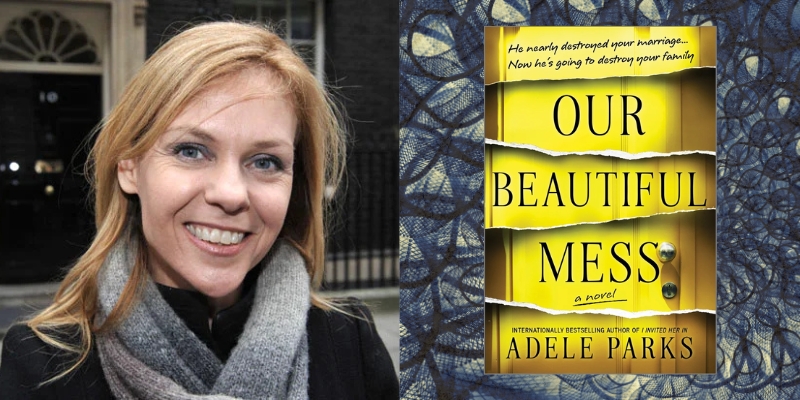
Our Beautiful Mess is full of dark secrets, mistakes from the past and tough demons, including London’s criminal gangs. Connie’s family are in serious danger but she’s been preparing for this moment for years, so I trust that she’ll manage.
***