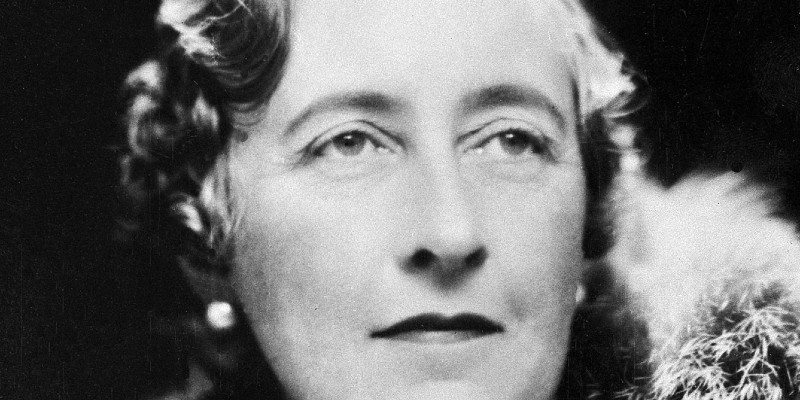
‘A good detective story should be like a good bull-fight. The reader charges up and down distracted by the red herring until exhausted, when the author plunges the unexpected explanation into him like a sword – the moment of truth, as the Spaniards call it. From the bull’s point of view, the object of the performance is simply to get at the author before the author gets at you. The author has a more delicate role. He must give the reader a chance to get at the man but take care that he only reaches the cloak: and the closer he allows you to brush past, the better the author. The slightest miscalculation, however, may be fatal. No wonder so many authors lose their nerve, trail their capes far afield, jump the barriers of common sense, and finally assassinate their readers with a feeble poke at the seat of intelligence. These bunglers retire hooted with derision; but they survive the ordeal to write their next book. My simile is suggested by the welcome reappearance in the arena of that formidable espada, Mrs Christie, who passes the bulls closer to her chest than any other living writer.’
This review, by Ralph Partridge, of Taken at the Flood, appeared in the New Statesman in January 1949. At that point Mrs Christie has been ‘reappearing’ for almost thirty years and Partridge was a consistent admirer. In his reviews he often used a chess analogy to explain Mrs Christie’s ingenuity in plot construction and reader misdirection, but this clever bull-fighting simile, while more bloodthirsty, is even more telling; especially the comparison between ‘red herring’ and ‘red cape’. It was reprinted for many years on hardback reissues of her books. And although it appeared almost half-a-century later, it applies even more so to her first masterpiece from twenty-three years earlier: The Murder of Roger Ackroyd.
Throughout this book, Christie ‘allows the bull closer to her chest’ than in any of her later novels; it is a masterpiece of reader misdirection. By a judicious blend of inclusion and omission, she manages, through her narrator, to tell the truth, while successfully concealing the whole truth, of the murder in King’s Abbot. There is no finer example of ‘playing the game’ in the entire genre. If Agatha Christie had never published another word, her name would still be respected today, a century later; her ingenious daring earned her an unassailable place in Golden Age history. Sadly, the only mention of this novel in her Notebooks is a brief, and incomplete, list of characters – nothing else.
At first glance, and, indeed, for much of its length, The Murder of Roger Ackroyd is like many other detective novels published in the newly developing Golden Age: country village, local wealthy landowner stabbed in his study, impecunious relatives acting suspiciously, stolid secretary, enigmatic butler, inscrutable housekeeper, respected local doctor, and his gossipy spinster sister. Throw in a little romance, a mysterious stranger, some telltale footprints, and an inexplicable disappearance; add a baffled local investigator and a resident professional detective (retired) and you have the ingredients of hundreds, or even thousands, of Golden Age novels.
But the revelation of the identity of the murderer of Roger Ackroyd catapulted the book into Golden Age immortality and ensured that Agatha Christie’s reputation would be forever celebrated. In just his third full-length investigation Hercule Poirot puts his little grey cells to work – and King’s Abbot, and the world of detective fiction, was never the same again.
With soon-to-be-hackneyed elements Agatha Christie ensured her international and enduring fame, the perpetual devotion of her readers, the envious admiration of her fellow writers and the ecstatic approval of her new publishers, Collins. And she did this by not only playing the detective fiction game by providing maps and diagrams, clues, suspects, hints, an official and an unofficial detective but, unknown to her readers until the shattering denouement, also by playing a game with the broader game of detective fiction. And because there was no indication that she was playing this game-within-a-game – and there was no obligation on her to do so – her solution was a gasp-inducing one: the narrator did it. The person who was a highly respected professional member of his small, rural community, a close friend of the victim, the confidant of the great Hercule Poirot, and who shared (to a greater or lesser degree) his thoughts and reactions with his readers, is revealed as a heartless blackmailer, a resourceful liar and ruthless murderer.
By playing a game within the game so early in the development of classic detective fiction, Christie was able to take her readers completely unawares; they assumed, not surprisingly, that, when unmasked, the killer would prove to be a member of the Fernly Park household. No reader was on the lookout for a unique twist; they were satisfied that this latest Christie and Poirot novel would be as entertaining and clever as the two earlier ones (Mysterious Affair at Styles and Murder on the Links) and Christie astutely supposed that no one would even see the doctor-narrator, Dr Sheppard, in the same way as they saw, for instance, Parker the butler, or Ralph Paton, the prime suspect.
‘It is the reader’s business to suspect everybody.’
Dorothy L. Sayers, Great Short Stories of Detection, Mystery and Horror (1928)
As early as 1921, in an essay ‘How to Write a Detective Story’, Chesterton wrote: ‘The criminal should be in the foreground, not in the capacity of a criminal, but in some other capacity which nevertheless gives him a natural right to be in the foreground.’ In Sheppard’s case the foreground in which he moved could not be more apparent, thereby rendering him, to a large extent, invisible. Chesterton himself exploited this strategy in one of his most popular and anthologized Father Brown stories: ‘The Invisible Man’.
This is in direct contravention of the first ‘Rule’ of both the Ronald Knox Decalogue and John Dickson Carr’s Rules, although it must be remembered that, despite their name, these were, in many cases, not Rules, merely personal prejudices.
The criminal must be someone mentioned in the early part of the story, but must not be anyone whose thoughts the reader has been allowed to follow. (Knox)
The criminal shall never turn out to be the detective, or any servant, or any character whose thoughts we have been allowed to share. (Carr)
Almost all of everybody’s Rules were ignored, bent, or breached throughout the Golen Age and often by the best practitioners; sometimes even by the Rule-maker. And, of course, when The Murder of Roger Ackroyd was published none of the formal Rules had yet been published.
Although The Murder of Roger Ackroyd was the novel that brought fame and (subsequent) fortune to Agatha Christie, she had already made a gesture in the same direction two years earlier with the revelation of the villain in The Man in the Brown Suit. Utterly different in style and presentation, The Man in the Brown Suit is a thriller, with the emphasis on physical, rather than cerebral, action. Although beginning in London, much of the book takes place in South Africa, where Christie and her husband, Archie, had spent much of 1922 on a trade mission with Archie’s boss, Major Belcher, the model, at his own request, for the novel’s Sir Eustace Pedler. The book displays Christie’s ability to keep the story moving and the reader intrigued, even if the plot does not stand up to forensic scrutiny. And the technique adopted to conceal the criminal may well have given her the idea for The Murder of Roger Ackroyd, even if everything else about both books could not be more different.
Is it possible that Agatha Christie intended Hastings to disappear forever at the end of The Big Four? Consider the chronology:
Dec 1922–March 1923 Murder on the Links serialization
May 1923 Murder on the Links book; Hastings leaves for Argentina
Jan–March 1924 The Big Four serialization UK; Hastings returns from Argentina
July–Sep 1925 The Murder of Roger Ackroyd serialization UK; No Hastings
June 1926 The Murder of Roger Ackroyd book; No Hastings
Jan 1927 The Big Four book; Hastings returns to Argentina
(March 1927–Jan 1928 The Big Four serialization US)
Mar 1928 The Mystery of the Blue Train book; No Hastings
Poirot’s usual sidekick, Captain Hastings, had vanished to Argentina at the conclusion of The Murder on the Links in 1923, with his new wife, Dulcie (‘Cinderella’) Duveen, who had been a murder suspect in the novel. The Murder on the Links had been serialized between December 1922 and March 1923, before book publication in May 1923. He returned from South America for The Big Four (serialized between January and March 1924) before book publication in 1927; and Hastings returned to Argentina immediately after. And did not reappear until Peril at End House in 1932. Eight years is a long time in the world of a ‘Watson’ and Poirot appeared alone in The Mystery of the Blue Train (1928). So, it is not unreasonable to imagine that Christie had possibly been toying with the idea of permanently retiring Hastings to Argentina: hence Doctor Sheppard. Although, of course, his presence could only be a one-off.
The game between Agatha Christie and the reader of Roger Ackroyd begins with the first word. And that first word plunges us straight into the story; the death of Mrs Ferrars is the starting point for everything that follows. By the time that Dr Sheppard gets back to his house after examining the body, the challenge to the reader is well under way.
As early as the second paragraph, just before admitting to being ‘considerably upset and worried’ – without offering any explanation – Sheppard’s instinct warns him of ‘stirring times ahead’. And although he prefaces this with the phrase ‘To tell the truth’ (which, for the most part, he does) it is not always the ‘whole’ truth. This establishes the basis for the doctor’s highly dangerous, and Christie’s highly challenging, game. He admits – to the reader but not to his sister – to a ‘secret belief’ that Mrs Ferrars took her own life but disguises this fear by a furious denial when Caroline states this (p.8). In fact, when he mentions Caroline’s arrival at ‘the truth’ by mere ‘guess-work’, could anything be more truthful? So, the first chapter is littered with truths, half-truths, evasions and denials – but their true significance is apparent only in retrospect.
Meanwhile, Christie’s game with the reader and Sheppard’s game with Caroline (and Fate) has begun . . .
On page 11, Sheppard remembers that when he saw the tête-à-tête between Ralph Paton and Mrs Ferrars the day before her death, a ‘foreboding for the future’ assailed him; and rightly so, as it subsequently transpires. But how daring of Christie to give the reader that piece of information and to underline its effect on Sheppard.
This scene is referenced again while Sheppard is having his uncomfortable meeting with Roger Ackroyd on the night of the murder (Ch. 4). And this time the narration is even more daring, referring to a ‘throb of anxiety’ as he recalled the meeting. How many readers stop to ask themselves why Sheppard should be anxious at that memory? ‘Supposing’ writes Sheppard. ‘Supposing what’? Isn’t that what the alert reader (and game-player) should be asking?
Even two pages earlier (p.41), with complete, albeit ambiguous, truth Sheppard is ‘silent for a minute or two’ as he ponders what answer to give Ackroyd who is pressing him about the true cause of Ashley Ferrars’ death. And when Ackroyd confidently asserts that Mrs Ferrars’ husband was poisoned, Sheppard ‘sharply’ counters with ‘Who by’, rather than the more natural ‘What! Are you sure? How do you know?’
The game moves up a considerable notch in the latter stages of the scene in Ackroyd’s study where Christie trails the matador’s red cloak brazenly. This is, in effect, a confrontation between determined killer and unsuspecting victim; and between determined author and unsuspecting reader. When (p.46) Ackroyd talks of a ‘queer feeling’ of being spied upon, few readers will consider that the spy is actually in the room with him. But Christie is doing exactly what Chesterton advocated: hiding her criminal in plain sight, sitting in the chair opposite his victim.
And then we come to the most (in)famous paragraph in detective fiction: ‘The letter had been brought in . . .’ In a masterpiece of misdirection every word is true and still duplicitous, overt and yet covert, honest and simultaneously dishonest. As Sheppard himself writes in the last chapter: ‘Suppose I put a row of stars in front of the first sentence.’ Suppose, indeed, the alert reader wondered what happened in those unaccounted for nine minutes – the reported dialogue could not have taken more than one minute – would the game have ended there? This is the literary equivalent of leaving your King exposed during a chess match, in the hope that your opponent won’t notice; or of hiding a personal murder in a very public series of murders . . .
And the faithful account of the presence of Parker just outside the study door is further evidence of Sheppard’s ‘honesty’, because he knows that, even if he doesn’t admit this, Parker will. His description of the butler seems particularly vindictive, and out of keeping with earlier personal descriptions, but is an honest reflection of his shock at the unexpected encounter.
A brazenly unmistakable clue is explicitly presented to the reader as Sheppard describes his walk home. The church clock strikes 9 p.m. as he exits Fernly Park, and we have been told that the letters were brought in twenty minutes earlier, while Sheppard took his leave of Ackroyd at ten-to-nine; the diagram shows that it could not possibly take ten minutes to walk to the gates. So, what happened during those missing seven/eight minutes? This is Christie blatantly displaying the red cloak and playing the game openly and honestly with, this time, no ambiguity whatever. This significant discrepancy is the clue that, later, will attract the attention of Hercule Poirot; and should do the same for the reader but does it . . . ?
Christie allows the bull close to her chest when Sheppard gets home to Caroline in time to stage-manage the telephone call, supposedly from Fernly Park. But how unobtrusively she manages this misdirection. How many readers will notice that only one side of the phone ‘conversation’ is reported? How many readers spotted that, although Sheppard ‘rose and yawned’, there is no mention of his feeling tired; in fact, he must remain alert in order to make sure he, and not Caroline, is the one to answer the telephone. And he faithfully records the grabbing of his doctor’s bag, this time with complete justification, if he is (supposedly) going to deal with a murder victim. Or planning to conceal a Dictaphone machine . . .
Page 53 contains another little masterpiece of ambiguity: ‘I did what little had to be done.’ A perfect phrase to both convey and conceal the truth: the tidying away of the trappings of murder. Again, the truth but not the whole truth – and all in just eight words.
On p.56 Sheppard, when questioned, ‘explained the circumstances carefully’. Carefully, indeed! And two pages later he faithfully records his amazement when Inspector Raglan introduces the topic of blackmail. But by drawing attention to Parker’s probable eavesdropping, he successfully distracts the attention of the Inspector – and the reader. Further, he decides to make a ‘clean breast of things’ and ‘then and there . . . narrates the events of the evening’ – adding ‘as I have set them down here.’ In other words, with the same careful omissions already withheld from the reader; again the truth, just not the whole truth.
So, from now on, not only is the author playing the game with the reader, but Sheppard is playing a similar literary, but in ‘reality’ much more dangerous game, with the Police. And the players lined up against him will soon be augmented by the arrival of Hercule Poirot . . .
Sheppard is being nothing less than truthful when he enjoins Flora (p.79) ‘not to drag this detective into the case.’ And manages to conceal the shock he receives when Flora mentions his (surreptitious, as he hoped) visit to Ralph at The Three Boars. And again, four pages later, he embarks on a ‘careful narrative’, again with the proviso that they are the facts as ‘previously set down’. In other words, whatever elisions and omissions already recorded were repeated for the benefit of his new audience.
On p.92 the Challenge to the Reader becomes overt when Poirot, with one of his enigmatic statements, observes that the altered position of a chair in Roger Ackroyd’s study, while seemingly unimportant, is ‘interesting’. Why? is surely what most readers will, at this point, be asking themselves. Why should such a minor act as moving a chair from A to B and back again be in any way significant? Because, when we get the final explanation, the reason for this act would, if properly interpreted, identify the killer. And Poirot, being A Great Detective, can recognize this instinctively. And, significantly, throughout this exchange, Sheppard is careful not to share his thoughts.
It must be acknowledged that Sheppard, in this scene, while not lying outright, either in speech or writing, does, at best, acquiesce, in a mistruth. When asked by Poirot if he moved the contentious chair, shakes his head, the universally accepted gesture for ‘No’. But is this not ‘cheating’? Well, it could – and should – be interpreted as an equally universal gesture of bewilderment. And is immediately followed by the assertion – but, significantly, by Parker – that the chair was back in position when the police arrived.
As with the moving of the chair, Poirot is indeed right when he foretells (p.150) that the explanation of the telephone call will lead to the explanation of the murder. And Sheppard’s declaration that it seemed ‘utterly irrelevant’ is truthfully what he said, but not necessarily what he thought.
‘Each one of you has something to hide’, says Poirot on p. 59. And Sheppard admits that he, in common with everyone else in the room, could not honestly meet Poirot’s eye. And here again Christie challenges the reader: what is Sheppard hiding? And how could he be hiding it when we, the reader, have been at his side from the beginning? Have we not shared his thoughts throughout?
Is Sheppard dissembling or telling nothing less than the truth when he admits (p.181) that he completely failed to grasp the significance of Ralph Paton’s boots? When Poirot asks Caroline to do some detection on his behalf, he disguises the significance of what he wants to know by asking her to determine the colour of Ralph’s boots. When Caroline tells her brother this, he is genuinely baffled – as is the reader; just as Christie intended. The colour of the boots is irrelevant; what Poirot needs to know is the ease, or otherwise, with which they could have been obtained from The Blue Boar where Ralph was staying. So, is it any wonder that the doctor seemed ‘dense’ during the discussion?
In many ways the most significant section of the novel comes towards the end of Chapter 17. Poirot is dining with Sheppard and his sister and during a relaxed after-dinner conversation he considers, in a ‘gentle far-away voice’, the story of an ordinary man who finds himself in financial difficulties; and shortly thereafter the man stumbles across someone’s secret. This secret becomes an unexpected source of income as the man turns to blackmail but, in his greed, the blackmailer effectively kills the goose that lays the golden eggs. And so, the man, facing exposure, turns vicious and ‘the dagger strikes’. Readers will recognize the King’s Abbot analogy but few, if any, will correctly identify the putative blackmailer. But Sheppard does – so no wonder that he writes: ‘I cannot try to describe the impression his words produced.’ At this point Hercule Poirot has joined the game-players; at this point Christie is playing with her readers, Sheppard is playing with Poirot and with his readers; and now Hercule Poirot is playing with Sheppard.
It seems clear that Poirot now knows who killed Roger Ackroyd; and his long and pointed speech is a covert challenge to Sheppard to admit defeat and to confess. Within a few chapters Poirot will gather his suspects together, torment them for a while, amaze them with his brilliance, shock them with revelation after revelation; and eventually take one of them aside and reveal to them the truth. End game approaches . . . To revert to Ralph Partridge’s analogy, we, the reader, are now ‘charging up and down distracted by the red herring’ and fast approaching exhaustion and the point ‘when the author plunges the unex-pected explanation . . . like a sword, the moment of truth, as the Spaniards call it.’ And surely Sheppard must be at almost the same point . . . ?
Even more dangerous for Sheppard is the conversation at the end of Chapter 18 when the doctor admits in retrospect that ‘the whole thing lay clearly unravelled before [Poirot]’, although at the time he thought (hoped?) that Poirot was being over-confident. The little Belgian further puzzles Sheppard by taunting him with mysterious references to Kent, both the character, Charles, and the county. Poirot is now beyond doubt playing a game with his ‘Watson’; secure in the knowledge that Sheppard is the blackmailer/murderer, Poirot can afford to play with him for a while at least. Until the ‘moment of truth’ . . .
Somewhat late in the day, it must be admitted, we learn of Sheppard’s workshop, ‘the little room at the back of the house’, where he enjoys tinkering with things mechanical. It is a private sanctum, which even the housemaid is forbidden to enter; when Caroline does, he admits to being startled. As this piece of information is vital to the plot, we should probably have been told of it much earlier; it comes three-quarter way through the book, although it is difficult to see why it could not have been given at an earlier point. Few readers, surely, would have made the necessary connection?
What a clever and enigmatic conversation (p.278) when Poirot discusses Sheppard’s manuscript; Poirot’s toying with the doctor is now approaching end game. Is it possible that Sheppard does not understand Poirot’s reference to ‘reticence’ and ‘modesty’? Probably, as his self-belief, even to write the manuscript in the first place, must be infinite. Clearly, Poirot has spotted the elisions and omissions, the ‘becoming reticence’, the clever prevarications. Even more dangerously, Poirot has read the manuscript while alone in Sheppard’s workshop, the setting for covert and crucial mechanical work, vital to the success of his crime.
Even as his unmasking becomes inevitable, Sheppard faithfully records that, as Ralph Paton enters the sitting room at The Larches, it was ‘an uncomfortable moment’ for him, even though, on the face of it, it shouldn’t have been. He takes a few moments to become ‘master of himself’– although, again, it is not immediately clear why. And when Ralph insists that ‘Dr Sheppard has been very loyal’ (p.293), Poirot concurs that he ‘has been the very model of discretion’.
Do we believe Sheppard when he writes (p.295) that ‘he still believed Poirot to be entirely on the wrong track’? Given his boundless self-belief, quite possibly. Although he has already noted the ‘menace’ in Poirot’s words and how dangerous he began to seem. As indeed he proves. During Poirot’s inexorable recounting of his deductions, even Sheppard’s confidence begins to wane. He manages a laugh (p.304), he tries to rally (p.306), and produces yawns, indicative of boredom with the explanation (pp.307–8). But the game is up. His ‘greatest fear’, Caroline, is the deciding factor in accepting Poirot’s ultimate solution . . .
And so, the reader has dutifully charged up and down, distracted by numerous red herrings, despite the truth shimmering just below the surface throughout, and the author has finally plunged the unexpected explanation like the matador’s sword. The formidable espada would continue confounding readers with dazzling ‘moments of truth’ for the next half-century, her capes continuing to pass ever closer to her chest. And countless readers the world over waited happily for the next sword-plunge of truth.
But arguably the greatest, the most daring, the fairest bull-fight in detective fiction took place almost a century ago in the village of King’s Abbot when Hercule Poirot solved The Murder of Roger Ackroyd.
***