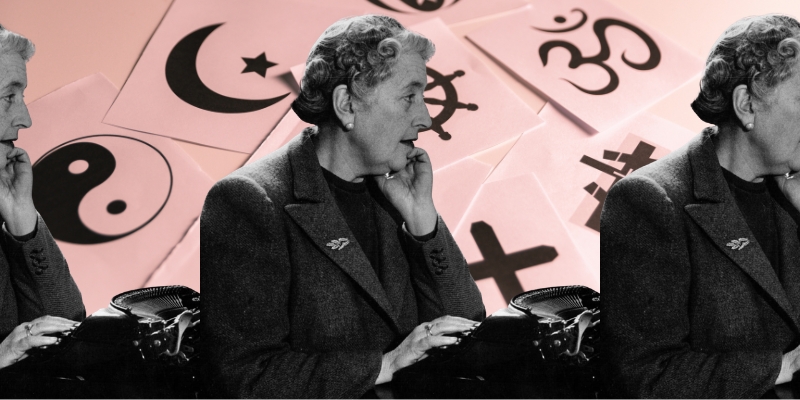
There’s no shortage of canons and vicars scattered throughout Christie’s delightful classic mystery novels, but observant readers may also note that Christie also peppers her tales with characters, anecdotes and musings about various world religions—not to mention the occult. And what of Christie herself—was religion a large part of her life, and did it affect her work and character development at times?
Christie was an Anglican, which her first husband Colonel Archibald Christie was as well, though her second husband Sir Max Mallowan was Roman Catholic. Though Christie was not Catholic herself, she did seem to take an interest in aspects of Catholicism. In fact, she even signed on to a petition letter to Pope Paul VI to request that the traditional Latin Mass be continued due to its cultural, literary and religious significance.
Christie’s faith was clearly of some personal significance to her in terms of her everyday life and beliefs, although she did not necessarily publicly discuss it or write about it much in most of her interviews or written works.
The biggest recurring religious elements of her mysteries do tend to be the characters and locales in more of a cultural depiction: vicars, vicar’s wives and vicarages, old churches and their churchyards, canons, and church-related groups and activities in villages and parishes.
That being said, it is possible to view some of her mysteries through a lens of belief and morality if desired; certainly many readers have had such interpretations over the years. At times, she also features deeply religious characters whose devotion to their faith plays a role in the mystery itself.
Christie did, however, write a book, relatively unknown to many of even her devoted fans, specifically focused on Christianity and faith: “Star Over Bethlehem,” which features poetry and short stories with explicitly Christian content and themes.
When it came to her main detectives, Poirot is depicted as a devout Roman Catholic—a logical choice religiously for a Francophone Belgian of his era. Meanwhile, Miss Marple is an Anglican. Readers aren’t provided with much information about Tommy and Tuppence’s religious beliefs but they would’ve been likely to have been Church of England as well given their identities, location and eras.
Tellingly, many of the characters in Christie’s mysteries are judgmental about Poirot’s Catholicism or any other minor character who is openly (or perceived to be Catholic), which is in line with many British prejudices spanning much of the decades that Christie wrote her books in.
When it came to religions outside of Christianity or even agnosticism and atheism, she did in fact feature a fair amount of characters and locations in her mysteries that were Jewish, Muslim, Hindu or potentially irreligious.
A number of Christie’s works, particularly her earlier books, resort to anti-Semitic caricatures and stereotypes without much mention or acknowledgement of actual Jewish religious practices. Though a few of her Jewish characters are portrayed relatively positively, such as Oliver Manders in Three Act Tragedy, nearly any time a Jewish character appears in a novel their physical characteristics are commented on negatively and derogatory terms such as “slippery Shylock” are often applied by other characters in the story.
Agatha Christie also had more exposure to Islam and the Middle East than many other British women of her era, through her various travels along with her archeologist husband, as well as other trips to the region such as her visit to Cairo in her early 20’s. Likely as a result of her travels and regional interests, she wrote a fair amount of books set in predominantly Muslim parts of the world, such as Death on the Nile, They Came to Baghdad and Murder in Mesopotamia.
Her Muslim characters aren’t really given much of a role or depth in any of her novels at all, though, except as a minor appearance or a brief caricature (the potential exception being Mr. Shaitana from Cards on the Table who has an Arabic-derived last name, but in the end his religious background remains unclear; it’s also possible he was meant to be Hindu).
Additionally, in “Death Comes As The End,” this mystery set in ancient Egypt features ancient Egyptian religious beliefs, rites and practices, generally unfamiliar to many readers but a topic that Christie had a great interest and knowledge of.
Besides the main monotheistic world religions, Christie has a rather high amount of output that concerns the occult and supernatural, including witches and spirits. Short stories such as “The Last Seance,” “The Red Signal,” “The Hound of Death,” and “The Lamp” deal with the paranormal and the unexplainable, as well as her popular book “The Pale Horse.”
In other mysteries, characters engage in seances not infrequently as a plot device and talk about ghosts or the spirits of the departed. Her short story collection “The Mysterious Mr. Quin” even gives us an essentially supernatural recurring character, Mr. Harley Quin.
While the topic of religion and the occult in Christie’s work and personal life are sweeping themes which have yielded entire academic papers beyond the scope of this piece, if the topic intrigues you as much as I personally find it fascinating, you’ll find plenty of sources and articles to dive into.
***