When confronted by historians questioning the accuracy of his Napoleon film Ridley Scott responded by addressing the entire historian community. “Excuse me, mate, were you there?” he raged. “No? Well, shut the fuck up then.”
There we have it in a neat example, the tension between storytelling and historical accuracy. However, without wishing to sound like a second-year philosophy student, the question begs to be asked. What is historical accuracy? Is it just a set of conflicting narratives battling for recognition and validation? Or are there some immutable facts that cannot be argued with? And if there are, do those facts alone really tell us anything?
No one doubts the bombing of Pearl Harbor happened on the 7th of December 1941 but beyond that everything starts to get cloudy. What did it mean to the Japanese? The Americans? The course of World War Two? Once you start examining a historical event for meaning and influence, we are back to conflicting and clashing narratives trying to make some sort of sense out of what happened. The events of 9/11 are a more recent example. Just go on the internet to see the reams of alternative history.
So, does “historical accuracy” even exist? Or is it, as out friend Napoleon called it simply “A set of lies agreed upon?”
And yes, Dear Reader, you are right. All this seems rather highfalutin for an article about historical accuracy in detective novels. So, I will bring things down to earth with a bump. I have no real idea why I wrote a detective novel set during WW2. I certainly wasn’t interested in the tension between narrative and historical accuracy. And to be honest I had no great interest in World War Two either.
I remember watching The World at War on the television with my dad, but I was never one of those boys that bought war comics or built Airfix model tanks. And I am not the kind of man who avidly watches the History Channel and only reads non-fiction books about Stalingrad or Operation Torch. So, I have no clear idea why at age fifty-seven I started to write a novel centring around a damaged World War Two veteran returning to Glasgow.
There must have been something. Something caught in the net of memory that decided to finally come to the surface. Was it reading that Glasgow was full of AWOL soldiers at the time, men who came back on leave and never went back to the war. That the city was well known as a place where you could disappear, where nobody would look for you. That crime was rife in Glasgow during the war, that people stole money out of bomb victim’s pockets and ransacked their houses.
Maybe something about that anti-Blitz spirit appealed, seemed more realistic somehow. Maybe the new ideas about what happened in Glasgow during the war seemed more interesting to me than the stuff I had read before. Conflicting narratives again.
Or maybe it was the fact that Rudolph Hess, believing in a mystical Aryan Race, magic and myths decided to come to Scotland for reasons that still aren’t entirely clear. Maybe it was the photo of excited wee boys and farmers standing by the wreckage of his plane, smiling for the camera, that stuck in my head. The fact that he found himself in a barracks in Maryhill Road being gawped at rather than being feted by the British aristocracy must have been a shock. Where was his master race now?
However, even the flight of Hess remains a battle ground for the truth. Throw a stick in Glasgow and you will hit someone who will swear to you that his Uncle/Great Uncle/Great Uncle’s Pal/Great Uncle’s Pal’s Next Door Neighbour were first on the scene of the air crash. That they pulled Hess from the wreckage/shook his hand/punched him. Even where he was taken after the crash is still up for debate. Giffnock Police Station? Barlinnie Jail? Straight in a car to London? Take your pick.
So, if what is historically accurate about that day seventy odd years ago is still a matter of dispute, what do we really know about Napoleon that is accurate? What can we really know about what happened two hundred and fifty years ago? Maybe Ridley is right after all.
What do I know about living through World War Two? Nothing really. Just stories I have read or heard. My Uncle John was in the war. He never really talked about it much. The only thing he told me was that when he jumped out a boat on D-Day, rifle in hand, he was more scared of the water than being shot by the Germans. That’s what my uncle remembered most about one of the most famous days in history.
And in some ways, it’s anecdotes like that that bring home the atmosphere of the day more than endless reams of facts and figures. And it was anecdotes like that that made me want to write a book about life during WW2 because if novels aren’t principally about people that you care about then they can be very hard work indeed. People are what matter, their stories and their experiences.
I looked to the small, seemingly, insignificant things rather than the big events. I was more interested in what people ate, what cigarettes they smoked, how they felt when they waved goodbye to their sons or husbands, what a city of no children was like, than the strategy behind the battle of El Alamein.
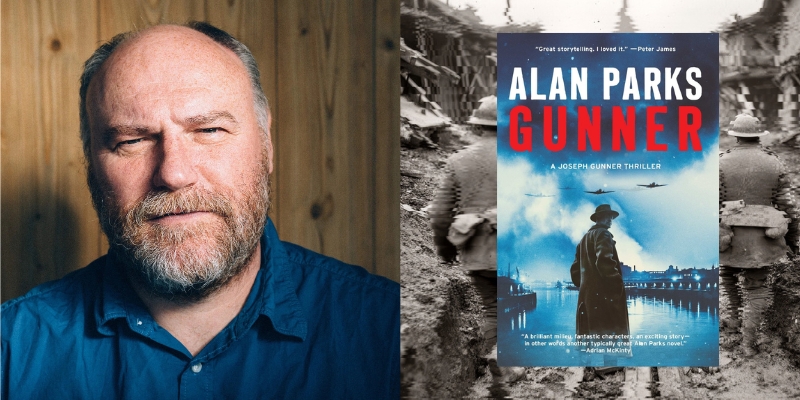
Maybe that’s why I wrote Gunner. To learn something about the war. And what did I learn? Simple stuff that I should have known. War happens to ordinary people. Ordinary lives become extraordinary for a short while. People die and are mourned and despite it all the world keeps turning.
Who knows what my Uncle John thought about D-day years later when he was on the bus or sitting in the pub. That it was all a kind of dream? That it was the greatest adventure of his life? That the sights he saw in France haunted him until his death bed? Or that with all the bullets and bombs on that Normandy beach what he remembered most was jumping into the sea when he couldn’t swim?
His story, like thousands of other people’s, is true and historically accurate and maybe stories like that tell us more about the war and the past than anything else.
Full disclosure. When my editor told me a copy editor was going to look at my book, I said to him “Please get someone who knows about WW2 because I really don’t.” He did and the copyeditor wrote me a very nice email saying how much he enjoyed the book but there were some historical things we need to talk about.
He wasn’t joking. His list of points of concern was six pages long. Maybe I’m not the person who should have written this article after all.
***