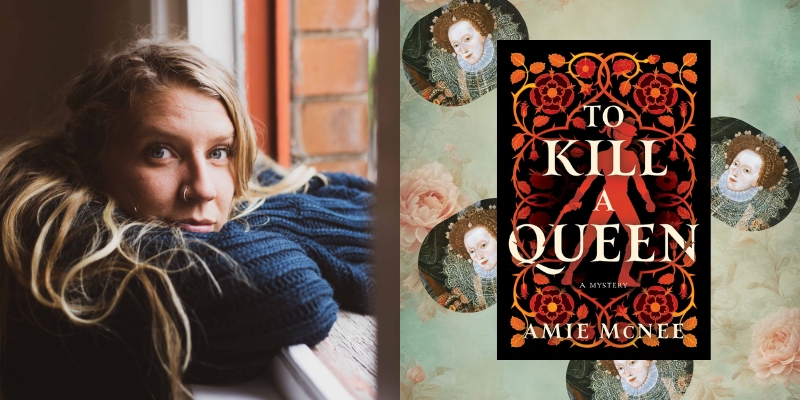
Amie McNee’s new book is the historical mystery To Kill a Queen, but she’s best known for her nonfiction. McNee is writer behind a popular newsletter, co-host of the Unpublished Podcast, gave the TedxTalk “The Case for Making Art When the World is on Fire,” and wrote the recent nonfiction book We Need Your Art: Stop Messing Around and Make Something. McNee has previously written two historical novels, Regrettably, I Am About to Cause Trouble and The Rules Upheld By No One, both set in sixteenth Century England, as is her new novel, her first mystery.
The book’s main character Jack is a woman who lives as a man, the child of a London crime boss who now works for a Justice of the Peace. The book and its approach owe as much to noir as to Dickens, with a criminal seeking to atone for past sins as they struggle in an unforgiving city.
McNee’s book starts with a historical incident, when Queen Elizabeth was shot at while on the River Thames, but from there Jack gets involved in the investigation into what happened, offering a glimpse at how the Tudor legal system worked, the machinations of the Queen’s spymaster Walsingham, and the knife’s edge that so many residents of Tudor London were forced to walk.
We spoke recently about what she learned from writing a mystery after years of reading them, the challenge of writing dialogue, and the strange origin of the character of Jack.
*
Alex Dueben: I really enjoyed To Kill a Queen, and I really enjoyed Jack. Where did she and the book start?
Amie McNee: All I knew when I began this journey was that I wanted to do my first ever murder mystery, which has been a huge genre for me as a reader and as a watcher. I love watching any sort of procedural murder mysteries. I was going to try my hand at this. I’d only ever written kind of historical fiction with love stories and just regular narratives. I’d never written a murder before. I was like, how am I going to do this?
It was a big mission for me. I knew that my detective was going to be important and was going to sit at the heart of this story.
Jack came to me in a very bizarre way. I was in a deprivation tank for the first time in my life, having an anxiety attack, absolutely hating it. This idea of having this ambiguously gendered character flipping between the world of male and female, with a crime lord daddy. She just came fully formed. I was just in this horrible little tank being like, this is the worst experience, and I was handed my book as a reward.
AD: When we talk about suffering for art, it’s usually more metaphorical.
AM: Trapped in a horrible cage. [laughs] But worth it, worth it!
AD: This is your third published novel, each of which is set in sixteenth-century England. What is it about this period?
AM: I did my degree in medieval studies. I’ve got a good knowledge of around 1300s up until early 1600s. I specialized in sex culture and how we thought of sex in that time period. How do we do pornography in that time period? How did we view gender? It’s a really juicy and interesting time period to look at sexuality and sex. I just became obsessed.
As I did my history degree, all I could think was, the books just write themselves. I mean, what else does one use a history degree for, but to tell stories? I can’t help but go back to that time period again and again, because the stories write themselves. It’s such an interesting time period.
AD: It is such an inserting period. When people think about this period they’re likely picturing Elizabeth and Henry VIII and a string quartet playing Haydn in the background– which is not what’s happening here.
Yeah. It’s a gritty, gritty time. We’ve got a lot of novels that look at these royals. The Tudors were incredibly fascinating. We want more Philippa Gregory books. As a historian, but also as an author, I became obsessed with who was actually living in these monarchs’ worlds.
All of my stories look at regular people who lived under these infamous monarchs and what life actually looked like for them. In this case, it’s Jack, who is the lowest of the low in Tudor’s eyes. Jack was born to criminals and had to do bad things to survive the Tudor London streets. What would a life be like for that? The research behind it was so interesting, so fun, and at times heartbreaking. It was a very hard time period to live in.
AD: I’m sure people use the word Dickensian to describe the book because he was writing about the Victorians, but was such an influence on how we understand life for the other 99.9% of people.
AM: Dickens was so great at bringing that story to the normal people and we get some of those stories from Victorian England, but we never get to hear about those poor little Tudors who were out on the streets a couple hundred years earlier because their monarchs were so interesting. All we can do is write books about them.
Obviously the Queen centers in this book. Someone tries to kill Elizabeth I, which really did happen. The whole set up to the novel is something that happened in real life, but I wanted this to be a story about what it was like to live during this reign.
AD: Queen Elizabeth is at the center of the book, almost an echo of how she was at the center of everyone’s life back then. No one interacted with her, but somehow she’s constantly there.
AM: Exactly. Everyone was constantly thinking about her, but no one was actually interacting with her. She’s like a myth. I hope it came across as this almost omnipresent feeling where she was there, but you never saw her. It’s this feeling of like godliness of these royals.
AD: You mentioned that the instigating event is something that actually happened.
AM: It’s not really a spoiler. What actually happened is also in the book. Someone nearly shot Elizabeth I on her barge while she was sailing down the Thames. The actual historical event was that a man named Appletree—and we meet young Appletree in my book—tried to shoot an apple off of his friend’s head, missed, and nearly shot the queen. That’s what literally really happened. Which is just the most bizarre story!
He was going to be killed, but Elizabeth pardoned him at the last minute for being just a drunken fool. I love these historical moments that I was able to bring into these books. There’s so much of that, that I just really enjoy, because again, the stories just write themselves. So beautiful.
AD: So you started with this and then went, Okay, but there’s more to it.
AM: There’s got to be more to it! It was a big day on the Thames. It was a festival day. So much was going on. And then someone nearly shoots the queen? And it was a drunken idiot? Let’s expand it.
Queen Elizabeth’s life was constantly at risk. Like there were so many people who wanted to kill her. The fact that in reality, it was literally just a drunk is hilarious and ridiculous. And so I decided to take over a bit there and alter history to make it slightly more probable. [laughs]
AD: You have a character like Walsingham, Elizabeth’s famous spy master. He’s not going to believe it was just a drunken fool.
AM: How could someone like Walsingham, who’s constantly on guard, constantly looking for threats against Her Majesty’s life, accept that when there were so many threats? Walsingham was an amazing character to have in the book.
Again, history writes itself. He’s an incredibly suspicious, intelligent man. His eyes were everywhere. He knew everything that was going on. To have a character like that in my book was deeply useful for me, because he had a lot of information.
AD: You said you were a reader, a viewer, of mysteries. What did you learn about the genre from writing one? What was the hardest part that you weren’t prepared for?
AM: I’ve always written fluidly and let the story take me where I wanted it to take me. Working with a murder mystery, it’s a lot more structured than I think any other novel is. A murder mystery really requires beats and it requires certain types of storytelling that you don’t see in other novels. For example, the red herrings that you need to put in there.
Something I found really difficult actually was rounding up the information that the detective had already gathered. That’s a real typical thing we see in murder mysteries where we’ve got to recall everything we’ve discovered. That’s just not something you do in a romance or women’s fiction.
So even though I was an avid reader and an avid consumer of the genre, actually looking at the architecture of how these stories are told was completely new to me. As I’m writing the second book, I’m getting used to it still.
AD: So you’re writing a sequel.
AM: I am. My first ever sequel of anything I’ve ever written. I’m excited. I always wanted there to be room for more Jack murder mysteries. I was talking to my partner the other day who loves like a good book series with like twelve books in them. I really can’t handle that. The only time I can handle it is when it’s murder mysteries. I like how they’re so tight. There’s a problem at the beginning and we solve it at the end. Whereas the very long fantasy novels with like, no beginning or no end, I can’t handle it.
I always thought I’d never write a sequel to any of my books because I don’t like the lack of tightness that comes with a sequel, but with a murder mystery, we can begin again with a new problem and we can solve that problem at the end. I can get behind that. I’m really enjoying writing the second book.
AD: Also, we want it to be just like the first one, but absolutely nothing like the first one. We want to be completely surprised, but not too surprised.
AM: What a balance! You don’t want to be betrayed, but you also want to be a bit shocked. That has been so fascinating to learn as a writer.
AD: I won’t spoil the ending, but you set it up with the possibility of more stories and besides that, I think you really nailed the ending.
AM: Thank you. I really appreciate that. It’s hard to know, I didn’t even know who the murderer was until I was near the very end of my first draft. The murderer revealed themselves to me during that first draft. So knowing that the ending feels like it hits all the notes is good feedback for an author.
AD: Did the person reveal themselves around the time that Jack figured it out in the book?
AM: I figured it out just a tiny bit before Jack figured it out. I had this big cast of miscreants. I was very excited at this idea of being able to investigate and get to know a lot of London’s rascals. There is this big cast of miscreants because again, doing my research, we have all these like bizarre, criminal jobs that people were doing. I was like, I want this cast of ridiculous people. And so I put them all in a novel. Then I was like, one of you did it. Let me just see what happens. Eventually one of them put their hand up and said, it was me. I did it.
AD: Talk a little about how the justice system functioned in Tudor London and Jack’s role in it.
AM: I recently wrote an essay diving deep into this bizarre justice system of Tudor England. Very different to what we experience today. Essentially, a lot of it was citizen’s arrest. We relied a lot on criminals being witnessed by regular people and then regular people saying, I’m going to ascertain that criminal.
And so a lot of the times it was what we would now call citizen’s arrest. You had the power to, and you would be expected, if you saw criminals or something going wrong, to intervene. Then we would bring in a constable or a warden, who were not exactly policemen. It was kind of like jury duty.
If you were a gentleman, every now and again, you were going to get charged with being a constable or a warden. It was just as bad as jury duty. You didn’t really want it. Basically, you got a truncheon and you’d be called in when someone’s made an arrest. You’d have to plod along, figure out what’s happened.
Then the higher up, the Justice of the Peace, these were the bureaucrats of Tudor London. The Justice of the Peace was meant to take the criminal to court, to have a jury look at what’s happened, to try and get a conviction. A lot of the times these Justice of the Peace were just gentlemen, people of high standing. They oftentimes didn’t do a very good job. They oftentimes might not be bothered to investigate very hard. Calling it a justice system may be a step too far. I don’t know how much justice was handed out, but it was what they had at the time.
So we’ve got a very vague, not exactly structured policing system. We definitely didn’t have anything that we would have called a detective. But Jack decides that they’re going to be of use to the Justice of the Peace and investigate these crimes more thoroughly so that the justice can do a better job at deciding who’s guilty and who’s not. So Jack does the detective work, essentially, that we would now assume as a detective.
AD: It feels a little like an anarchist system. You see a crime, you’re expected to respond.
AM: I’ve never heard of anyone say it like that, but it kind of is a little bit. It’s very community-driven. I kept researching, surely there’s something like a detective or an inspector, but that role really didn’t exist. Not in the way that we see it today. Putting Jack in there as this very modern detective, I’m sure will ruffle some feathers up the wrong way.
But there was a need to have a look at these situations more closely. And people like Walsingham, especially when it was to do with the Queen’s life, would want to thoroughly look at the what’s happening properly. That’s the the need that Jack serves during this whole debacle with the arrow that was shot towards the Queen.
AD: Walsingham, especially, is someone who would see the value in someone who can talk to anyone.
AM: Exactly.
AD: But also, with Walsingham, your job is not always to tell him the facts of what happened. Sometimes your job is to give him facts that he wants or needs.
AM: Exactly. We’ve got a very political situation happening. There were, again, many, many people who wanted to kill Queen Elizabeth. Jack finds themselves in the middle of an absolute political shitstorm.
What Jack knows is the streets. Jack knows criminals. Jack doesn’t know what’s happening with Scotland, and the politics that’s happening with the north, or with France. But somehow Jack gets entangled in all of that messiness and they have to work it out themselves.
AD: Or not.
AM: Or not. [laughs]
AD: One challenge in writing a historical novel is the dialogue. We all know what modern dialogue sounds like, and it can’t sound like that, but you can’t have people talk the way they did back then without driving readers batty.
AM: If you wanted to actually read a novel like they wrote, I’ve read so many primary documents from that era, you would have no clue what was going on. It is very hard to read. We don’t know what they sounded like in terms of their dialogue. The way that they wrote is all we have that’s left. They did not write it in a way that is anything like the way we speak today.
That said, I get a lot of shit, Alex, for how I write my dialogue. [laughs] Because I do choose to make it like ours, in many ways. How did you find it?
AD: I didn’t have a problem with it, because it can’t sound like Shakespeare. It was familiar, but had its own rhythm and structure.
AM: It’s a balance. A big thing that I always want to do with my historical fiction is to remind people of just how absolutely similar we are. I love the language that they use, and so I’m always going to be using little bits of the language that they use.
I do lean definitely much more towards modern language in my books for dialogue. Again, it pisses people off. But as a historian and as I research all these things, as I read court records, what I love the most is how absolutely similar they are to me and you. I’ve always liked to push that by making them sound like me and you, in many ways. Having similar humor to me and you. And similar issues to me and you.
Because, however many years might separate us, we are so similar in so many ways. I like bringing history close to us.
AD: They are like us, they had many of the same problems and concerns we have, but also they speak differently enough to remind us that they think differently.
AM: And they are. They’re from a different context. It’s a different culture. What normally happens is I write my first draft and it sounds like they’re from fucking down the pub, and I’ll go through and then I will deepen that language a lot more and make sure that they sound at least vaguely appropriate. But some of the worst Goodreads reviews I’ve got are just dialogue, dialogue, dialogue. But I’m sticking to it, Alex. I enjoy it.
AD: So as you’re writing the sequel, or another book? I don’t know how you think about it.
AM: I don’t know how to think of it either. Another Jack detective novel?
AD: As you’re figuring it out, how are you finding it? How are you approaching this book differently?
AM: That’s such a good question. I know who done it, initially. Accidentally, though! I don’t think it was an intentional choice. I do know who done it. I was like, let me think about what I want to do. I’ll read a bit of history.
Literally, I think day one, I’m opening up my books, reading them again. There’s this moment, slightly later than I’m writing, but still Elizabethan London, where this man comes into London and he says he’s Jesus. He gathers this incredibly huge cult following of people who think he’s Jesus come again. London gets this incredibly destabilizing moment of people thinking that Judgment Day is about to come and Jesus has come to collect his followers.
In history he’s an actor who’s just come and decided, I’m going to just fuck shit up a little bit. He makes a lot of money from it. He gets a lot of attention from it. Jack has a very, very interesting history. He’s committed a lot of crimes. There’s a lot of sin on him. What would happen if Jesus came again? How would this unfold?
So we’ve got Jesus coming again in the second novel. We’ve got murders happening because of Jesus. Jack’s got to figure out whether this guy’s an imposter or not. It’s been lots of fun. And again, I just love that the history was like, what about this? I was like, yeah, I’ll take that.
AD: I was going to ask, does Jesus arrive and people start dying? Or does someone kill Jesus?
AM: We’ll see, won’t we? There’s a few dead bodies and Jesus is still currently still alive, but I’m only like 30,000 words in. So we’ll see.
AD: Are you thinking that you have to reintroduce the characters? Restate everything?
AM: I think this is going to be an issue for me in multiple drafts further on. I started just after I finished reading the audio book. I read the audio book for To Kill a Queen, so I was very in touch with the last story. I went straight on without doing a huge amount of reintroduction.
I read Jack Reacher completely out of order. You just learn Jack Reacher, but I think Jack needs a little bit more explaining. I’m guessing in the editing, I might need to do a little bit of easing in, but essentially, I want people to be able to pick up and be like, okay, it’s a Tudor murder mystery. There’s a guy called Jack. Are they a girl? Are they a boy?
AD: So much about Jack is obscured. I joke that half of all mystery series have a page in chapter two where you reintroduce the character, describe what they look like, retell the plot of at least one previous book.
AM: I know! I’m glad you brought this up. Let’s make an intention right now. I will not be doing that. I don’t think you need really to know other anything other than Jack’s got a checkered past.
AD: That’s what you do in To Kill a Queen. We learn a lot about Jack over the course of the book, but you never detail Jack’s entire history.
AM: We just need to know that Jack’s done some bad stuff. It’s interesting having a murderer investigating murders. Or having someone who would have been part of a criminal crew trying to take down criminals. I think that’s part of why I really enjoyed writing this book.
It’s interesting having a murderer investigating murders.AD: You have Jesus in the second novel, because he who is without sin and all that.
AM: That really sits at the back of it all. Jack’s trying to take down murderers, but Jack’s done terrible things. You see this context of Tudor London where people are just trying to survive. People are really struggling. How punitive do we need to be to these people who are doing wrong things because they don’t have a lot of choice?
AD: No one’s hands are clean.
AM: That’s my favorite sort of book. When absolutely no one is innocent.
***