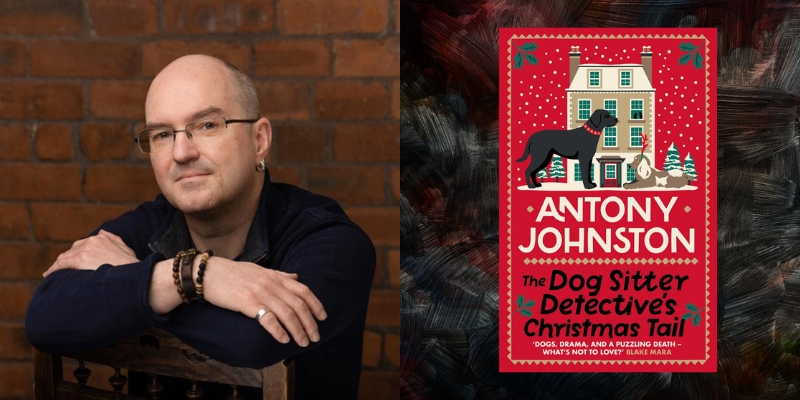
Antony Johnston is the best-selling, award-winning crime writer of Can You Solve the Murder? and the Dog Sitter Detective series, the fourth book of which, The Dog Sitter Detective’s Christmas Tail, came out in the U.S. last year. That’s just some of the most recent work in a prolific and varied career—and an enviable one, because as he said when we spoke recently, “I’ve been able to make a career writing whatever I want.”
That career has ranged from writing the Brigitte Sharp trilogy of spy novels to video games including Dead Space, Shadow of Mordor, and Resident Evil Village. He’s written dozens of comics and graphic novels in almost every genre imaginable, including mostly famously The Coldest City, which was adapted into the Charlize Theron film Atomic Blonde. He’s the author of the productivity system The Organized Writer. Years ago he also co-founded the website Ninth Art, devoted to comics criticism, to which I was a contributor.
The new book involves Gwinny stumbling upon her father’s past, and ends up snowed in at a house with Birch, two dogs, and a murderer. Like the other books in the series it is sharp and funny and plays with classic murder mystery tropes in different ways that make clear how much Johnston loves them.
As an acquaintance, I may not an objective judge, but I think that his recent novels are his very best work, and The Dog Sitter Detective books are a favorite of my mother and godmother–both of whom are cat people. We spoke by Zoom recently.
*
Alex Dueben: Antony, The Dog Sitter Detective’s Christmas Tail is the fourth book in the series, and your first Christmas book.
Antony Johnston: Yes, my first holiday-themed book ever, I think.
AD: It’s a slight departure from the first three, but in each book you play around with different settings and approaches.
AJ: I do, and that’s very deliberate. Each Dog Sitter Detective book features a different breed of dog, as is obvious. What may not be obvious is that I also theme each one around a different kind of mystery.
The first book was a traditional body in the library. The second book is a closed circle community. The third book is a locked room mystery–well, a locked movie trailer, but, same difference. This fourth book is the “help, we’re snowed in with a killer” scenario, which we all know and love.
So, yes, it is a very deliberate thing that I try to make each one a different kind of mystery. To keep myself interested as much as anything, but also to change things up and put Gwinny and the dogs in different situations.
AD: Each one is set in a different location. There’s a progression of time and the seasons over the course of the books, but you don’t hammer it over anyone’s head.
AJ: All this stuff I do fairly subtly, the passage of time, the seasons, it’s there to be noticed if you want to. I don’t draw too much attention to it because I want readers to be immersed in the mystery.
It’s the same with the way I write the books. I write the books in a very deliberately clear and easy reading style, because I don’t want readers to be taken out of the story noticing my beautiful prose. I want them to be fully immersed in the story and the characters.
I work very hard to make the books really easy to read and very clear, so there’s never any confusion about what’s happening, where somebody is, what somebody said, or who’s speaking. I do use confusion sometimes in my other books, but very deliberately not in the Dog Sitter Detective books because I want them to be that easy, page-turning read.
AD: Just to step back, can you talk a little about where this idea came from and what made you interested in writing one?
AJ: I’ve always read, and watched on TV, traditional murder mysteries and cozy mysteries; mostly of the British school rather than American, but not exclusively. I’d come up through comics and graphic novels, where there’s much more of a focus on adventure fiction and thriller-like fiction. Then Atomic Blonde happened, and I was expected to stay in the thriller world, so I wrote the Brigitte Sharp spy thriller trilogy after that.
I was actually supposed to be writing the third Brigitte book when the first COVID lockdown happened. I had to put that book aside, because the Brigitte books are about cyber espionage in Europe and involve Bridge traveling a lot to save the world from cyber terrorists and stuff. That requires foreign travel, it requires realpolitik, geopolitics, and the state of the world—all these things that were unknown and unpredictable during that initial time of COVID.
If you remember, prior to vaccines, serious people were contemplating whether airlines would exist by 2022. I couldn’t write a spy thriller in that environment.
But I am not the sort of writer who can just sit around doing nothing. So I thought, why don’t I write something that will cheer me up, that will literally make me smile as I’m writing it? Why not do a traditional murder mystery? I’d written murder mysteries before, but not in the gentle, traditional, cozy style. A bit of lightheartedness, a bit of humor.
That’s also why it features dogs. For many years I had two Lurchers, and they both died within a year of one another, just before COVID. They were both rescue dogs and we gave them good long lives; they both made it to fourteen years old. But of course it’s still sad and you miss them. That’s why I thought, I’ll put some dogs in here. I know dogs, I love dogs.
It’s why the dogs in the first book are a pair of Salukis, because both of my lurchers were Saluki cross breeds. It’s kind of a tribute to them. I knew that I could get some good laughs out of the dogs’ personalities, because Salukis have, to my mind anyway, very amusing personalities.
I just started writing this traditional murder mystery, honestly, with no thought of publication. I really was just writing it to make myself smile and laugh, until I could write the third Brigitte Sharp book. But I got about halfway through and I started thinking, hang on…maybe there’s something here.
When I finished the initial rough draft, I sent it around to a few writer friends, people who are also in the traditional murder mystery and classic mystery space, like Fiona Veitch Smith, Martin Edwards, and Vaseem Khan. I said, am I mad or is there something here? They all basically said the same thing: it needs a lot of work. (They were right. It was very rough.)
But yeah, there’s something here. This is very enjoyable. It’s a good mystery. And I thought, great…then I put it aside and did nothing with it for a year, because at that point, vaccines were on the horizon. So I finished the third Brigitte book, The Patrios Network. When that was all done and finished and off to the publisher, then I returned to The Dog Sitter Detective manuscript, which was in the back of my mind the whole time. I polished it up, lengthened it, because it was too short, and cleaned it up.
The only problem is that nobody expected a book like that from me. It was so very different to anything I’d done before. My agent didn’t even know that I’d written it. So I very warily approached her and said, I’ve written this cozy mystery. I know it’s not my usual sort of thing, but I think it’s pretty good.
Now, I love my agent. I’ve been with her for many, many years and she’s very used to my strange whims. [laughs] She said, send it over and I’ll read it. I did, and she said, this is good, I’m pretty sure I can sell this. Do you want to do it as a series?
I said, yes, absolutely. We had interest from a few publishers and went with Allison and Busby, who now have published the whole series. I knew they were a great publisher, because some of my friends have published through them. And now here we are four books later. The first one was published in summer 2023, and I’ll be starting to write the fifth one this week.
AD: It feels like it’s found a new audience, and a larger audience for you.
AJ: I’d say so, yes. As is so often the case with my books, I had no idea what kind of reception it would get. [laughs] Or what kind of audience there would be for it. At the time when I wrote it and when the first book was published, there were not–in the U.K., I should emphasize, I’m not talking about the American market–not a great number of murder mystery series featuring animals at all. And certainly not featuring dogs. Nowadays there are quite a few, but at the time, there were none. So I had no idea how this was going to go down, but it was received very well.
The first book won the Barker Book Award for fiction. It became my best selling book ever very quickly, and the series has continued to thrive. Until I published Can You Solve the Murder? last year, the first Dog Sitter Detective book remained my best selling novel. The whole series is more popular than I would have let myself imagine when we first launched it.
AD: In this new book, not to spoil anything, but it involves her father’s past.
AJ: Her father’s mysterious past.
AD: Her father’s mysterious past. You mentioned that you had an idea for something like this from the start.
AJ: It’s something that I wrote in the first book: the mention that his funeral brought out a strange assortment of people from the City, that is the financial city district of London, but also government officials, civil servants and the like. Gwinny is baffled to see them and has no idea why these people are there. She has some vague recollection that her father knew some people in the Foreign Office. He was a German immigrant, so that wouldn’t be unusual.
But in this book she finds out that actually, there was much more to it than she realized at the time. That is, as you say, a seed that I planted in the first book, kind of on a whim. But as soon as I’d written it, I thought, I’m going to want to do something with this. I mean, it’s me. Spies are never too far from my thoughts. [laughs] I expected that I would come to this subject at some point in the series, and this book just felt like the right time to do so.
AD: You didn’t have a story in mind. You just thought, I’ll do something with this.
AJ: When I wrote that passage in the first book, I had no idea what the story would be. I didn’t figure out the details of what his past with the Foreign Office would entail. But yes, I knew I’d figure it out at some point down the line.
AD: Did you put a lot of those little seeds in the first book or since then?
AJ: I put a few, like Tina and her Salukis. Tina is the suspect in the first book. She’s Gwinny’s best friend. The Salukis that Tina then winds up adopting in the first book reappear from time to time throughout the series. There’s ongoing characters like the Dowager, Gwinny’s next door neighbor, who’s obsessed with property prices. Birch, the burgeoning love interest.
This business with Gwinny inheriting the house from her father and then discovering that it’s fallen to pieces and it’s a money pit—which anybody who owns a house can sympathize with, I think. [laughs] I planted all of those things in the first book, knowing that I wanted them to be part of the series going forward. Then it’s just a question of what exactly you do with them as you move through the series.
AD: Throughout you’re also playing with different ideas, different stories, going to different places, Bath, Somerset, teaching all of us about London’s Little Venice, which I had no idea existed.
AJ: Little Venice is a wonderful place, it really is. Obviously the community that I wrote about, in the second book which is set there, is fictional. But Little Venice, as I describe it in that book, is entirely accurate. The layout, the streets, the types of houses. The fact that when you’re in it, even though you are just 10 minutes walk from Paddington Station, one of the busiest rail stations in the country, you do not feel like you’re anywhere near central London. It’s amazing.
AD: We’ve known each other and I’ve been reading you for over twenty years now.
AJ: Way to make an author feel old. [laughs]
AD: Way to date both of us. [laughs] You’ve always been interested in different genres. When you started out in comics, you would write a horror story, a western, a romantic comedy, science fiction. You were doing all kinds of different things and playing with genre in interesting ways.
AJ: That’s something I’ve done throughout my career, as you say, just because I enjoy it. I have nothing against superheroes. I spent a couple of years working for Marvel, but I don’t have that nostalgic affection for them that many people do, because I didn’t grow up reading them. I grew up reading 2000 AD and Judge Dredd, and anthology comics like that; the relaunched Eagle, Scream, Battle and so on.
In the U.K. the tradition is anthology comics, so you get five or six different stories every week in five or six page installments. If you’re buying multiple comics, that means you’re getting 20, 30 different stories every week. All different genres, all done by different people, and all featuring different characters. And so to me that’s just how it works.
I was also a voracious novel reader. The idea of restricting oneself to a single genre, as an author, doesn’t interest me. It never has. I write video games, and even though I’m kind of known as a horror guy in video games because of some of the bigger games I’ve worked on, I’ve worked in all sorts of genres in that media. I like doing lots of different things.
If I have an idea that interests me, I want to be able to act on it. I want to be able to put it out into the world without worrying that people will say, oh, but you don’t write this sort of thing. I’ve never done that. That’s one of the reasons that I worked across so many genres early in my career, because I didn’t want to be pigeonholed.
AD: Not only did you not want to be pigeonholed, you’re not pretentious about genre. You enjoy all these different genres and approaches.
AJ: Absolutely. I have never written anything that I didn’t want to write. I’m very fortunate that I’ve been able to make a career writing books, video games, graphic novels, fiction–stories that I would want to read, play, watch myself. I have never written anything just for commercial purposes, because that way madness lies. [laughs] I mean, I can imagine doing it, but it would be horrible. As I say, I’m very fortunate that I’ve been able to make a career writing whatever I want.
In the case of the Brigitte Sharp books, I love spy fiction. That’s pretty clear from The Coldest City/Atomic Blonde, which was a tribute to John Le Carre. The Dog Sitter Detective, as I said, I’ve always read traditional murder mysteries, and I love watching them on TV as well.
Can You Solve the Murder? came out of a childhood love of gamebooks and role-playing games. It was getting into role-playing games that interested me then further in video games, and it wasn’t long after I’d started writing graphic novels that I stepped into the world of video games as well. I guess I’m pretty eclectic. I like reading lots of different things, and I like writing lots of different things.
AD: You mentioned Can You Solve the Murder?, which came out last year and immediately became your biggest book.
AJ: Yes, to my great surprise.
AD: I’m sure for all the people who loved that book, there’s just as many who do not understand what it was.
AJ: Probably, but there are other books for those people. The way I put it is that if you are the sort of person who reads a crime novel and halfway through goes, “I know who did it!” then this is the book for you. Time for you to prove it. [laughs] This book invites you to do that and see whether you have indeed got it right.
It’s also for people of my generation who grew up reading Choose Your Own Adventure books, or Fighting Fantasy, Lone Wolf, and Endless Quest. What we used to call gamebooks. Nowadays, we’re fancy and we call them an interactive novel, but it’s a gamebook, except this one doesn’t require dice. It doesn’t have rules in the same way that many of those books did. It is also a full-length traditional murder mystery story, that just happens to be interactive.
AD: So many people loved reading old Choose Your Own Adventure books, and love new ones now for adults, but I would imagine it’s hard to write one.
AJ: It’s pretty difficult, it turns out! When I was about eleven or twelve, I made my own Fighting Fantasy style book. I wrote it out and drew some ball-point pen illustrations and made my friends play through it. Sadly, Hellfire of Death’s Caverns is lost to the mists of time. But even then, I remember thinking, this is more difficult than I realized. [laughs]
Writing one of this length and complexity for adults really is difficult. You have to build a flow chart, for a start. You cannot wing a book like this, you have to plan it out. I’ve written the second book and it’s going through the editing process now.
For both books, I had to build this enormous flow chart and plot the book out. That alone takes about two weeks. Then obviously, you’ve got to write it and put in all the clues and figure out the clue number system that I use in the books, to keep track of the clues you’ve gathered, and the evidence you’ve found, and who you’ve interrogated, and so on.
So yes, it is very, very complex. I like to think that my extensive experience writing video games has stood me in pretty good stead there.
AD: I remember thinking, this is the kind of book that requires having written crime books and written video games and knowing the designs and structures of those forms.
AJ: Exactly so. That was partly what prompted it. I kept thinking, is there some way to bring these two things together? Is it possible to write a murder mystery game book complete with clues, and red herrings, and interrogating suspects, and so on? It took quite a while to figure out how to do it. I’m pretty sure I wouldn’t have succeeded, if not for that background in games writing and games design.
AD: Was this something you’d been thinking about and playing with for a while? Did this take a lot longer to write than a typical book?
AJ: The actual writing process took about the same time as any other kind of novel. For somebody who doesn’t know game design, maybe it would take longer, but it took me about the same length of time as writing a regular novel.
The conception of it took a while. It was early 2023 when I first started seriously thinking I wanted to try and figure out how to write a mystery story in this format. I wrote some short stories as a kind of proof of concept, sent them to some friends, and said, again, am I mad or is there something here? [laughs] I do that a lot.
They said, yes, this is fun. They encouraged me to develop a book length version, which I pitched and it was acquired in early 2024. Then the book came out in mid-2025. So it took a while to come to fruition.
The first time that I thought about doing some kind of book like this was probably ten years ago, but from the moment I actually got serious about the idea rather than just thinking it would be nice to do one day, it took about two years from there to the book coming out. That’s not bad.
AD: Was the second book easier to write?
AJ: No. You’d think it would get easier, but it never does. [laughs] If anything, they seem to get more difficult as you go along, because you’re trying not to repeat yourself. You’re always trying to write a better book than the one you did before.
Writing the second Can You Solve a Murder? book went a bit more smoothly, and certainly the editorial process did, but the actual time to draft the manuscript took me just as long as the first book. I’m always trying to make sure that it’s as good as it can be. For me, and for most authors I know, that means trying to write a better book than the one you did before.
AD: I feel like that’s how you’ve always operated. You’re always trying to challenge yourself. Not just, write a better book, but a different book.
AJ: [laughs] Yeah, I guess.
I do that in video games as well. A lot of the video games I’ve worked on have been titles with some kind of innovation. A game mechanic that hasn’t been done before, or launch titles for new systems. As I said, I like doing lots of different things, and new things. I like that challenge of, “Nobody’s ever done this before. So let’s have a go.” That’s me in a nutshell, really.
AD: No one’s ever put these two things together. Can I do that?
AJ: Right, and: can I make it good? That is also an overriding concern. Not only can I do it, but can I do it in a way that other people will enjoy?
AD: You mentioned that you’re working on the fifth Dog Sitter Detective. Do you have an end to the series in mind, or are you taking it as it goes?
AJ:I’m taking it as it goes. I mean, there are many, many dog breeds in the world. I’m not going to run out of those. But I don’t have a long-term plan. I take each book as it comes. I love spending time with Gwinny and Birch and all the other characters. I love writing murder mysteries, and people seem to love reading them. As long as that continues, and as long as the publisher keeps asking me to write them, I’ll carry on writing them.
AD: There’s another Can You Solve the Murder? book coming out soon. Is there anything else you’re working on or can mention?
AJ: The video game that I’m currently working on will be out soon. Altered Alma is a cyberpunk metroidvania with romance elements.
I’m co-writing that with Emma Beeby, who is another multi-hyphenate writer. She writes comics and video games, and has the distinction of being the first woman to have written Judge Dredd in 2000 AD. She’s a fantastic writer, a good friend, and we’ve been working on this game together for a couple of years. That will be out in April, I think. You can wishlist it on Steam right now.
The second Can You Solve the Murder? book is called The Forest of Death, but I can’t tell you anything more about that.
AD: It is a great title.
AJ: Thank you. The plan is to put it out simultaneously in the summer in the U.K., USA, and Canada, as we did with book one. And the next Dog Sitter Detective book will be January 2027.
***