Every couple of years the crime genre gets a rebrand, a makeover and a fancy new nametag to go with it. The Girl With A Dragron Tattoo, in part, created the ever popular “Nordic Noir”, which travelled in the suitcases of Jane Harper, Chris Hammer and Sarah Bailey down past the equator until we called it “Aussie Noir”. Gone Girl and The Girl on the Train shepherded in the “Unreliable Narrator” genre, which in turn led back to the “Fair Play” mysteries; Richard Osman and Nita Prose brought back the “Cosy” and Anthony Horowitz the “Meta”. And then there’s genres inside genres. Is it a “Locked Room” (a murder happens inside a room with no entrances or exits) or a “Closed Circle” (all the suspects are trapped in one location)? Is it a “whodunnit” or a “howdunnnit” or even a “whodidntdunnit”? Nowadays, labelling a book in a bookstore is like building a Tinder profile and listing all your features: “6ft open-door vampire romance seeks blue-eyed no-gore psych-thriller.”
All of these genres, of course, existed before the examples I mentioned above – but it’s when the tides rise and publishers need to put a brand or a name on the genre, to quantify exactly what they’re looking for and what might sell and be marketable, that definitions are hurled around and, suddenly, hello “Romantasy”.
Right now, I’m writing in what is called “fair-play” mysteries. That is, a murder mystery where all of the clues are laid out fairly and in plain sight for the reader. The effect of doing this is that the solution to the mystery, when laid out by the detective, is recognisable in its deductions. The reader goes “ahah!” instead of “what the?”. They’ve had a chance to solve the crime themselves, if only they paid enough attention. That is, you played “fair”.
Agatha Christie is obviously the most famous example of a fair-play mystery. Hercule Poirot unravels clues in front of us, and though we see them clearly, the context of the clue is often the surprise reveal. The detection club, a group of crime authors who met up to discuss technique, pledged allegiance to playing fair in the 1930s. Arthur Conan Doyle, in my opinion, doesn’t play quite as fair – as Watson, chronicling the events, often doesn’t understand or see things as clearly as Holmes does, and so neither does the reader. We, the reader, are impressed by Holmes’ genius, but we never really stood a chance as he reveals hidden knowledge right at the end of several stories.
Here’s the real difference in a fair-play mystery: are you fooling the reader, or are you fooling the characters? If an author is obfuscating the truth inside the reading experience itself, by withholding information the characters already know, they are fooling the reader. Spoiler alert: The Murder of Roger Akroyd or The Silent Patient do this. Now, being fooled is great fun – these books excel at their choice of genre. But it is not fair-play if you start the race by tying your readers feet together.
But I said there was a new genre. And fair-play has been around long enough, and sits as a sub-genre among several major categories (cosies, whodunnits, mysteries), that its resurgence is not all that surprising. We’re another level deeper now: the gamification of the fair-play genre. That is, the book has become a game. Not only does the author lay out all of the clues in front of you, but they actively want you to interrogate them and try and guess the ending.
“Gamification” is a term I learned recently in a meeting with a screenwriter, about how film and television creators are now seeing their development of whodunnits. It’s the act of endorsing the ‘play along’ of solving the mystery. It’s not just the detectives on screen learning about the clues and sharing them with the audience, it’s us being invited in. Being challenged to guess it first. Internet forums and office tea rooms debating the ending of a The White Lotus season is nothing new. But The White Lotus goes one further: it wants you to guess. You could literally bet on who the murderer was during Season 5 of Only Murders In The Building. These shows know that their audience is playing along. And, in a true “Fair Play” fashion, they don’t mind if you’re right.
My wife, Aleesha, has long suffered me guessing at the endings of stories. Not to pat myself on the back, but I’m pretty good at it. Nowadays, our policy is that I write my guess into the notes app on my phone and can only show her at the end of the series/book. I recently texted my brother about the fantastic Dept Q: “I solved it at the end of Episode 4. Beat that.” It’s not a bad thing I’ve figured it out early, it’s not a critique on the show (which was brilliant): it’s a high score. That’s what gamification is.
I was told, in this meeting, that my books were “gamified” too, and it’s true. I lay out all of the facts directly, with no omissions or subterfuge. You have everything you need to solve the crime, and I want you to try. I will, of course, solve it all for you if you’re just here for the passenger seat. But if you want to drive: here are the keys. I’m not going to pretend I don’t have tricks up my sleeve (I do) but they are honest tricks. And I do believe I’ll trick you, somewhere, somehow; but I think you’ll also outfox me sometimes too. And I love that. Reader and author are both a team and an opponent. It’s push and pull. That’s what makes mystery novels fun.
“Gamified Fair Play Aussie Noir Whodunnit” seems a mouthful for a bookshelf category. So I’m going to coin it afresh. I’m calling it a “Let’s Play” mystery.
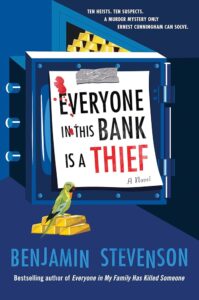
So why not? Pick up my new murder mystery Everyone In This Bank Is a Thief, and let’s play.
You have until Chapter 40. Good luck.
***