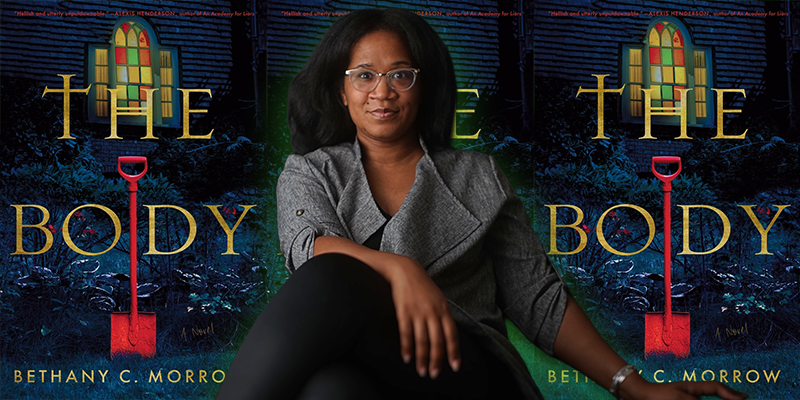
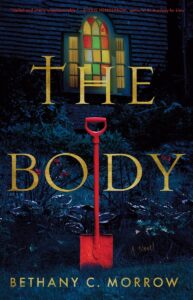
I’m in love with the new novel from Bethany C. Morrow, who won my gothic heart with her very weird Cherish, Farrah, an instant cult fave. In The Body, religious trauma manifests in increasingly disturbing ways for a woman in a troubled marriage. Morrow’s protagonist is desperate to escape her past, determined to hold onto her husband, and unready for the horrors that await her (neither was I, dear reader). Morrow was kind enough to allow me to ask a few questions about her latest work, her singular approach to craft, and her deeply thoughtful use of metaphor. The Body is now available from Tor Nightfire.
Molly Odintz: Religious trauma plays a central role in The Body. Can you talk about purity culture, marriage as status symbol, and how your narrator’s religious background affects her perception of reality?
Bethany C. Morrow: Mavis wants to be married. That’s not a horribly unique desire, and it’s not one to be ashamed of. But shame has so much to do with it for her. How does that happen? In my experience in various American evangelical churches, schools, and organizations—and in my observation as a former student of sociology—the American church has the same problem as the rest of American society: patriarchal misogyny and racism, both of which inevitably create hypocrisy and inequality. Standards, rules, and punishments that only apply to certain demographics. The demonic part of this being the case in religious spaces is that it’s done by invoking divine authority, which means it has far more impact and the consequences are interiorly catastrophic. What institutional oppression does on a macro or societal level, interpersonal spaces where intimacy and love and community are supposed to happen do on an interior, individual level. And those attacks are near impossible to evade. They’re coming from inside the house, impacting the very fabric of our identities and our perceptions of reality.
“You can’t teach purity that only applies to one gender. That’s not purity, that’s control.”Religion for example is meant to be about faith and empathy and intimacy, but when there’s poison at the root—when patriarchal misogyny and racism have been wholly adopted and are now fundamental to the American evangelical church (and not by accident), the fruit is and can only be rotten. You can’t teach purity that only applies to one gender. That’s not purity, that’s control. You can’t take a covenant and dangle it like a carrot (or carat) in order to create docile bodies without destroying people in the process and creating a hotbed of abuse. Because if being married is for a man a status symbol or the necessary requisite to some other level of authority, but for a woman is proof of her personal worth, there’s a power imbalance that begins before you ever exchange vows. He has something she requires to be complete, while he just needs it for a resume.
 The problem is that indoctrination works, particularly when it co-opts concepts like salvation and sacrifice and is hard at work on someone’s self-esteem from a young age. It’s impossible to look at institutions like family, early education, and early exposure to religion and not recognize the extreme harm that can and often is done. Because what we learn in those spaces does affect our perception of reality. And as we can all see, when those spaces are corrupted, breaking free is not a given. Not everyone will divest or deconstruct. Mavis is one of those people for whom this indoctrination of fear worked. The Body is a tragedy because from the moment the story starts, it’s already too late for her.
MO: The Body made me think of that scale in Donny Darko where everything is placed on a continuum of love and fear; in The Body, love is the source of fear: a visceral fear of loss, rejection, and abandonment. What did you want to explore about community, connection, and the fragility of the ties that bind?
BCM: The Body is probably most about consequences. Not for Mavis; for groups who successfully employ coercive control—which, yes, must depend on fear. The entire ecosystem of repression is dependent on fear. Which means, also, that there is no opportunity for love to exist at all. There’s therefore no community, no connection—as soon as you threaten someone, love is impossible. Consent is impossible. Intimacy is impossible.
There’s a part in The Body where Mavis recognizes that there is no repentance where there is no hope of redemption. If vulnerability and honesty is weaponized and only ever used as a ledger to further debase someone, the very thing that’s supposed to make that community worth it—the promise of unconditional love and intimacy—goes out the window. If the novel has a warning, it’s that. That when you do this, you destroy any possibility of experiencing love.
MO: I loved your fifth novel, Cherish, Farrah, so much – it’s got a strange, moody atmosphere to it that returns in your sixth novel. What’s your take on crafting a vibe, and how do you bring such spiraling doom to the page?
BCM: This is such a tricky thing to answer for me! Like much about craft, learning how something’s made isn’t the same as learning how to make the thing, and I overthink the ethics of positing that I’m able to teach it.
For me, I think the vibe is dependent on my story fluency: my grasp of the characters and the truth of the world. The logic of how this world works, what has happened and what the outcomes will necessarily be. I can start writing a story before I know the ending (though I don’t know if I ever have because endings come pretty immediately after concepts for me) but the vibe won’t be on the page in that initial drafting. It comes from knowing the reality of this world, therefore knowing how the world socialized these characters, then knowing what characters individually know—where they are in their own socialization process, for instance—and all of that is constantly impressing on the narrative.
For example, to write a story that takes place in a world in which time is cyclical, I must know how cyclical time works and all its implications, even if I’m writing about a character who is unaware of time’s nature.
MO: Anxiety is a palpable presence in your text; what does horror provide when it comes to portraying insecurity and instability?
BCM: This is interesting. I am realizing that anxiety shows up pretty centrally in every single one of my novels, regardless of the category or genre. As someone who doesn’t deal with an abundance of anxiety (other than that which has been released due to multiple, overlapping, long-term, global crises), I think this is because of how acutely human anxiety is and how full-body it is experientially. It’s visceral, making it fertile for narrative building, character expression, and reader engagement.
In horror, what you have at your disposal is an abundance of worst case scenarios. Ample opportunity to stoke and provoke anxiety, and to let it fully unfurl into a story engine. In social horror specifically there’s an opportunity to make tangible what in our real lives can feel intangible. What in our world is treated as anxiety and dysregulation becomes a reasonable and approximate response when the threats are made more visible and literal. It allows us to reveal how justified that insecurity and instability might be.
MO: Why do you think horror, and in particular, the moody, slow-burn terrors of your fiction, have struck such a cord among readers and fellow writers?
BCM: Horror, like most genre fiction, is most successful I think when it tells the truth. (I could go on and on, but I really think that’s the answer.)
MO: How did you balance your main character’s subjective interiority and complex perceptions with the novel’s wider supernatural occurrences?
BCM: We relate not only to people’s circumstances, but more deeply to how they are impacted by them. The way the impact breaks the skin reminds us of a time we’ve been hurt, times we’ve bled, times we’ve grown callous. I don’t know how to tell a wider story without focusing on a character, on the way the world breaks against them, or the way the world breaks them. Like all of my characters, Mavis is the vessel through which the story of the wider world is revealed. It feels less like something to balance, and more a requisite specificity that unlocks the universal.
MO: What are you working on next?
BCM: I’m currently working on a resort horror, by which I mean a colonialism horror. I was inspired both by my own travel and also by the words of the former Zamibian Vice President, Simon Mwansa Kapwepwe, who said, “If we do not manage our independence well, colonizers will return as investors.”
***