My debut novel, Ava, is a feminist speculative fiction story set in the near-future South. Its dystopian edge can feel uncomfortably close to home, and I know that kind of reading is not always what people want when they sit down with a book. Sometimes you do not want to confront the darkness of the world. You want to step away from it for a while.
Just as we doom-scroll our phones and suddenly feel relief when the algorithm shows us a woman desperately trying, and repeatedly failing, to return a turtle to the ocean with a perfectly timed voiceover, we also need stories that give us a moment to laugh. Humor creates a small pocket of space between us and the heaviness.
Whether it is absurdist, satirical, or darkly funny (and I definitely lean to the darkly funny), these books take me out of my own head and remind me that joy and ridiculousness still exist, even when the world feels crushing.
*

David Sedaris, Squirrel Seeks Chipmunk
This collection of modern animal fables is sharp, absurd, and quietly devastating in the best way. Sedaris uses talking animals to reveal the worst and most tender parts of human behavior, including jealousy, loneliness, cruelty, and the desperate need to be loved. You find yourself laughing and then realizing you have been gently exposed.
I rarely listen to audiobooks, but I always make an exception for Sedaris. His narration ratchets up the humor and adds another layer to the stories. It feels less like listening to a performance and more like being confided in by someone who is letting you in on a deeply awkward secret.

Allie Brosh, Hyperbole and a Half
This book manages to be ridiculous and emotionally honest at the same time. Brosh’s crude drawings and chaotic storytelling capture the inner experience of anxiety and depression in a way that feels startlingly accurate without becoming overwhelming. There is something freeing about seeing complicated feelings reduced to simple, messy cartoons. So many images and stories still stick with me since I first read it a decade ago (CAAAAAKE!).
It’s a book that makes you laugh hard while also making you feel understood. If you have ever struggled with your mental health, or loved someone who has, this book offers humor without minimizing the reality of what that struggle looks like.

Terry Pratchett, Neil Gaiman, Good Omens
This novel is a delightfully chaotic take on the apocalypse. An angel and a demon team up to prevent the end of the world, but their efforts are constantly undermined by inefficiency, bureaucracy, and human absurdity. Pratchett and Gaiman weave together sharp wit, absurd situations, and clever satire that makes the end-of-the-world scenario feel hilarious rather than terrifying.
It is the perfect book for anyone who loves humor with teeth, a little chaos, and an imaginative spin on how truly weird life—and the end of life—can be.

Jenny Lawson, Furiously Happy
I cannot remember where I bought this book, but I saw the cover and had to have it. Who could resist that crazed raccoon? I appreciate both the humor and the honesty of this book. Lawson writes about her life, her brain, and her struggles in a way that is wildly funny and unexpectedly tender. The humor comes from her willingness to share her messiest thoughts and most awkward moments without pretending to have everything figured out.
It is the kind of book that makes you laugh so hard you forget, for a moment, how heavy things feel. Not because life suddenly makes sense, but because you realize someone else is stumbling through it with the same combination of chaos and hope.
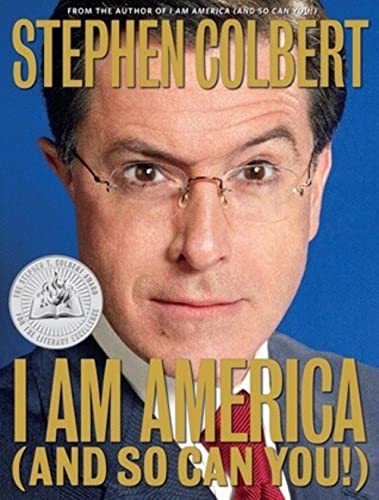
Stephen Colbert, I Am America (And So Can You!)
This book leans fully into satire, using Colbert’s exaggerated public persona (prior to his talk show) to mock politics, media, and American self-importance. The humor is intentionally ridiculous, but there is a sharpness underneath that makes the jokes land harder than you expect. It’s hard to pick a favorite line from the book, so I went with something timely: “Here’s an easy way to figure out if you’re in a cult: If you’re wondering whether you’re in a cult, the answer is yes.”
When the news starts to feel surreal, this book feels like meeting that surrealism at its own level. It does not fix anything, but it does offer the relief of laughing at the spectacle when taking it seriously feels exhausting. It’s a great book to keep on your nightstand. You can open it to any page and enjoy Colbert’s sharp wit as a great alternative to doom-scrolling on your phone.
***