August 9, 1997
“I can’t talk about Joe.”
That’s what Jack Hurley said as soon as I brought the name up. I was disappearing behind a closing door, and I hadn’t even gotten started. So I told him I’d been advised to get in touch with Jack Hurley if I wanted to know about Joe McDonald, “—and you send me back to them?” I feigned offense.
“I can’t talk about Joe,” he said again. “He wouldn’t want me to.”
There was a time when closing the door was the only thing to do, when talking about Joe McDonald, especially Joe McDonald, was hazardous to one’s health. Hurley’s reluctance wasn’t rooted in fear or the echo of fear, however. It was rooted in loyalty. I understood that.
But it’s the ghost of loyalty. I gently reminded him that Joe has nothing to hide anymore, that his friend is out of reach of the law. Long out of reach. Long gone.
Jack Hurley has a lot of friends. Now seventy-nine and living on Cape Cod, he’s sponsored hundreds in Alcoholics Anonymous after damn near drowning in a bottle that damn near became a coffin. He spent years clambering up and sliding down, and when he finally emerged, battle-scarred and almost broken, he turned around like an Irish Harriet Tubman to grab as many hands as he could. Jack Hurley has saved a lot of lives.
He was the soberest bartender in Boston. The regulars in the mob joints loved him and looked out for him like he did for them. Eventually, he bought himself a limousine and went to friends like Joe in Teamsters Local #25 to help his business along.
Despite their exclusive transportation contract with Hollywood, they gave him the green light, as he puts it, to operate as a non-union driver when stars came to town for shoots. He was such a big hit with the cast of the Boston-based crime drama series Spenser for Hire that he appeared in the first episode as himself.
“Jackie Hurley is from South Boston,” said a voiceover. “He spoke the truth.” Spenser, a P.I. played by Robert Urich, only had to drop his name to confirm that his information was on the level. “I talked to the limo driver, Jackie Hurley,” he said. “He’s straight,” said Avery Brooks as Hawk, an African American mob enforcer.
Hurley is a Boston street guy. Boston street guys have stories to tell and we tell them well, but Hurley and his generation are in a class by themselves. They were around during the bad old days, when underworld tensions exploded into polite society, when mayhem was blaring across front pages and the obituaries were crowded with Teamsters and longshoremen who never finished parole.
Those who survived are opening up now, finally, much like their predecessors in the Greatest Generation who wouldn’t speak of their combat experience until they were grandfathers.
“Jack. He’s out of reach now.” I was still trying to get Hurley to open up about Joe McDonald. His silence is that old Irish silence, which means it’s more than an expectation with a gun behind it; it’s a cultural artifact that goes back centuries.
Then I told him that Joe’s daughter had given me her full blessing. “It’s time,” I said. He stared off for a moment as if communing with a ghost.
“I loved that man,” he said.
I clicked my pen.
I looked up and saw Hurley in his early thirties, tending bar at Chandler’s, a long-gone restaurant in the South End. Joe is on a stool in front of him, sipping coffee. He’s in his mid-fifties and looks neither flashy nor menacing. A building superintendent— he looks like a building superintendent.
Behind the dull roar of voices, a juke box plays Marvin Gaye’s What’s Going On. Silverware jangles, glasses clink, and bellows of laughter rise above the din, but Joe is not a part of any of it. He’s just there, the still form in the storm, the solitary one in the crowd—the one watching, listening, measuring, and never saying a word.
“You know, he knew before anyone else that Whitey Bulger couldn’t be trusted,” Hurley said.
“Weren’t they partners in the Winter Hill Gang?” I said.
Hurley shook his head at the thought of Joe partnering with “that piece of shit. Joe hated Whitey. Whitey was a con, just a con and a bully. You couldn’t con Joe and you sure as hell couldn’t bully him,” he said. “He was the real deal. Say some heavy came around spouting off about a problem he had with such-and-such, making threats, that sort of thing, all that had to be said was Joe likes him and that’d be it, no more problem. His name went a long way.”
“And what if it was Joe who had a problem with you?” I said.
“You better catch the next train to Cambodia.”
Train. I laughed a little.
Hurley caught it and laughed too. “Train, plane—what’s the difference? Get outta town.”
“Better yet, shoot yourself and save money,” added Mickey Finn, who also knew Joe, albeit from a safe distance. He remembers the morning in the early 1970s when he saw him standing at the counter in Charlie’s Sandwich Shoppe in the South End, glaring at him. Finn could tear a phone book in half and had a criminal record almost as thick, but he wasn’t looking for trouble. Not that kind.
“Hi,” Finn said, trying to keep things light.
Finn finished eating, got up, and walked past him to get some water at the other end of the counter. Those Manson lamps followed him.
The next day, Whitey Bulger caught up to him: “Do you have a problem with Joe?” Finn told him the story. “He’s a fuckin’ asshole,” Whitey said. “I’d take him out, but….”
It was hollow bravado. Whitey was afraid of him. “Deathly afraid,” said one. “Scared shitless,” said another. “Even [Joe ‘the Animal’] Barboza was leery of him,” said Bobby Covino, a boxing trainer now and bartender at a Winter Hill hangout in the late 1960s. Was the reverse true? “Oh no no no, Joe was leery of nobody.”
He was, I was told, as capable as it gets: “capable” meaning willing to murder and able to get away with it. “No one saw him coming.” Sometimes, Covino said, he’d be dressed in drag when the gun came out. “If Joe had it in for you and you’re walking down the street, that fuckin’ mailbox becomes Joe.” It made things that much more demoralizing, especially for those who missed the train to Cambodia. There are rumors of torture.
How many lives did he end? The responses I got were invariably a variation of oh geezuz.” But he was never indicted for murder, much less convicted. A great majority of his crimes went undetected over a career that spanned five decades—he’s at the origins of the Winter Hill Gang in the 1950s and was the shadow on the wall in the underworld mayhem of the 1960s.
By the late 1970s, his loansharking business crisscrossed New England and beyond and was still operational in the early 2000s. It was whispered that he had ties to the IRA, the Gambino crime family, the Montreal Express, outlaw motorcycle gangs, a Hollywood star, and the three convicts who escaped from Alcatraz. His mugshot was reportedly tacked to a bulletin board at the FBI’s Boston office in Government Center, and over it was written “the most dangerous man in North America,” but law enforcement didn’t know what to make of him.
I made a request through the Freedom of Information and Privacy Act for all documents related to him and was told there are 1,387 pages that are multi-subject, complex, and only potentially responsive. That isn’t much. I’d read in Eric Konigsberg’s Blood Relation that they had 18,000 pages on New York hitman Harold “Kayo” Konigsberg, and he never made the Top Ten Most Wanted Fugitives list. Joe did.
There’s been a glut of books, blogs, documentaries, and films on the Boston underworld since Whitey went on the lam in 1995, and more since his execution in 2018, but Joe Mac, as he was called, is rarely given more than a mention and sometimes his name doesn’t appear at all. Most are replete with inaccuracies that can be downright comedic at times, though not everyone’s laughing.
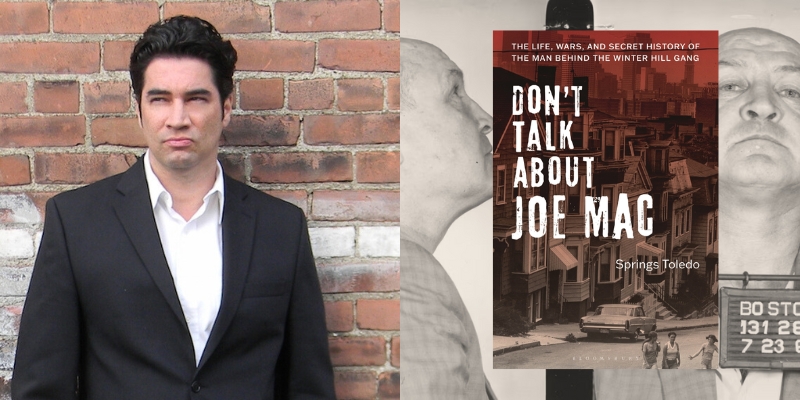
I recently came across a comment under a blog entry about the Boston underworld. “You have little correct,” it said. “Don’t talk about Joe Mac.”
Loyalty, mystery, echoes of fear.
Joe Mac is long out of reach. Long gone. He ended his days not in prison, or the electric chair, or face down on some street with two in the hat, but in a hospital bed in Burlington, Massachusetts—tied to a hospital bed and heavily sedated after breaking a nurse’s nose. He was eighty years old and suffering from dementia.
One visitor saw that he had a plastic knife up his sleeve. “We’re breaking out of here tonight,” Joe told him. “After lights out.” Another left with a shiner: “He thought I was a screw!”
Michael McLean, the youngest son of Joe’s best friend who was murdered in 1965, told me that he was in and out of consciousness. “The doctors would come in for an orientation check. ‘Can you tell me your name?’ they’d ask. Joe looked at them sideways and wouldn’t tell them shit,” he said. “He probably thought they were cops.”
One day near the end, the cops did come in. He opened his eyes to see an FBI agent and a police detective standing by his bed in a last-ditch effort to get information about an unsolved murder.
They talked and talked; perhaps they brought up the recent Boston Globe article exposing Whitey Bulger as a top echelon informant or reminded him that he’d be facing a different judge soon enough. When they were finished, I imagine they stole hopeful looks at each other while Joe stared at them, through them.
“I can’t talk too good anymore,” he rasped. “Lean in.”
They did.
“Go fuck yourself.”
Those might have been his last words.
After he died, a nephew he entrusted with his street interests went through his house in Winter Hill in the dead of night. He found an arsenal in the walls: revolvers of every caliber, rifles, semi-automatics, and a rocket launcher.
Upstairs in the bathroom closet was a secret compartment behind the shelving with thousands of dollars stashed inside. Buried under blankets and old VHS tapes in another closet was a trash bag filled with wigs. There were iron mesh trash cans in the basement, and the joists in the ceiling were blackened. “That’s where he’d burn evidence,” I was told.
An ice pick wrapped in a bloody cloth was found in the detached garage. The garage was soundproofed. “Take a wild guess why.”
*
A breeze whispered through the trees at Medford’s Oak Grove Cemetery on the morning of August 9, 1997. An American flag was draped over his coffin and an honor guard in dress whites stood at either end of it.
Off in the distance, a lone bugler sounded taps. As the last note disappeared behind the hum of the Mystic Valley Parkway, the sailors ceremoniously folded the flag, stars up, and one of them took hold of it, stepped toward the next of kin and got down on one knee.
On behalf of a grateful nation and a proud Navy, I present this flag to you in recognition of your loved one’s years of honorable and faithful service to his country.
The sailor arose, stepped back one pace, and saluted.
A half mile from the cemetery, a World War II memorial stands majestically in Victory Park. The name of every Medford resident who answered the country’s call is engraved in bronze.
Among the honored are two brothers. The younger one was still a teenager when he was killed in action and lost at sea on August 9, 1942. The other, “McDonald, Joseph M.,” came home at war’s end. I set out to find him, the truth of him, no matter what roads and risks would have to be taken.
“You’re poking around in dangerous places,” I was warned early on.
“Watch your back.”
“Don’t talk about Joe Mac.”
This is his story, finally told. Whether it’s safe to tell is yet to be determined.
***