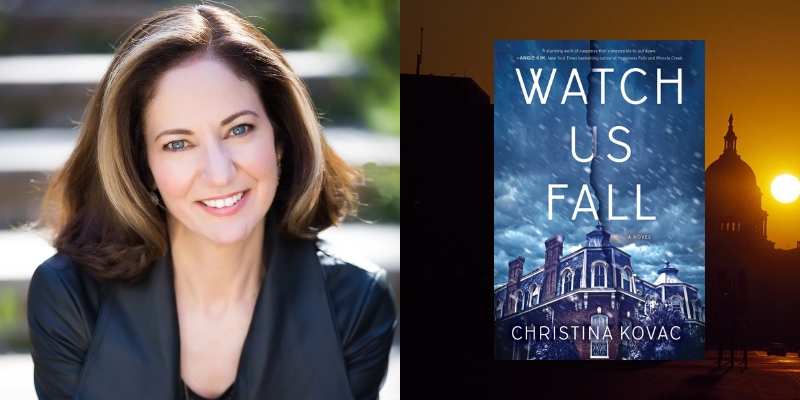
Christina Kovac’s new novel, Watch Us Fall (December 2025), tells the story of a four best friends who have recently graduated from college and are living what seems to be their dream life in a shared townhouse in Georgetown. When Addie’s boyfriend, Josh, a magnetic TV anchor, suddenly goes missing, the cracks in their friendship and the secrets they’ve withheld from each other rise to the surface.
Like Kovac’s debut, The Cutaway (2017), Watch Us Fall is a compulsively readable psychological thriller. I finished it in a day and a half and was grabbed from the first page by the promise of secrets that were about to revealed.
*
Radha Vatsal: Christina, The Cutaway drew on your experiences in television news. Watch Us Fall also has some connection to TV news—but is more about the lives of four young women who work in different professions, and women’s friendships—particularly between Addie and Lucy, the narrator. Can you tell us what drew you to this story?
Christina Kovac: Watch Us Fall takes place during that tumultuous time after college graduation. I imagine these girls having one foot in university life and another stepping toward real adulthood but going nowhere fast—that’s how I remember my first postgrad years anyway.
These four friends live in a rundown old Victorian only a few blocks from their alma mater. They can see the university spires over their rooftop. Though they want good jobs and adult lives, do they act like it? Every day is brunches and parties and sharing clothes and living communally—so fun! That is, until Josh Egan comes into their lives.
Josh creates the modern love triangle I was so attracted to. The choice between romantic, sexual love and devotion for your girlfriends you love more than anyone. Josh assumes Addie will leave everyone for him. I find that conflict so rich and interesting, and I wanted to explore that.
Radha Vatsal: Can you comment on how class plays a role in the novel? Lucy comes from a troubled, working class background. Addie and her other friends, as well as Josh, come from affluent families. How does this affect the story?
Christina Kovac: Writing this novel, I was very curious, and not a little worried, about how impossibly expensive this world has become for our kids. Georgetown is one of the more affluent parts of DC, and most expensive.
Lucy, who is working-class, struggles mightily to stay with her friends, who are really her family. She rents a tiny attic room in the group house. She can’t live without her friends yet feels she’s clinging to her life with them by her fingertips.
Interestingly, though, Josh comes from a powerful political family of obscene generational wealth, he and Lucy in many ways reflect each other. They share suffer similar childhood trauma. They both had terrible relationships with their fathers that have scarred them for life. Addie represents something healing to both of them, though in different ways, and despite their demographics.
Radha Vatsal: I’m intrigued by Addie’s race/ethnic background. It doesn’t play an important role in the novel but right in the prologue, she’s described as having “pixie-cut black hair, her warm, copper-brown skin like a penny in the sun.” Later, the characters discuss how, in college, other students thought she might be related to President Obama. I’m curious why you decided to treat the issue of race obliquely.
Christina Kovac: They say write what you know! I wanted to write a novel about friendship, and my best friend I’ve loved my entire adult life is a black woman (I’m a white chick). So Addie was always going to be a beautiful, brilliant black woman from a professional upper class family, like my bestie. (Though I’m not Lucy!) Anyway, that was the starting point.
But Watch Us Fall is psychological suspense novel about obsession that creates its own blind spots. Lucy may be slavishly devoted to keeping her best friend safe from Josh, and Josh is wildly in love with Addie, but nobody really asks what Addie’s feeling, what she’s afraid of worried about! What it’s like to be a black woman whose famous boyfriend has gone missing. And I chose not to use Addie’s POV for plot reasons.
Once I locked into Josh and Lucy’s POVs, I was locked into their obsessions—which is always more about the lack in the obsessed character. What did Addie represent to them? How did she fill their lack, or ease their wounds?
But I was struck in chapter one, after Addie is attacked on the towpath, when she refuses to call the police, by Lucy not questioning why. Lucy jumps straight into detective mode, trying to figure out who attacked Addie, instead of asking simply, are you afraid of the police? Tell me how you feel. In missing an opportunity to listen, which is respecting Addie’s fears, Lucy indulges her huge blind spot.
Josh and Lucy throughout the novel are incurious about whatever dangers Addie’s ethnicity poses within the story’s conflict. But then, obsessive love is not good love.
Radha Vatsal: The novel is about secrets, stories that people don’t want to tell—even to themselves, and it alternates between a first-person account from Lucy, Addie’s best friend and the narrator; and a third-person account that sticks closely to Josh’s POV. What made you choose this interesting and unusual format? Was it something you knew you had to do right from the start or did you land on it as you worked out the details of the story?
Christina Kovac: I wanted to pit a character who cannot tolerate a lie against a person who refused to face the truth—this felt so timely to me. We live in an era of misinformation, of attacks on facts and truth and science. We suffer a widespread distrust of each other, and I wanted to explore what that felt like in a love triangle, and among the most intimate relationships.
Once I realized I was writing a novel about conflicting stories—a kind of he said/she said—I had to let the “he” and the “she” both tell their sides of the story. It felt fair to me.
Regarding the specific POV choices themselves: Lucy’s a chronic overthinker who drowns in her fears, and her cognitive strengths and challenges drive the action of the story, so her first-person narration felt like the best way to let the reader feel this directly.
Josh Egan has big third-person energy. He was born son of a senator in a famous political family. Their tragedy happened on the public stage, and as an adult Josh willingly steps in front of the TV lights.
He’s also, honestly, gorgeous. That means, in DC at least, Josh can’t walk down a street or sit in a cafe without strangers taking his picture without his consent. He’s keenly aware of how others watch him. Third person felt right for this kind of character.
Radha Vatsal: Speaking of secrets, when you’re writing psychological suspense do you start with secrets first or characters who you know are hiding something and then later, you figure out what it is they’re hiding? Are their secrets a secret to you as you start out?
Christina Kovac: In this novel, the secrets are the character, to a certain extent. They’re the past they carry around with them, the wound that never heals but that they believe Addie will somehow fix for them. She has that thing in her that attracts the wounded.
So their narratives are through the lens of the past. Their motivation is to right past wrongs—even if they’re making a terrible mistake trying to shoehorn the present into it. So if the novel was going to be this, I had to discover Josh’s upbringing and problems with his father at about the same time as I saw his gas-burner blue eyes and his father’s face.
Radha Vatsal: What kind of books or other art do you like to read/engage with in your spare time?
Christina Kovac: I read at night—mostly crime novels, but also literary and some fantasy. Last night I finally got a chance to watch Frankenstein—oh Jacob Elordi was so good (although ending with a Lord Byron quote did stick in my craw).
Mostly, though, I like to get out and touch grass in my spare time. Walk around the lake near my house where bald eagles nest. Hike along the back bay at a barrier island near our family’s beach place. The parks in and around DC are so great.
Radha Vatsal: What are you working on next?
Christina Kovac: A crime novel that takes place on Capitol Hill, which is the largest, oldest neighborhood in DC. It’s about mothers and what you’d do for your children, which I suppose it to say, if they’re in danger, what wouldn’t you do?
***