When it comes to TV and film, music makes everything better. Years ago, when I worked as a writer and producer in the Dallas Cowboys’ media department, I enjoyed watching a video’s transformation when the editor slapped a stirring track over routine football footage. Suddenly, a humdrum practice or press conference felt more like a montage in Rudy or Remember the Titans.
Books don’t get that sort of melodic treatment. The words alone must snap, crackle, and push the reader forward. In my forty years of reading, humor is what keeps me turning pages, acting as a dash of creamer in an otherwise flavorless cup.
Like Frost wrote, “If we couldn’t laugh, we would all go insane.” A little levity can make a story better, even if the topic is no laughing matter.
Death isn’t funny. Neither is violence. Unfortunately, crime fiction, even cozy mysteries, require both elements to advance the plot.
Yet it is fiction, after all, meant to entertain and distract us from our everyday stresses. Whether it’s a snatch of dialogue or a blundering scene, I’ve always felt the best crime stories offer something light to break the tension, the anger, the sadness—whatever is weighing down the page. Otherwise, the book can become, as the cool kids say, a tough hang—especially with so many other entertainment options at our readers’ fingertips.
Two years ago, I enjoyed hearing award-winning mystery author Alan Orloff and others discuss the mashup of comedy and crime at the Malice Domestic conference. I’ve always been drawn to humor in books and movies, perhaps because I’ve never done well with full-on solemn. I don’t like seeing people suffer. Ultra-heavy stories tend to stick with me long after I’ve finished them, like hurtful words from a bully you encountered years ago.
I can still recall sitting in seventh grade English class reading Hamlet and marveling at the poetry in the prose, but the characters I most connected with were Rosencrantz and Gildenstern, my formal introduction to “comic relief.” Hamlet’s “buddies” came off like a toned-down, seventeenth-century Dumb and Dumber, a walking contradiction of calculating and clueless. My twelve-year-old brain enjoyed a brief respite from the tragedy unfolding in front of me.
Mysteries soon became my focus because 1) I liked the idea of solving a puzzle on a page; and 2) early “cozy” TV shows dominated my parents’ living room set. Murder, She Wrote was my mother’s comfort food; Columbo was my father’s favorite; and I gravitated to the original Matlock, which felt more like a comedy-drama with a lighter tone than its courtroom predecessor, Perry Mason.
Andy Griffith played the friendly, “aw shucks” façade to perfection, politely disarming potential witnesses and fooling potential suspects into underestimating his considerable investigative skills (when he wasn’t fussing about the price of gas or groceries). And many of the show’s best scenes involved clever legwork from traditional freelance sleuths Tyler (Kene Holiday), Conrad (Clarence Gilyard, Jr.) and Jerri (Carol Huston).
By the time I reached high school, my mom introduced me to many classic detective novels, including Agatha Christie’s iconic Miss Marple cases, Rex Stout’s Nero Wolfe series, and Raymond Chandler’s The Big Sleep (expertly adapted by Bogie on the big screen in ’46). The more pulpy, hardboiled stories grabbed my attention.
The shy teenager in me admired how Archie Goodwin’s New-York-minute wit could charm women and ruffle Wolfe’s considerable feathers. I used to underline Philip Marlowe’s biting comebacks to the morally bankrupt people he encountered in The Big Sleep—Chandler’s symbols for corruption beneath the sunny sheen of southern California.
Forty years later, Robert B. Parker evolved this style with smart aleck Boston PI Spenser, whose cynical edges are softened over time by his longtime girlfriend (and razor-sharp shrink) Susan Silverman. More recently, cozy authors Janet Evanovich and Elle Cosimano have introduced hilarious, endearing heroines who might not always have their lives together but find creative ways to solve the case.
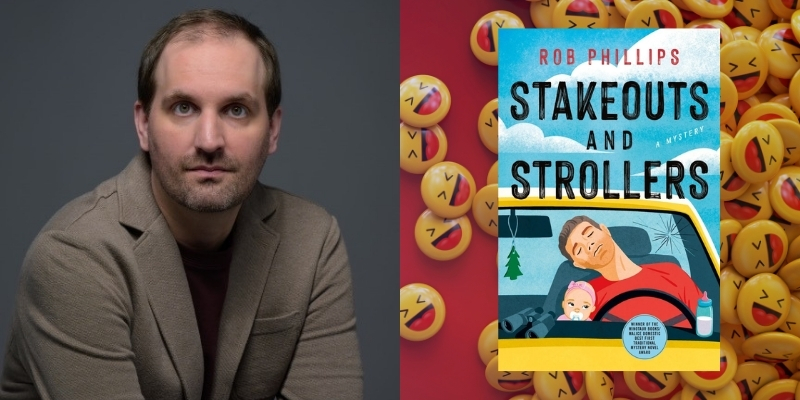
In short, I like a protagonist who can laugh at themselves while navigating the deeply flawed world around them. Real life can be hard enough. It’s one reason my debut mystery, Stakeouts and Strollers, maintains a comedic undercurrent through the book, even in its most dangerous moments.
I wrote Stakeouts during a very complicated time: the very start of COVID, just as my wife and I welcomed our first child. My wife had just lost her younger sister to a rare, sudden disease, and it felt as if we were sitting on a razor’s edge, balancing intense grief with new-parent joy and stress about the pandemic-induced world our new daughter had just joined. We found ourselves cramped and overwhelmed in a tiny house similar to the Shaws’—my main characters Charlie, his wife Ryan, and their baby Callie.
And so, I wrote to escape. I needed an outdoor adventure in a classic Ford Bronco and an exciting far-away city like San Francisco. I needed to laugh a little.
There’s a particular scene inside the Shaws’ North Beach home where Charlie has gotten himself in quite a crack and three generations of ladies—Callie, Ryan, and elderly night nurse Grace—stare at him as if he has three heads. That’s how I felt every time I tried to stop my daughter’s crying fits without her mom in the room.
Stakeouts and Strollers has dark moments, especially within the theme of family and its many burdens, but the general premise is about a new father with a big, heavy heart, two fists, and very few of life’s answers. In some ways, Charlie is channeling pandemic-era me on the page. There is some humor in feeling alive and adrift at the same time. That’s basically the human condition, right?
***