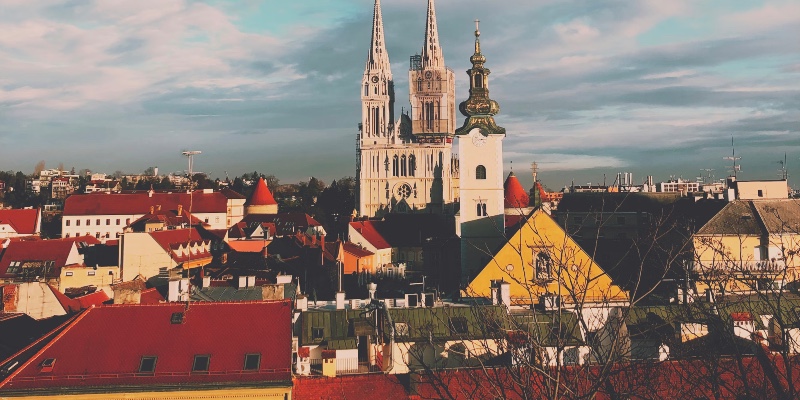
There are few European capitals with more charm than Zagreb, the main city of Croatia, with about a million people in the city proper and the surrounding metropolitan area. Museums, café culture and with easy access to neighbouring Moldavia and to Croatia’s stunning coastline. No wonder it’s been a major holiday and weekend break destination for Europeans for some time now. But of course, Zagreb and Croatia were part of the former Yugoslavia, and so there are tragedies and ghosts in the city too from its not-too-distant troubled past.
Let’s start with Zagreb Noir, a collection edited from Ivan Sršen and with no end of local crime writers – Ivan Vidić, Josip Novakovich, Andrea Žigić-Dolenec, Robert Perišić, Mima Simić, Pero Kvesić, Nada Gašić, Zoran Pilić, Ružica Gašperov, Darko Milošić, Nora Verde, Ivan Sršen, Neven Ušumović, and Darko Macan. Stories range from Zagreb’s role in World War Two to its culture of soccer hooliganism, and the shadowy Balkan underground. Sadly Zagreb Noir is the only place you’ll find many of these Croatian writers translated into English so, while I always recommend the entire Akashic Noir series, editions where seeking out the writers is next to impossible elsewhere this edition is a must-have.
A second stop on the trolley bus line of Croatian crime writing is Alen Mattich, born in Zagreb and now based in London. Zagreb Cowboy (2013) is the first in a trilogy about Marko Della Torre, a secret policeman on the run during the breakup of Yugoslavia in 1991, blending noir with history and black humor. Marko returns in Killing Pilgrim (2014), still in 1991 Yugoslavia as Croatia and Slovenia officially declare independence and war is imminent between the Croats and the Serbs. Marko gets caught in an intricate web woven by the CIA and members of the Croat nationalist movement. They enlist Marko to make contact with a man living in the shadows: an agent who assassinated Olof Palme, the former prime minister of Sweden. And finally, The Heart of Hell (2016) and Yugoslavia is still falling apart – Marko in Zagreb is in limbo as no orders are now coming from Belgrade as the country fractures. When the body of a young woman, identified as an American agent washes up on the shores of Italy, Marko is summoned by the Americans as the last person to have seen Rebecca alive. Incidentally her two colleagues have also been found shot dead on an island in Croatia. Marko goes on the hunt for an unscrupulous Zagreb cop, Julius Strumbic, gone rogue.
And then there’s Adam Medvidović’s “Balkan Times” series of four books, all mystery spy thrillers, which follows the real events inside the Catholic Church and intelligence affairs in Eastern Europe. They are quite deep and meandering but create a fascinating world of secrets and old world law. In Night in Zagreb (2023) it is the 1960s and a Spanish priest, on a temporary assignment in Yugoslavia, sinks into the occult work of communist services in Eastern Europe as they search for a diary written by a nun from Kraków. Onwards to Night Train from Munich (2024) and we are plunged into the relations between the Catholic Church in Croatia and the Third Reich in the Balkans. The third in the series deviates to New York and the fourth, Cwayka (2024) is a Gothic spy thriller bouncing between Budapest, Zagreb and other eastern European locales. Adam Medvidović is what they call a writers’ writer and certainly not an easy read. He defies genre and convention, but his books are deeply unsettling in a way that perhaps, for many outsiders, Zagreb and the Balkans so often are.
And now a few other crime novels featuring Zagreb…
- The many, many lovers of the late Philip Kerr’s Berlin wartime cop Bernie Gunther will already know book ten of the fourteen book series, The Lady From Zagreb (2015). Summer 1942 – Managing to get recalled from the meatgrinder of the Eastern Front Bernie is tasked (by none other than Goebbels to whom saying no is not really an option) with finding Dalia Dresner, a rising star of German cinema. The trail leads to Zagreb and the zone of slaughter in World War Two that is Croatia.
- Jurica Pavičić’s Red Water (2018) is set on Croatia’s Dalmatian coast, following a 1989 disappearance and its investigation, which falters as Yugoslavia plunges into civil war. Three decades will pass before the truth is revealed. Inspector Gorki Šain, haunted by his failure to unravel the case the first time, returns to solve the crime in 2017. It was a big hit in Croatia when it was published. Pavičić (born 2 November 1965) is a Croatian writer, columnist and film critic.
- Annabella Thorpe’s The People We Were Before (2017) is set on the Dalmatian Coast of then Yugoslavia in the summer of 1979. Eight-year-old Miro’s family has moved from the inland city of Knin to the village of Ljeta on the coast to forget a family tragedy. Then the civil war comes to Yugoslavia and Miro, now a war reporter, is dragged into the conflict and the ghosts of his past.
- David G Hennessey’s The Croatia Border Crossing Mystery is, amazingly, book 65 in the Grace Whitmore Mystery series (there are 71 in total!!). Globe trotter Grace Whitmore is crossing into Croatia when she notices a suspicious figure slip through the checkpoint after exchanging words with the guards. One glance is enough to spark a chain of events Grace cannot ignore.
And finally, Edo Popovic’s Zagreb, Exit South (2006) a quite extraordinary novel about people who have given up on life, who can only exist on the street or in bars because they fear and dread going home to their high-rise caverns in the “New” Zagreb. This is the post break of Yugoslavia world a long way from charming Zagreb old town where the old certainties and rules are all gone and everyone is adrift in post-war Croatia. Stymied writer Baba takes readers through the streets of Zagreb bemoaning the dying out of domestic beer, Kancheli’s ridiculous musical lighter, and the fear of going home. His wife Vera, facing wrinkles and an alcoholic spouse, discovers that e-mail is cheaper than therapy as she reshapes her life. Not so much a traditional crime novel as a noir stream of consciousness.
And that, in many ways, is the conundrum of Zagreb. A pretty, chocolate box perfect, East European city of café tables and bistros, old churches and red roofs that can mask the tragic histories of the Balkan twentieth century.