Motherhood has long followed an unspoken script: a woman becomes a mother by carrying a child, giving birth, and raising that child within a recognizable family structure. Even when reality is messier, the narrative holds. Biology, pregnancy, and childrearing define what motherhood should look like.
Literature has mostly stuck to the same script, with the bottom line that motherhood proves a woman is good and is the natural conclusion of her story. For example, Marmee in Little Women gets to be wise and domestic while Dorothea in Middlemarch starts out ambitious but ends up absorbed in caring for others.
But that script is breaking down. Recent novels like All Fours by Miranda July show motherhood in conflict with desire, autonomy, and a woman’s inner life, rather than the thing that neatly resolves it.
Contemporary fiction has started asking different questions: What if motherhood is less about biology than desire? What if it’s defined by emotional labor instead of genetics, by deliberate choice instead of something that simply happens to a woman?
New narratives explore who gets to claim motherhood, who is denied it, and question why we remain so determined to police the boundaries of something so deeply human. Earlier novels treated motherhood as a destination. Jane Eyre fights her way to independence, but the story still ends with her marriage and the domestic life waiting for her.
Contemporary stories, on the other hand, treat motherhood as an ongoing condition, characterized by care, sacrifice, attachment, fear, and responsibility. While biology may initiate motherhood, it rarely defines it. Celeste Ng’s Our Missing Hearts shows how outside forces, such as authoritarian politics, can completely reshape what motherhood and childhood even mean.
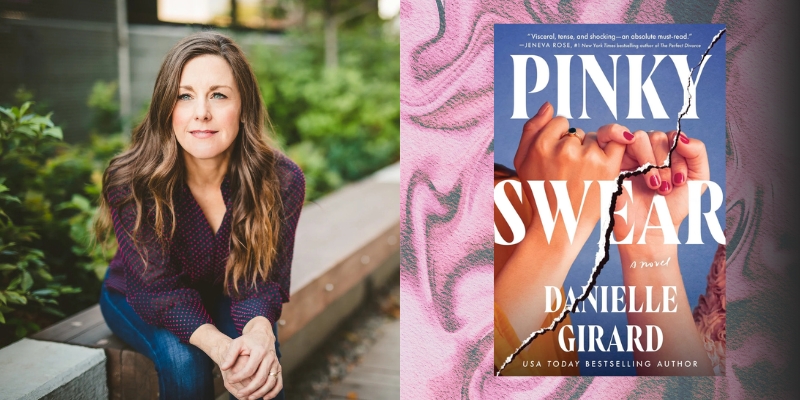
Pinky Swear grew out of this tension. At its center is Lexi, a woman whose desire for a child has become inseparable from her sense of self. Diagnosed with idiopathic infertility—the inexplicable inability to carry a pregnancy—she lives with the quiet grief of wanting something profoundly and being unable to will it into existence. When her estranged best friend Mara offers to become her surrogate, the arrangement feels both miraculous and deeply fraught.
We like to think of surrogacy as a practical solution to infertility. It sounds modern, medical, and straightforward—a problem solved through science and goodwill. But in Pinky Swear, it becomes the spark that ignites both gratitude and obligation, creating a shifting power imbalance that eventually breeds unspoken resentment. The arrangement exposes how desperately we want motherhood to be simple and how rarely it is.
What matters about surrogacy isn’t its logistics but what it reveals about legitimacy. We still prize visible sacrifice. Pregnancy functions as public, embodied proof of motherhood.
When motherhood takes other forms, it is often treated as provisional or incomplete. Adoptive mothers, stepmothers, foster parents, surrogates, and women who mother through care rather than custody are asked to justify themselves in ways biological mothers are not.
Lexi’s claim to motherhood is questioned because she doesn’t—and can’t—carry her child. Meanwhile, Mara’s role is both central and diminished: her body is indispensable, even as her emotional experience is brushed aside, recalling a long literary tradition of valuing what mothers do over how they feel.
Contemporary stories push back against this hierarchy by reframing motherhood as a relationship rather than a biological event. Less interested in origin stories, newer narratives shift the focus to aftermaths: who stays, who sacrifices, and who is changed. Works like Rachel Cusk’s A Life’s Work and Elena Ferrante’s Neapolitan novels resist sentimental motherhood narratives, instead portraying maternal identity as fragmented, ambivalent, and woven with loss.
The story in Pinky Swear similarly explores how motherhood is inseparable from vulnerability. Lexi’s longing for a child shapes her decisions, clouds her judgment, and exposes her to real risk. This is not a sentimental portrayal of desire, but a dangerous one. Wanting a child makes her hopeful, but it also renders her susceptible—to denial, misplaced trust, and ultimately self-deception.
Her story reflects a broader cultural truth explored in contemporary fiction: as traditional pathways to motherhood become less accessible or less appealing, women are increasingly forced to define themselves against its absence.
Motherhood does not heal Lexi’s past trauma; it reactivates it. The adolescent wounds she carries—fear of abandonment, the desire to be chosen, the belief that love requires performance—resurface through her pursuit of motherhood. This marks a shift from older literary traditions, where motherhood often functioned as resolution or reward.
In contrast, recent novels like Ashley Audrain’s The Push expose how motherhood can magnify fear, guilt, and instability rather than resolve them. Motherhood certainly doesn’t make women holy. Instead, it makes all parts of them more visible—their fears, their limits, everything they were before the child arrived.
This shift in storytelling does not diminish motherhood’s significance but expands it. When motherhood is no longer confined to biology, it becomes more honest and inclusive, allowing space for women who mother imperfectly, ambivalently, or at great personal cost. It also acknowledges that caregiving can coexist with resentment, fear, and grief without invalidating the love that grounds it.
The discomfort surrounding such narratives reveals how invested we remain in clear boundaries. If motherhood can exist without pregnancy, the cultural authority of the maternal body weakens. If motherhood can be claimed emotionally, it becomes harder to identify who is “real” and who is not. Ambiguity threatens hierarchy.
Pinky Swear does not argue for a single, correct version of motherhood. Instead, it presents multiple, conflicting claims—none of them clean, all of them costly. This may be uncomfortable territory, but it’s closer to how motherhood actually feels for a lot of women, even if we haven’t traditionally seen those stories in print.
***