Fall 2008. The Waldorf Astoria, New York. Two armed men storm the hotel’s famed bar and hold the occupants hostage: an American corporate raider, a Chinese tycoon, a British hedge fund manager, a Japanese housewife-turned-celebrity, a Mexican undocumented worker, a Wall Street bond salesman, and a Norwegian environmentalist.
Who are these terrorists? What do they want? And what ties them to their captives?

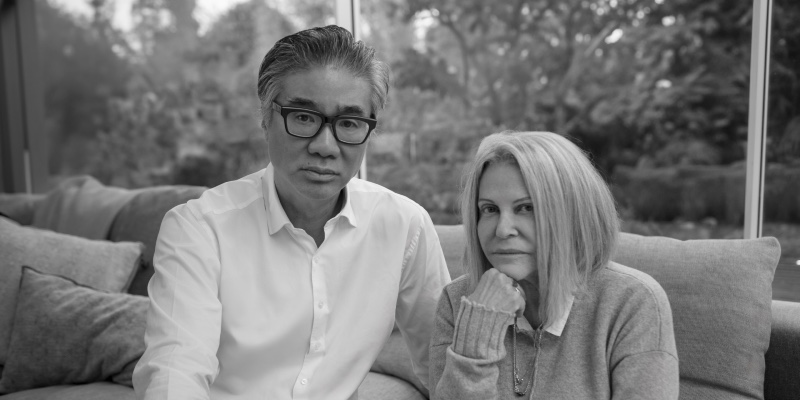
Our debut novel Merry-Go-Round Broke Down—a financial thriller (and USA Today bestseller) about how the world spun out of control—was published on March 31. What follows is a conversation about what it was like for a husband and wife to write a novel together. Because this is a story painted on a global canvas, we discuss the challenges we faced—and had to overcome—and why, in the end, our collaboration worked well,
Margalit: I think what people really want to know is—what possessed an economist and an architect to write a novel, and what gave them the hubris to think they could do it well? The book was your idea, so you should answer that.
David: I wanted to be a novelist long before I became an economist. It would be a stretch to say that I studied economics in order to write novels, but I’ve always been drawn to big, ambitious fiction about sweeping societal change—books like The Red and the Black and Dead Souls. If I was ever going to write one, I felt I needed to understand the world first. What I didn’t know was how long that would take—a Ph.D. at Columbia, five years at the International Monetary Fund, and another twenty on Wall Street—before I felt I understood the world well enough to embark on my first novel. Giuseppe Tomasi di Lampedusa didn’t start working on The Leopard until he was fifty-eight. Some novels only arrive after you’ve lived them. That’s how I feel about Merry-Go-Round Broke Down.
Margalit: But understanding the world is one thing. Turning it into a novel is another. There’s a lot of craft involved. How do you think your experience as a Wall Street strategist helped?
David: On Wall Street, I was paid to explain the world—and predict the future. I was good at my job because not only I knew the numbers, but I was also interested in the people behind them. The world is driven by decisions people make. Behind the forces that shape it—economics, politics, geopolitics—are ambitions, fears, incentives, and miscalculations. Being able to see that, and to tell those stories in an engaging way, is what set me apart on Wall Street. Those same skills, honed over years, helped shape many of the stories in Merry-Go-Round Broke Down.
Margalit: But why this novel and not another?
David: Because globalization is the defining story of our lifetime. It touches everyone, everywhere—whether they realize it or not. And because I felt uniquely placed to tell it. I was born in Pittsburgh, raised in Taiwan, educated in the United States, and spent much of my career in Europe. I have lived between worlds; I speak four languages; I feel equally at home in New York, London, and Beijing. Moreover, my time at the IMF and on Wall Street took me across continents and introduced me to people from many nations and all walks of life. The globalization I know is not an abstract force, but a web of human stories—interconnected, unequal, and often unseen. I wanted to tell that story in a way that anyone could understand, and more importantly, relate to. That is why I chose to write a novel. In The Plague, Camus explores how people behave when the world around them begins to break down. I wanted to do something similar, but in the context of globalization—to capture how it shapes our lives, binds us together, and, at times, pulls us apart.
But as much as I was determined to write this book, I knew I couldn’t pull it off on my own. It was too big a project for one person. I needed help. I knew we would make a good team because our skills and experiences are so complimentary. But it took me more than a year to convince you to join me.
Margalit: Yes, I still remember the day you came to me with the idea of writing a novel about globalization’s butterfly effects and unintended consequences. It must have been sometime in 2010. I thought you had a good idea, but I wasn’t sure how it could be done. But I was caught up by your enthusiasm once you came up with the outlines of what later became the first two stories. Suddenly I could see the whole book in my head. When that happened, all my hesitation vanished.
David: And almost immediately, you came up with the conceptual breakthrough that got the project off the ground—the structure we needed to tell a story on a global canvas.
Margalit: Because the book was set across many countries, I wanted it to unfold like a chain, each story linked to the next, like beads on a necklace. Then I remembered an old black-and-white film, La Ronde, based on Arthur Schnitzler’s 1897 play. In both the film and the play, character A meets character B in the first scene; in the next scene, B meets C, who then meets D in the following scene, and so on, until, in the final scene, the last character meets A, completing the circle. In Schnitzler’s version, the thread that binds the characters is sex. I thought we could borrow that structure to explore how people are connected by money.
David: And I fell into love with your idea right away. The structure gave us a clear direction—to write nine or ten interlinked stories that would bring the domino effects of globalization to life. But that was easier said than done. In a chain of interlinked stories, every link must hold—or the whole structure collapses. Because this book is about the forces shaping the world today, the connections between stories had to make sense both economically and dramatically. That, in turn, meant we had to map out the outlines of all the stories before we could begin writing. It was like assembling a complex puzzle where every piece had to fit perfectly.
Margalit: But the economic arc of globalization gave you a clear roadmap for the novel.
David: Yes, the economics helped me pin down the time and place for each of the nine interlinked stories. For example, globalization as we know it began with China’s opening to the world, so I knew the first story had to be set in China sometime in the second half of the 1990s. China’s opening, in turn, led to the outsourcing of American jobs, which meant the second story had to be set in the United States in the early 2000s. Job losses forced the Federal Reserve to embark on aggressive interest rate cuts, so I chose London—the only global financial center to rival New York—as the setting for the third story. Low interest rates, in turn, encouraged financial speculation. One manifestation of this in the mid-2000s was the rise of Japanese retail investors in the so-called yen carry trade, which is why I set the fourth story in Tokyo. And so it continued.
This was how I came up with the principal settings for the book: China, Cleveland, London, Tokyo, Los Angeles, Norway, Brazil, Dubai, Cuba, and Palm Bay/New York. We wanted to take our readers on a journey around the world. As it turned out, the easiest part of organizing the trip was figuring out the destinations and their sequence.
Margalit: Then came the hard part: coming up with nine stories, each with its own plot and human drama. We spent nearly three years researching the book—visiting the settings of each story and reading everything we could get our hands on, especially accounts of real people whose lives had been shaped by globalization. Even though this is a work of fiction, we wanted to ground it as much as possible in reality. Many of our protagonists are composite characters, drawn in part from people we knew or read about. For example, Arkady is inspired by a Russian trader you once knew who went to Cuba in search of true love after his wife left him for an even richer man.
I based the character of Tomoko, our Japanese heroine in chapter 3, partly on my former mother-in-law. She arrived in Israel in the 1930s from Poland. She was only eighteen, considered herself unattractive, and married a handsome man. Israel was a very poor country back then, and she lived on the edge of middle-class respectability. When I knew her, she saved everything—plastic bags, wrappings, aluminum foil. She would run to the supermarket for a five-percent sale and come back with fifteen packages of sugar—fifteen kilos—dragging them home in a shopping cart and hauling them upstairs. So, when I read about the lengths Japanese housewives went to in order to save money, I felt I knew exactly who Tomoko was. The couple of months I spent in Tokyo, where my daughter was studying architecture, also helped me get under her skin.
What was the most difficult part of the writing of the book for you?
David: For me, it was the dialogue. We wanted the novel to be guided by ideas without becoming a novel of ideas—to let readers discover them rather than be told. We had to get the dialogue exactly right to keep the characters from becoming mouthpieces. A related challenge was making sure each one spoke in a voice that was uniquely their own. That was hard enough for our American and British characters, but for our non-English-speaking characters, it sometimes felt impossible—we had to capture how they would naturally speak in their own languages while keeping the English clear and readable. We studied English translations of Chinese, Japanese, Spanish, Russian, and even Norwegian novels to internalize the cadence, rhythm, and idioms of each voice. We probably spent more time working and reworking the dialogue than anything else. I’m happy with the result—but it was learned the hard way, through trial and error.
Given the novel is set in ten countries, a major challenge we faced was making every place feel real and authentic. This was your responsibility. Can you talk about how you did it?
Margalit: Having lived in London and New York, I knew those cities intimately. Our many research trips to China, Cuba, Cleveland, Los Angeles, Norway, and Dubai helped bring the other settings into focus. I discovered as early as high school that I had a gift for descriptive writing, and my training as an architect proved to be a big asset when it came to rendering places on the page. I drew on architectural detail to give texture and depth to each setting, to imbue every location with its own atmosphere and mood.
In a sense, the novel itself is architectural. Each story is a room within a larger structure, and only by stepping back can one see how they connect.
David: This is also how we came to frame the book as a thriller—a financial thriller. The form aligned naturally with both the structure of the novel and the story we wanted to tell. It also imposed a discipline: reveals had to be precisely timed, key information had to be withheld or reframed, and the narrative perspective had to remain deliberately limited or shifting. By opening with the hostage scene, we draw the reader into a quest to uncover the novel’s central question.
Margalit: Writing this book was definitely not the easiest thing we’ve done together. We argued over practically every paragraph. It is a miracle that our marriage survived this book. Do you remember that you went crazy when I wrote about the downlights in Simon’s high-end kitchen? We fought over the word “downlights” for a month!
David: It was definitely hard. Thank God we’ve been married for forty years; my ego has already been worn down to size. The upside is that when either of us got stuck, the other person would often come through with a solution. It made the pressure of undertaking such an ambitious and complex project more manageable.
Margalit: The iterative process of our collaboration worked very well. You came up with the outline of each story, I turned it into a first draft, and then you did the first round of editing. From there the manuscript moved back and forth between us for weeks—sometimes months—until we were both satisfied. The point is that we each owned a crucial part of the process.
David: Would you consider writing another book with me?
Margalit: Maybe, but not if it’s going to take another ten years. Remember, I will soon be 80. Also, fewer and fewer people are reading books these days.
David: I hope our next book will be easier to write. This was our first, and we had much to learn about the craft. But I know there are still many stories in me waiting to be told. Netflix has created a global audience—one as comfortable watching a Korean detective drama as an Italian romantic comedy. That is the audience for Merry-Go-Round Broke Down. Culture will adapt, as it always does, to changing tastes and habits. There was a time when people believed novels could change the world. Perhaps they still can—not by telling us what to think, but by changing how we see the world. In an age of increasing polarization, I truly hope novels can remind us of the humanity on the other side of our differences. If it does, then 10 years of my life were worth it.