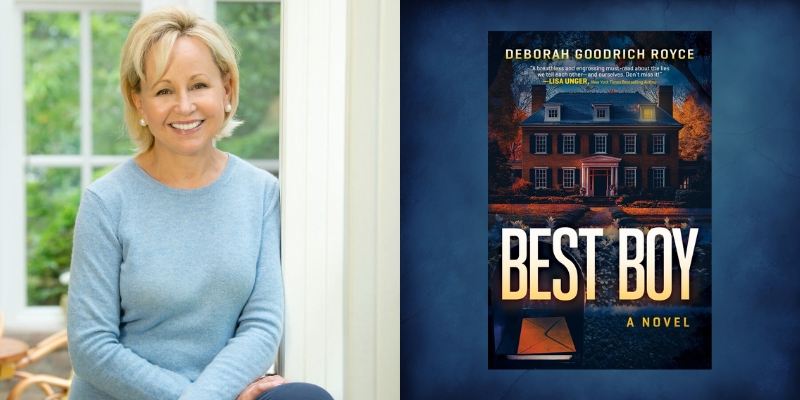
Life, like novels and movies, plays out in a series of acts—and Deborah Goodrich Royce has embraced each chapter of her story, using fragments of fact in the creation of facsimile.
Before commanding readers on the page, Royce entertained audiences as an actress. Perhaps best known for her role as Silver Kane—the sister character of Susan Lucci’s iconic Erica Kane—on All My Children, she also starred in the cult classic slasher April Fool’s Day, among other television and film appearances.
Then, after marrying and having children, she worked as a story editor for Miramax, helping to shape the screenplays of eventual blockbusters like Emma, Chicago, and A Wrinkle in Time. And now, as an Empty-Nester, Royce has picked up her pen in pursuit of psychological suspense, having published four critically acclaimed novels beginning with 2019’s Finding Mrs. Ford.
Royce’s newest, Best Boy (February 24, 2026; Post Hill Press), draws on a multitude of personal experiences—her Michigan upbringing, her career as a young actress in Hollywood, marriage and motherhood, and domestic contentment after relocating to Connecticut.
The story’s protagonist, Viveca Stevenson—formerly known as Ingrid, until a tragic incident in her teens caused her to change her name (and her face) and flee to California—has finally settled into the comforts of family life with her husband and son. But when a break-in at their Greenwich home is followed by the delivery of a series of unsettling letters from an acquaintance she can’t seem to remember, Viveca is forced to confront the possibility that her past may have resurfaced with a vengeance.
Unsettled by the implications of these escalating intrusions, Viveca—a recovering alcoholic who suffers from migraines and memory loss—becomes increasingly erratic, raising the concern of family, friends, and even investigators. Her behavior might be understandable except for the fact that she hasn’t shared the full extent of her youthful folly or the existence of her present-day stalker.
With everything to lose, and beginning to doubt everybody she thought she knew, Viveca must drop all performance and pretense to reckon with the girl she once was. Otherwise, she’ll never be at peace with the woman she has become.
Now, Deborah Goodrich Royce discusses how delving deep into the fabric and feelings of life can be essential to the making of narrative substance and suspense.
*
John B. Valeri: Best Boy was inspired, in part, by a real-life situation in which somebody from your past who you’d forgotten reached out and initiated a correspondence. Tell us about this experience and how it served as a catalyst for the book. More generally, what is your approach to drawing on your own history and fictionalizing it for the purposes of story?
Deborah Goodrich Royce: You’ve struck a resonant chord with that question. I—like all fiction writers I know—draw from life to create its facsimile.
In the case of Best Boy, I did receive an email very similar to the letter that Viveca receives in the novel. It was from a man who said he’d been the best boy on a film I was in and he proceeded to recount a series of touchpoints in our lives, just like in the book. And, like Viveca, I didn’t remember him. While the actual man who wrote to me turned out to be totally legitimate and unthreatening, he got me thinking about the fallibility of memory.
As to the second part of your question, all of my books have a spark of reality that ignites them. Finding Mrs. Ford began as an exploration of female friendship as I reflected on a girl I had known in college who was absolutely incandescent but whose life did not turn out well at all.
The beginning of Ruby Falls popped up in my head because it was a place I had visited as a child that had scared me witless. And Reef Road grew out of the knowledge of the unsolved murder of my mother’s childhood friend and the lifelong effect it had on her.
JBV: Viveca, much like yourself, was an actress in a former life. In what ways did sharing that background allow you entry into her character? How are Viveca’s experiences illustrative of the chasm that often exists between personal and professional fulfillment and the struggle to achieve some kind of balance between the two?
DGR: Because I was an actress the first ten years of my working life, I really imbibed the acting class teaching that there is always something within the character you are playing that can (must!) be drawn from your own life. For example, odds are you’ve never murdered anyone, but—if you’re playing a murderer—there is something you can use. Old feelings of jealousy or rage or fear. Then the work becomes to delve deeply into your own experiences to utilize them and make the made-up situation feel real to both yourself and your audience. Or, in the case of a novel, your reader.
The pull between professional and personal fulfillment is real. I was an actress for a number of years before I had children. And, once I did, I had a hard time managing both of those careers at the same time. And I didn’t really get going with my writing career until I had an empty nest. I guess I am more of a serial careerist than a simultaneous one!
JBV: Viveca was once known as Ingrid and grew up in Detroit, where she suffered a tragedy that had life-altering consequences (both for herself and others). How did that event alter the development of her personality and priorities? In what ways does revealing the truth of it through alternating identities and timelines amplify the work’s overall suspense?
DGR: The scars of everything that has ever happened to us are somewhere on our persons, even if they are not visible to anyone else. Young Ingrid makes a series of foolish—and what will turn out to be dangerous—mistakes. She’s a kid, she doesn’t know better. But those mistakes lead her into a situation that deeply hurts her and changes the trajectory of her life.
She spends the rest of her life—up until the present moment when we meet her—running from what happened. She is someone who white-knuckles control over her life. Or thinks she does until the past comes back to find her.
I like employing multiple timelines because it enables me to dole out information in pieces in a way that I believe builds tension and interest for the reader.
JBV: Viveca also struggles with migraines and memory loss. How does, or can, this affect her credibility and perceptions? What was your approach to handling her condition(s) so that they came across as humanizing rather than simply a plot device to render her unreliable.
DGR: As a lifetime suffer of migraines, including the ocular variety, I can testify that they are blinding and debilitating. I have suffered from diminished vision under an attack, though I have never blacked out. However it can happen.
Viveca also has a drinking problem, which has affected her memory at key moments in her life. I think both of these issues are humanizing because they reflect the human condition, which is flawed. We are all flawed. Viveca, like many of us, holds herself to standards that she can’t possibly meet, and there begins her real problems.
JBV: What is the import of the house depicted on the book’s cover? How does its presence depict the tenuous nature of stability – and thereby reflect the story’s overarching theme(s)?
DGR: The pretty house on the cover of Best Boy is symbolic of everything that Viveca does to try to create a safe and protected world for herself and her loved ones. As a girl, she falls in love with a life-size reenactment of The Streets of Old Detroit at the Detroit Historical Museum. When she is there, she feels somehow removed from her own life and its concerns.
This is when she starts making shadow boxes—tiny perfect worlds where she has complete control over everything in them. She carries this habit into her adult life in her choice of career—acting—to her meticulous care of her own home and the dollhouse that sits in her office. It is all about control and safety for Viveca. And she is not so different from many of us. We may know that we cannot keep catastrophes at bay simply by controlling our surroundings. But that doesn’t keep us from trying!
JBV: You dedicated the book to a true literary luminary, Luanne Rice. Tell us about the friendship you’ve developed with her since becoming an author yourself and what that’s been so profound. Also, how has the writing community at large benefited you, both in terms of camaraderie and craft?
DGR: One of the greatest aspects of this writer’s life is the ability to connect with other writers. And Luanne Rice is at the top of both the literary and the friendship pantheon. She is a smart, funny, and generous friend and the best companion along this path.
I have met and become friends with so many writers along this road and it is one of my favorite aspects of this life. Thinking back to being a young actress, that was a zero-sum game. Either you would get the part or I would, but we couldn’t both get the part. With writing, a rising tide floats all boats. Or, in this case, novels!
JBV: You champion reading and writing through your work with the Ocean House Authors Series, the Deer Mountain Writers’ Retreat, and the columns you write for Hey Rhody and Providence Monthly. What was the impetus for each of these endeavors? How do you think the communal experiences they foster enhance what could otherwise be isolating/solitary for reader and writer?
DGR: All of these other ventures were really an unintended and unforeseen blessing that came along when I got going as a writer. I don’t mean to imply that they just fell in my lap because I worked hard to create both the Ocean House Author Series and the Deer Mountain Writers’ Retreat. But they have each provided such a wonderful connection with other writers.
To your question, the impetus for the OHAS was simply to expand what I had already done on my own—that is give a little author talk at the Ocean House—into a fully-fledged series that features a stunning collection of the best writers out there. The impetus for the Deer Mountain Writers’ Retreat was the longing for a stretch of time away from daily responsibilities to be able to write. And to connect with other writers each evening!
At the retreat, we do no workshopping, teaching, or any other form of programming. We write. And what a joy it is to be able to do that in such a beautiful setting and with such an amazing group of fellow authors.
Finally, the Hey Rhody column is such a pleasure. I spend time researching the books that are coming out in that season and I get to encourage readers to buy them!
JBV: You don’t adhere to a book-a-year publication schedule. How have you found this to benefit the work? Finally, what advice would you offer to others in terms of balancing the quality of their output with the quantity of it?
DGR: I am so lucky that I have been able to go forward with my career without having to adhere to the book-a-year formula. I don’t think it would work for me and, in many ways, it would defeat the purpose of what I am trying to do. I really set out to write the book that I am called to write. And to develop it in the way that it needs to be developed. For each novel, that requires a different amount of time. But it keeps the joy in the process, the thrill of discovery, the adventure.
Each writer has different obligations and needs, whatever they are. I am grateful that I am able to do this thing in the way that works for me.
As far as advice for other writers, I would say more-or-less what I’ve said above: write the book you’re called to write. Spend the time on it that you need to. And revise, revise, revise. Never underestimate the power of revision!
***