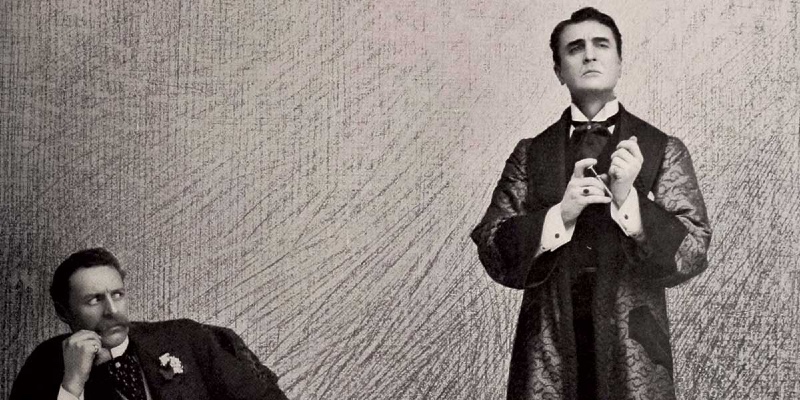
Sir Arthur Conan Doyle’s second Sherlock Holmes novel, The Sign of the Four (1890), begins with Holmes injecting himself with a seven percent cocaine solution while Watson, unchill narc that he is, stands disapprovingly by.
Forty-odd years later, across the pond, Dashiell Hammett wrote The Thin Man (1934) starring hardboiled protagonist Nick Charles, a former detective who’s given up the gumshoeing to look over his wife’s family business interests. He’s the kind of drinker who, at the urging of said wife to have some breakfast, delivers the iconic line “it’s too early for breakfast” before mixing another scotch and soda.
Indeed, the hard-drinking PI had already become convention by the time Raymond Chandler wrote The Big Sleep in 1939, so much so that he pokes a bit of fun at it in his famous first passage: “I was neat, clean, shaved and sober, and I didn’t care who knew it.” But that self-awareness doesn’t preclude Chandler—himself an unequivocal alcoholic—from including profound amounts of booze in his Marlowe novels, too.
So what’s behind the long lineage of the detective-hero’s vice? When exactly did it come about and get solidified into canon, and why? Having picked up the gauntlet in my first novel, Dirty Metal, I was inspired to take a deeper look into the genre’s history to answer that question.
The wild popularity of Conan Doyle’s Sherlock Holmes sparked innumerable imitators over the next three decades, mostly “consulting detectives,” armchair amateurs, or x profession (barrister, physician, journalist) turned sleuth, as well as the newly introduced character of the police detective. The emphasis was on puzzle and solution, with authors vying to outdo each other with their clever (if not especially believable) gambits.
Around the start of World War I, a “new style detective story” emerged, as traced by Howard Haycraft in his 1941 book Murder for Pleasure. This new story was more plausible, more natural, with fallible narrators who don’t have almost superhuman, Holmesian powers of deduction. They sometimes got it wrong on the way to getting it right. But the “Golden Age of detective fiction” still featured protagonists that were, largely, gentlemen. There was Agatha Christie’s Hercule Poirot in England, Georges Simenon’s Inspector Maigret in France, S.S. Van Dine’s Philo Vance and Rex Stout’s Nero Wolfe in the United States. Eccentric and effete, sometimes even snobbish, these sleuths who might enjoy a fine wine or a beer, but they weren’t having bourbon for breakfast.
Then the hardboiled genre emerged in 1920 with the publication of the pulp magazine Black Mask and the game was changed for good. Leave it to us to take the genre’s genteel European roots and go slumming. Ironically, the rise of the hard-drinking PI character is most often interpreted as a direct result of Prohibition, which led to widespread corruption among the powers-that-be and engendered the rise of the mercenary gun-for-hire. Americans have always been fond of taking things (land, justice, revenge) into their own hands, and conditions proved perfect for this most American of archetypes: the knight of the mean streets.
While the basic framework of the story didn’t really change—the murder, the clues, the detective with the unique ability and commitment to put them together—the world was seedier, the characters wilier, the motives less straightforward. Moreover, this kind of detective fiction was more character driven, with the detective often narrating his own adventures, no Watson required. We’re in the detective’s world-weary shoes, one foot of which is already planted in the demimonde. His vice isn’t an enjoyable indulgence like Maigret’s beer or Poirot’s crème de menthe. It’s a compulsion, a necessity—an addiction.
An essential element of this more psychological crime fiction is that the detective might have his own self-image called into question in addition to risking his life. In Hammett’s first novel, Red Harvest (1929), the Continental Op purposefully downs two glasses of gin laced with laudanum—an opium tincture—because he’s fears he’s going “blood simple,” causing murders instead of solving them. He passes out, only to find himself with an ice pick in his hand and his drinking companion dead. Later as he (presumably) ruminates on these events, he sits “drinking unpleasant whiskey, thinking unpleasant thoughts.” His vices are both a self-medication for his lapses and the source of those lapses, allowing him to immerse himself in the dirty mining town of Personville (his “Poisonville”) but also creating a doorway to bad behavior.
It’s often said that Edgar Allan Poe laid out all the tropes of the detective story as we know it in one fell swoop in “The Murders in the Rue Morgue” (1841), all of which Conan Doyle would pick up handily almost five decades later. There’s the presenting of evidence, the ingenious amateur sleuth who sees what the police do not, the withholding of cards from the slower, narrative sidekick before the dazzling reveal. Poe’s protagonist takes the form of Le Chevalier C. Auguste Dupin, who possesses the cold brilliance and outsider status necessary to come to the one possible solution that is yet outside the normie’s range of vision. He’s basically Holmes if Holmes were an impoverished French aristocrat with a sprinkling of Goth vibes. But this and Poe’s two other Dupin stories represent a finite, mid-career departure from his Gothic horrors, following “The Fall of the House of Usher” (1839) and preceding “The Tell-Tale Heart” (1843). So why this brief but brilliant mid-career foray into stories of deduction?
In Murder for Pleasure, Hayward provides an explanation: Poe had finally attained some financial stability as editor of William Burton’s Gentleman’s Magazine, a position he lost in 1840 after one of his “periodic jousts with his earthly demons,” of which alcohol, and maybe laudanum, were a part. He was offered a new editorship by George Graham, who was helming the new incarnation of Gentleman’s called Graham’s, on the condition that he could frickin’ behave himself. Being perennially drawn to extremes, he created a proxy version of his newly self-disciplined, hyper-analytical self in the character of Dupin. The very birth of the detective fiction genre was a way for Poe to put himself on the straight and narrow after a very long bender.
And going back to Holmes for a minute—why does he need the morphine, the coke, his arm “all dotted and scarred with innumerable puncture marks”? Because he’s in between cases with nothing else to occupy his preternatural mind. As he complains about the lack of “brain-work,” he tells Watson: “Stand at the window here. Was ever such a dreary, dismal, unprofitable world? See how the yellow fog swirls down the street and drifts across the dun-colored houses. What could be more hopelessly prosaic and material?” He needs something not to totally give in existential dread. “Give me problems, give me work,” he demands. Then, he says, he’ll quit. And lo, he does.
So the detective needs his drug in order to face the brutality the rest of us can’t stomach, to immerse himself in darkness and bring the truth to light. It keeps the sang froid, the hand steady. But at the same time, the detective needs the case—the cold, demanding work of investigating—to keep himself from totally succumbing to his chemical vices.
Parker Snow, the protagonist of my novel, Dirty Metal, which takes place in 1992 New York City, finds her own Achilles’ heel in a little orange pill bottle. This was, in part, a deliberate nod to the noir tradition. It also makes Parker a somewhat unreliable narrator from the very beginning, when she finds herself standing in the aftermath of a young woman’s murder after a visit to her shady doctor in Brooklyn, having already taken a fistful of pills that sweep her away “on a current of chalky pharmaceutical blue.” As Parker pursues the story, she’s also trying to get her own memories to cohere.
But it’s not just genre trope or plot device. There’s always a point in noir crime fiction in which the professional becomes personal; a point of no return in which the protagonist goes beyond her professional remit to solve the case at hand, even when there are a dozen shrill voices warning her not to. That’s part of why I was drawn to this type of crime novel versus a thriller in its more modern incarnation, in which an ordinary person finds themselves in a high-stakes or uncanny situation and has no choice but to solve the mystery to get themselves out of it. Parker, like Sam Spade or Philip Marlowe, doesn’t have to do what she’s doing. She could say no to the story. She could get another job. But it’s her own moral code, her stubborn insistence on uncovering the truth even when she has no personal stake in the matter, that makes her stay at it. To paraphrase Chandler, Parker is still the best woman in her world—even if she doesn’t always behave like it.
Of course, the somewhat-to-very f’d up protagonist has been a persistent motif in pop culture of the last few decades, from Lisbeth Salander to Gone Girl’s Amy, from Tony Soprano to Jackson Lamb. But beyond our shared preoccupation with the antihero, the use of substances in crime fiction serves another purpose: it means that the hero’s moral code is still in question. We have to believe that our protagonist is ultimately a good person, and yet we’re aware that their vices might cause them to miss, to botch, to succumb. They’re an unstable atom that could break apart at any moment. It adds a deeper tension beyond the plot itself, while haloing the would-be hero in that age-old question: why are they the way that they are?
That, to me, is the next evolution of the protagonist’s vice in crime fiction. It’s the mystery that remains once the story has been broken, the case has been solved. Understanding human nature is a pretty big one as far as mysteries go, and ultimately what makes us return to the genre again and again.
BIO
Allison LaMothe is the author of Dirty Metal, named one of CrimeReads’ Most Anticipated Crime Novels, Mysteries, and Thrillers of 2026. After spending a year in Russia and a decade in New York, she now lives in Miami.
***