Some crimes aren’t illegal. Consider the plight of many migrant workers from Southeast Asia who enter Taiwan in search of opportunity only to be overcharged and exploited in an opaque bureaucracy dominated by job brokers.
Like many countries with advanced economies, Taiwan has an aging population and low birthrate, and is increasingly leaning on migrant workers to keep things humming along.
TaiwanPlus, an English-language media outlet funded by the Taiwanese government, noted in December 2025 that are over 800,000 non-resident migrant workers in Taiwan, mostly from the Philippines, Vietnam, Thailand, and Indonesia. They form the backbone of the caregiving, manufacturing, and agriculture industries. When including another 90,000 undocumented workers—who either fled from harsh jobs or remained in the country after a work contract ended—that’s nearly 1 million migrants working blue-collar jobs.
Taiwan’s entire workforce of 11.6 million is shrinking—a “looming labor disaster,” according to a recent commentary in newspaper Taipei Times.
Bringing in foreigners to fill jobs isn’t a post-industrialization phenomenon. Some of mankind’s oldest laws apply to labor, and some of the oldest labor laws apply to migrant workers.
Deuteronomy directs employers to pay workers, native and foreign, on the same day, before sunset. Not doing so is a sin. Exodus warns not to treat foreigners unfairly.
Taiwan doesn’t live by the Old Testament, but it needs migrant workers, and many Southeast Asians want the opportunity to labor on the island nation. Yet Taiwan currently requires foreign jobseekers to jump through expensive and cumbersome hoops.
Michael Beltran, a Filipino journalist and grantee of the Pulitzer Center, was subject to a thorough medical exam in Manila before he could enter Taiwan to do a story about its undocumented workers. The first two questions in the interview portion with the examiner were, “Have you ever thought about killing yourself?” and “Have you ever thought about killing your boss?”
Beltran was only looking for a working visa for two months in Taiwan, and already had a work contract with a Taiwanese daily. That alone wasn’t good enough, though. Taiwan’s Ministry of Labor required copies of his university diploma and grades, authenticated by two local government agencies, an “employment plan,” and a list of his past work experience. All that had to be translated into Chinese characters, as well. The whole process took several months, and cost about $170.
Yet Beltran noted that that burden “pales in comparison” with what a prospective factory worker from the Philippines would face.
New OFWs—Overseas Filipino Workers—first strive to dodge sham job agencies in their home country (The Guardian newspaper found some recruiters charge illegal fees and lend money to cover them at triple-digit interest). Then they have to borrow $5,000 or so to pay for health checks and visa fees, and their own airfare, and that’s even before Taiwanese job brokers take their percentages of OFW salaries.
A recent Taiwanese government survey showed that migrant workers made about $1,100 a month, including overtime. Taiwanese job brokers are allowed by law to siphon off about $50 to $60 of that. But Beltran found that some workers said their brokers were taking a fifth of their salary. Calls to government hotlines set up to report abuse had no effect.
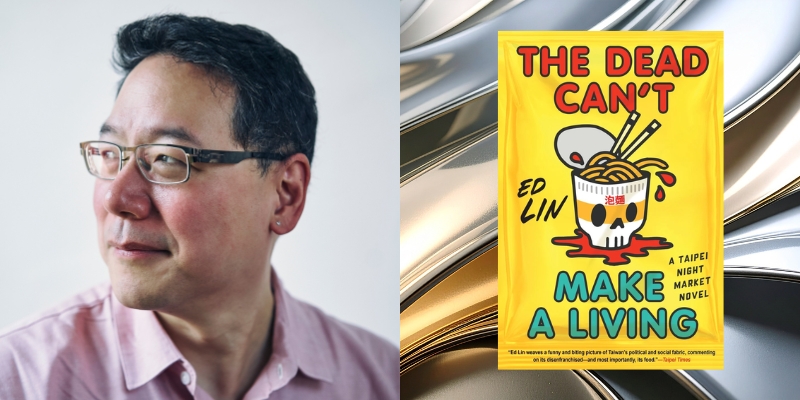
But things are changing for the better in ways I didn’t think were possible while researching and writing The Dead Can’t Make a Living, which explores the fictitious story of one unfortunate OFW in Taiwan and his family.
In the book, there’s one event in which protagonist Jing-nan—who is posing as a migrant worker in a Taiwanese factory—is slightly injured on the job. He stops by first aid for a simple bandage, and is charged for a medical appointment. When Jing-nan objects, the doctor tells him he has to fill out a form in the official language of Taiwan for a refund. Even though the two converse in fluent English, the doctor tells Jing-nan that legally he has to fill out the form on site in Chinese characters by himself—something that exactly zero blue-collar workers from Southeast Asia can do.
In December 2025, however, Taiwan’s Ministry of Labor announced the “Legal Rights Assistance Program for Workers Suffering from Occupational Accidents and Their Families.” This program provides “interpretation services throughout the entire process for migrant workers who suffer occupational accidents, ensuring they can effectively assert their legal rights.”
The government agency conceded that Taiwanese “employers, facing minimal liability, do not place sufficient emphasis on workplace safety” and that “migrant workers who suffer occupational accidents are frequently hampered by language barriers and insufficient familiarity with regulations.”
Perhaps more significantly, in the first quarter of 2026 Taiwan will open a recruitment center in Manila for Taiwanese employers to bypass job brokers and directly hire Filipino migrant workers. The Manila Economic and Cultural Office, the Philippines de facto embassy in Taiwan, in a statement acknowledged “the financial burden on Filipino workers” and “abusive brokerage practices” that has been the rule of day. Direct hiring is also set to expand in Indonesia.
Also, starting April 1, Taiwanese employers will be required to set aside pension funds for blue-collar workers who have worked for the same employer for more than ten years, Taiwan’s national news agency reported.
Will this all pan out as intended? Earlier efforts to promote direct hiring didn’t make much headway against the entrenched broker system, said Tiwa, a Taipei-based nongovernmental organization that advocates for migrant workers, in a report.
Interestingly, Taiwan’s national pension seems more generous than America’s Social Security. Taiwan doesn’t require migrant workers to remain in the country to receive payments. The U.S. requires migrant workers to contribute to Social Security while working, but won’t pay them benefits after they have been outside the U.S. for six calendar months.
***