When The Guinness Book of World Records first appeared, in 1956, its most gruesome distinctions fell in the Crime & Punishment section. Here H. H. Holmes was named “Most Prolific Murderer,” having “disposed of some one hundred and fifty young women ‘paying guests’ in his ‘Castle’ on 63rd Street, Chicago.”
But by the time the 1968 edition appeared, H .H. Holmes had been demoted to “the most prolific murderer known in recent criminal history,” and his former title was bestowed upon a woman, a sixteenth-century Hungarian aristocrat with an actual castle:
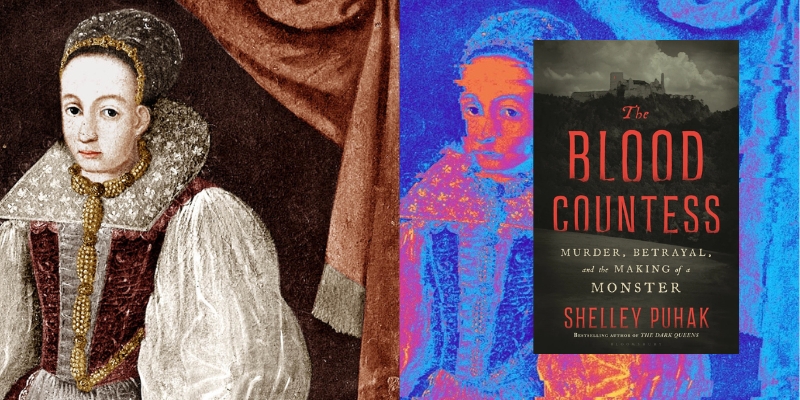
The greatest number of victims ascribed to anyone has been 610 in the case of Countess Erszebet Bathory (1560–1614) of Hungary…a witness testified to seeing a list of her victims in her own handwriting totaling this number. All were alleged to be young girls from the neighborhood of her castle….[When] she died on 21 August 1614…[s]he had been walled up in her room for three and a half years, after being found guilty.
Countess Bathory was later demoted to “Most prolific female murderer,” her body count being surpassed by that of a man, but Guinness would continue to claim that she had dispatched more than six hundred victims.
As one of the world’s cruelest and most notorious serial killers, and a female serial killer to boot, the Countess has long been an object of dark fascination. Today Bathory enjoys a dedicated cult following.
She is the namesake of a Swedish death metal band and the subject of novels, poems, films, and an opera; she even garnered a TV portrayal by Lady Gaga in American Horror Story. The ruins of the castle where she was imprisoned are a popular tourist site; thousands flock there every year. One can buy Elizabeth Bathory mugs, T-shirts, Halloween costumes, and miniature figurines.
Her story has influenced everything from fairy tales and vampire legends to the development of modern psychiatry and criminology. The claim that Bathory bathed in the blood of virgins has morphed into the contemporary trope of the “blood bath,” featured in everything from Batman comic books to Eminem music videos and episodes of The X-Files and Buffy the Vampire Slayer.
Yet there are serious flaws in a story long propped up by horror fans and true-crime enthusiasts. The original Guinness account, for example, contains several inaccuracies. Bathory was never found guilty in a trial, and she was never walled into her tower room.
And as for that witness who testified to seeing a list of over six hundred victims? She was a young servant girl named Susanna, the only one of the three hundred and three witnesses who did not provide a last name.
She repeated a story she had heard about a man who worked a hundred miles away. This man, one of the Countess’s estate administrators, had supposedly “found a written document or a register in the captive Lady’s trunk listing the dead girls, numbering up to 650, a number that was authenticated by the very own signature of the Lady.”
At the time, the scribe recording this tale marked it as something only “know[n] from hearsay.” Yet in the centuries since, Susanna’s shocking claim became an established fact.
Six hundred fifty victims would be an enormous number even today, but in 1611, when Susanna testified, there were only 1.8 million people in the entire country of Hungary; most villages had only twenty to twenty-five houses and a total population of 150 to 170 people. Susanna was accusing the Countess of killing enough girls to fill four entire villages. How could this be true? Was it creative license, a way to express the enormity of the trauma Elizabeth Bathory had inflicted upon the community? Or was it completely invented?
After all, at this time, girls like Susanna testified to all manner of things—that they saw their neighbors fly, that their mothers brought down the hail, that their siblings spoiled the cow’s milk. In England around this time, a nine-year-old girl denounced her mother, her brother, and her neighbor as witches, leading to their execution. (That girl would, decades later, be accused of similar crimes by a ten-year-old boy.)
Perhaps Susanna’s testimony can be attributed to the overactive imagination of an illiterate servant. But what do we do with all the other testimonies? They claim that the Countess brutally tortured her victims, not just by beating them, sometimes for hours, but by dunking them in ice water, pricking them with needles, and burning and branding them. Some witnesses also claimed that Elizabeth Bathory not only killed girls, but also cooked and ate them; that she attempted to assassinate the king and other government officials; and that she once conjured demonic cats and dogs to harass a local pastor.
The most chilling accusations, however, are those that declare that Elizabeth Bathory was the head of a child trafficking ring, assisted by “dedicated girl catchers,” a ring that included other noblewomen, servants, and even one of her own daughters. Was Elizabeth a criminal mastermind, coordinating a vast network across a dark and foreboding landscape? Or are these testimonies just as problematic as Susanna’s?
If Elizabeth Bathory did even some of the things she was accused of, she challenges most of our conventional wisdom about serial killers. And if she didn’t do any of them, then she is the victim of a remarkably successful disinformation campaign, one that has lasted more than four hundred years.
***