I first met Cindy Sherman’s Untitled Film Stills at the Vancouver Art Gallery on a drizzly fall evening. Sherman started making this suite of seventy black-and-white photographs in 1977, in imitation of the publicity stills for noir and arthouse films from earlier decades.
I was surprised by how small they are, how they invite you to lean close to the glass to see them in detail: a woman sitting in a windowsill wearing a crucifix, a woman wearing a robe outside a closed apartment door, a woman sprawled on a bed in her underwear. If you look closely at this last image, film still #6, you’ll notice the woman is holding the camera’s remote shutter release in her left hand.
Each of these women is the artist herself, posed in a variety of vintage costumes, wigs and makeup. Reproductions make these images seem monumental, but in person they are intimate objects, like pages from a book.
The gallery was unusually quiet—the rain had kept the people away, and the big white rooms were strangely echoey. I’d expected to run into friends at the gallery but saw only one familiar face all evening. Instead, I found myself almost alone with Sherman’s cinematic cast of archetypes. Ingénue, femme fatale, lonely housewife.
Each small photograph suggests a larger story unfolding around the moment of its capture, and all of these moments feel almost recognizable from a film. Seeing those photographs hung together to create a cinematic universe shaped the direction of my own novel-in-progress, its scenes reverberating with the echoes of classic horror cinema.
What I saw in the film stills became so entwined with my writing that it was a totally irresistible setting; I sent my protagonist, Brooke, to the gallery on a rainy November evening, where she becomes fixated on Untitled Film Still #13.
In the still, a glamorous blonde stands beside a bookshelf, reaching for a book on dialogue. A few titles are legible on the book spines—CRIMES OF HORROR, THE MOVIES. The woman’s gaze is fixed on something off-camera, as if she has turned to look at someone in the middle of this small, quiet act, an act made somehow transgressive by the photograph’s composition. It feels like a paused scene from a library thriller.
#13, like all the film stills, functions as a cinematic fragment—a horror story in miniature, suggesting danger without showing violence. For Brooke, the photograph becomes a portal for memory and fantasy, both of them perilous territory.
Because of Sherman’s dual role as photographer and model, the images reveal these feminine archetypes as deliberate performances. The photographs adopt the visual language of cinema while exposing its artificiality, yet they remain seductive, emotionally charged and symbolically powerful. Who is that woman? What will happen to her?
It’s true that the women are isolated, often in crisis or menaced by something just outside the frame, and that these kinds of narratives are ingrained in our cultural imagination. Yet the women are also granted a strange kind of agency, the suggestion of a life beyond the heightened moment we see them in, sometimes reaching towards knowledge, breakthrough, or release. The photographs are layered with these heady ambiguities.
I came away from the gallery fascinated with the idea of the body as a constructed cinematic site, subject to the narratives and conventions of genre. These thoughts would percolate for a long time. How could I harness ekphrastic techniques to turn this visual experience into language? What if a character found themselves caught inside a photograph, a horror movie, or a story they were telling themselves? Might it be dangerous to try these archetypes on—did they in fact already haunt us?
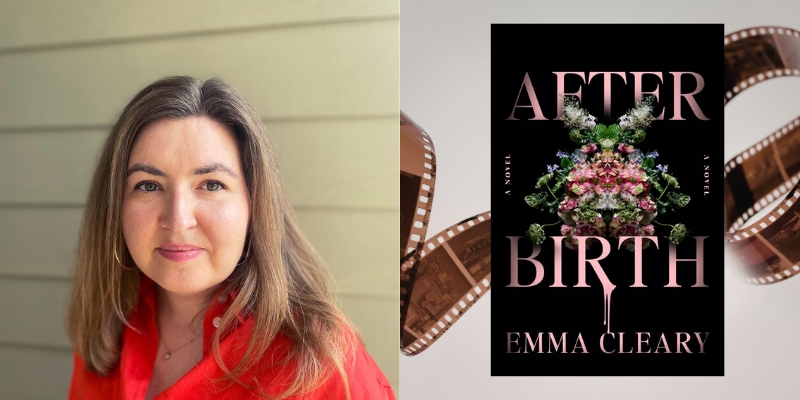
In Afterbirth, the horror films Brooke interacts with begin to take root in her real life, influencing her behavior, her perceptions, and crawling under her skin. I, too, soaked myself in horror to be able to write her story.
Squeamish when it comes to gore—I can’t watch medical shows—I found myself drawn to psychological horror made in the 1960s and ’70s: Carrie, Rosemary’s Baby, and Don’t Look Now, all literary adaptations. These films masquerade at first as drama, except for a creeping sense of unease that gradually morphs into something completely unhinged.
Horror both amplifies and destabilizes, allowing us to represent the otherwise “unspeakable” or uncanny experiences of living inside a particular body: the shame of puberty, of being socially outcast, of abuse by a parent in Carrie; of coercion, rape, and forced pregnancy in Rosemary’s Baby. Supernatural suggestion, heightened transformation, and the unreliability of perception coalesce in these films to make something that feels recognizable, that feels true.
Similar to Cindy Sherman’s film stills, Nicholas Roeg’s Don’t Look Now is built from a signature iconography in which images echo and proliferate, such as the film’s most potent image—the red raincoat the Baxters’ daughter is wearing when she drowns in the opening scenes.
Fascinatingly, Don’t Look Now foregrounds the production of images in its story of grief and perception, a story in which John Baxter can see (he has “the gift”) but refuses to look. The film’s editorial style, its scenes intercut with moments from the past, future, or simply from another room, forces the audience to assemble a narrative from glimpses.
John’s job restoring a sixteenth-century church—the project that takes he and his wife Laura to Venice—involves painstaking work with slides, stained glass, and mosaics, fragmentary materials. John realizes he must make the church a facsimile of itself, where the visitor (or worshipper) can’t tell the difference between the altered windows and the originals: “Restore a fake or let it sink into the sea.”
What the Baxters have lost cannot be restored, yet they must contend with harbingers, visions, and doubles that conjure the dead. Did I mention the murderer on the loose or the psychic sisters yet?
The red coat reappears in a series of partially glimpsed, shadowy sightings in the labyrinth of Venice, creating a chain of misrecognition that leads us to the film’s bloody climax, where we discover all is not as it seems—I’m doing my best not to spoil the ending.
In Afterbirth, haunted by a moment from her own past and steeped in her sister’s grief, Brooke begins to see things the way John Baxter eventually does—through a pattern of terrifyingly seductive, invasive and fragmentary images that lead her to live out her worst nightmares. These are characters in search of a sacred understanding; instead they uncover something monstrous.
I wrote Afterbirth partly as a love letter to the horror that shaped me, assembling the narrative like a series of film stills. The power or usefulness of horror is that it can splinter realism to carry experiences that resist straightforward representation, experiences that feel already distorted or uncanny—illness, loneliness, trauma, pregnancy, grief—making the familiar something far stranger, kaleidoscopic, reimagined and seen anew.
***