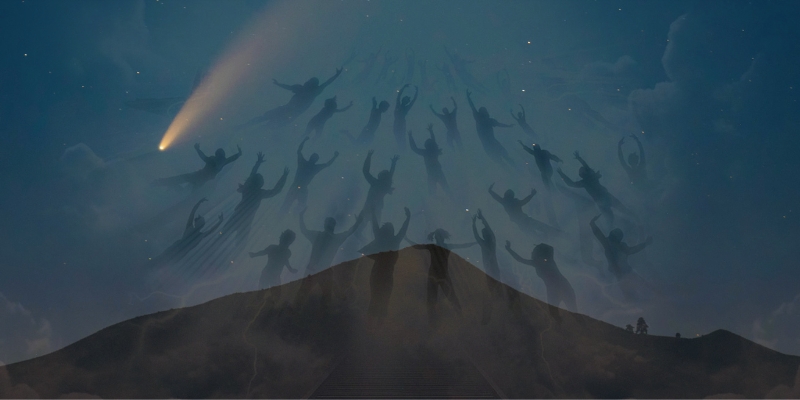
It was supposed to be the apocalypse a few weeks ago. It largely played out in a TikTok phenomenon called #RaptureTok: you can probably still find the videos online, albeit the ones that weren’t deleted in the days after (more on this later).
A brief summary: a few months ago, a South African pastor named Joshua Mhlakela predicted that the world was going to end on Tuesday 23rd September. Evangelical Christians on TikTok took it very seriously and started posting videos about preparing for the End of Days. There were clips of people selling all their belongings, telling their children, discussing the awkwardness of ascending to Heaven while their partner definitely wouldn’t (details not provided).
When the day finally arrived, people filmed the skies, waiting to collect imminent footage of believers rising to the firmament.
As you’ve already guessed, nothing happened. Everyone had a good laugh about it, and then things carried on as normal. It reminded me of the other two times that the world didn’t end in my lifetime: the Y2K panic of 1999 (badly-formatted Windows 95 clocks, nuclear winter), and the Long Count Calendar Apocalypse of 2012 (Mayans).
But increasingly, people seem to believe that things are about to end more than ever: according to research carried out by the Pew Institute in 2022, forty-seven percent of American Christians believe that we’re currently living in the End of Days. I can certainly understand why people feel that way: it’s difficult to look at all of our pressing global concerns and not feel like something must be hugely wrong. No wonder preppers worldwide are filling their basements with canned food, crossbows and emergency grab-bags.
The thing is, we’ve been saying this for ages. The earliest proclamation that the world was ending comes from an Assyrian clay tablet dating from roughly 2800 B.C., which says: “Our Earth is degenerate in these later days; there are signs that the world is speedily coming to an end; bribery and corruption are common; children no longer obey their parents; every man wants to write a book and the end of the world is evidently approaching.”
The fact that one of the horsemen of the apocalypse is self-publishing is maybe my favorite part of this whole prediction. But doesn’t the rest of it feel oddly familiar? Systems falling apart? Bad manners? Things used to be good, but now they’re terrible?
There are tons more where that came from. Pope Innocent III predicted that the world would end in 1284, exactly 666 years after the foundation of Islam; the German mathematician and astronomer Johannes Stöffler predicted that the world would be destroyed by floods on February 20th, 1524 (it ended up being a drought year); in 1806, a Leeds hoaxster convinced people that his chicken was laying eggs saying JESUS IS COMING (the explanation is gross).
I could go on, and on, and on. People like thinking the world is about to end: it gives them something to look forward to.
But the one that captured my attention the most—my favorite cataclysm, if you will—is the Halley’s Comet Panic of 1910. Everything about it is so characterful and unusual.
In short: Halley’s Comet was scheduled to pass the Earth on May 19th, 1910. There had been so many scientific and technological leaps since it had last passed in 1836: it could be photographed, for the very first time! Studied by scientists!
Astronomists gamely used a spectroscope to study the chemicals in the comet’s tail, and discovered that it contained—among other things—poisonous cyanogen gases. Which became worrying, when astronomists also calculated that the comet would pass much closer than usual this time—in fact, Earth would pass right through that cyanogen-filled tail.
People naturally started to feel worried. In a bid to reassure the public, French authorities asked the esteemed scientist (and science fiction writer) Camille Flammarion to explain that there was no chance of danger.
It did not go to plan. Flammarion said that if we passed through the tail, there were a number of things that might theoretically happen. The hydrogen gas in the tail could ignite, “blasting Earth asunder in a gigantic explosion”; the cyanogens could turn into cyanide gases and poison the entire planet; or the nitrogen could replace our entire atmosphere with laughing gas, “suffocating all animal life in a ghastly parody of death” and causing every single living thing on the Earth to perish “in a paroxism of universal joy, delirium, and madness, probably delighted with its fate.”
Or, you know…it might not. Flammarion wasn’t sure on the details. He just thought it was something worth mentioning.
People started to panic. Scientists around the world lined up to point out how ludicrous Flammarion’s suggestions were: the cyanogens in the comet’s tail were so rarefied, they said, that they couldn’t poison anything, and Earth would pass through it like a car driving through fog.
But it didn’t matter: comets have always been seen as portents of bad news, the change of history and the death of kings, and the spectroscope readings seemed to confirm everyone’s worst fears. Suddenly anything unusual that happened – floods in Europe, freak hailstorms in America—were seen as confirmation that the world was coming to an end. When Edward VII unexpectedly died two weeks before the passing, it escalated wildly.
And that was when another key change from the last century kicked in: newspapers. News about the comet, and the panic about the comet, was now being distributed globally every single day and building it to a fever pitch. There were riots and stampedes. People built shelters and buried their love letters. People sold comet insurance and anti-comet umbrellas. Someone in Haiti started making anti-comet pills. A farmer in California crucified himself.
And then, of course…nothing happened. Because it never does. History carried on, and the event is nowadays more or less forgotten, cropping up every now and then in articles like these about bizarre moments of history.
Which—as it just so happens—I love.
That’s how I came to write my very first adult book: The Murder at World’s End. I knew I wanted to set a story during the Halley’s Comet Panic—I just couldn’t work out what the crux of the book would be. When I realized that I could use the event as a centerpiece for a good old fashioned manor-house murder mystery, I saw how it would tie together: a prepper Viscount, convinced that Halley’s Comet is going to end the world, decides to seal up his entire mansion from top to bottom, making it impervious from poisonous gases.
He seals every door, blocks every chimney, locks each and every guest and member of staff into separate bedrooms so that they can safely spend the night waiting out the apocalypse…but in the morning, the only person who’s dead is the Viscount himself, murdered with his own ancestral crossbow in a sealed room that nobody entered or left. A locked room murder mystery—no one’s ever done one of those before!!
The rest of it came to me, piece by piece. I figured that if I was setting it in a manor-house, then I should have an upstairs-downstairs detective duo solving the case. A young under-butler could be one of them, I decided—an outsider, fresh out of Borstal and on his last chance.
But who would be the gentry that he solves it with? I needed a science angle in there, I decided—something that would work with the central theme of the comet, and bring an academic angle to proceedings.
I eventually decided on the Viscount’s elderly aunt: an octogenarian scientific genius who’s kept hidden away in the corner of the mansion for her own safety (and ours), with a mind like a bullwhip and a mouth like a sailor. I loved the idea of an unlikely Holmes and Watson pairing: a young butler pushing around a cantankerous old dowager in a wicker bath chair to solve a case that is as eccentric as it is deadly, before the killer strikes again….
The things with the Halley’s Comet Panic is that it all started from something so well-meaning. Comets had always been seen as a sign from God: scientists wanted to demystify it and study it properly, but that inadvertently fed everyone’s superstitions.
The Comet is coming back as we speak—in 2024 it reached the farthest bounds of our solar system, and started heading back towards us. It’s due to pass by the Earth once more in 2061. When it does, I have no doubt that someone, somewhere, will say that it’s a sign of the world ending.
Because people will always like thinking that the world is about to end in their own lifetime: strangely enough, it makes you feel important. Maybe that’s why we keep finding ourselves repeating that cycle, over and over.
This piece originally ran in Aspects of Crime (UK) in November, 2025.
***