It began, like most investigations, with one simple clue….
My younger brother, Joel (one of many “Joels” in the family, a fact I also never knew) has been researching our family history for several years. He recently sent me a message about Joel Townsley Rogers, an author published from the 1920s through the 1950s. My brother shared the suggestion that the author was possibly a relative, through my paternal grandmother’s family.
Naturally, I was intrigued and had to find out more. It didn’t take long to discover that Joel Townsley Rogers, who was born in Sedalia, Missouri in 1896 and passed away in 1984 in Washington, D.C., was an extremely prolific author. Focused mainly on short stories, his bibliography includes over a hundred and forty-five published works, many of which were reprinted in other magazines or anthologies after their first publication.
He wrote in a variety of genres, including westerns, adventure stories, mystery and detective fiction, and even science fiction. He also wrote for a wide variety of publishers—many of them the popular pulp fiction magazines and publishing houses like Top-Notch Magazine, Adventure, and, more importantly, Fiction House.
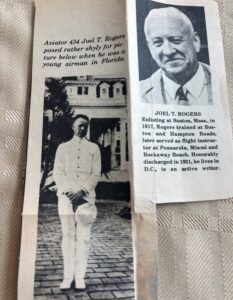 Joel T. Rogers
Founded by J.Q Glenister and John B. Kelly in 1927, Fiction House introduced short stories set in the world of aviation to American readers. They had a few different imprints, including Air Stories, Wings, and Aces. Joel Townsley Rogers, who was an aviator and had been a flight instructor for the military during World War I, wrote numerous short stories for Fiction House’s imprints. His work was based on his real-life aviation knowledge and experience and was considered some of the most accurate and intriguingly plotted “air stories” about the first World War.
Rogers also wrote a few western tales, but his biggest breakthrough into the mainstream was in the realm of mystery fiction. (Naturally this fact intrigued me the most, since I also write in that genre.) His first foray into this field, a short novel, “Murder of the Dead Man,” was published in Munsey’s Detective Fiction Weekly in 1934.
Following this publication, Rogers wrote numerous short stories, novellas, and even an occasional novel in this genre. In fact, by 1945, his literary output was primarily in the mystery and detective field.
Many of his stories were published by Popular Publications’ Detective Tales and New Detective Magazine, although he also contributed to Detective Fiction Weekly, as well as Fiction House’s Detective Book Magazine, Argosy, Two-Book Detective Magazine, and All-American Fiction.
His most well-known work, The Red Right Hand, was a novel of mystery and suspense, first appearing as a short novel in New Detective Magazine in March 1945 and then expanded and published by Simon and Schuster as part of their Inner Sanctum Mystery series.
The Red Right Hand is considered a classic in the mystery genre, and in 1951 it won the Grand Prix de Littérature Policière International Prize, the most prestigious award for crime and detective fiction in France. It is a unique work, blending mystery fiction with hard-boiled noir, as well as including aspects of psychological thrillers and horror.
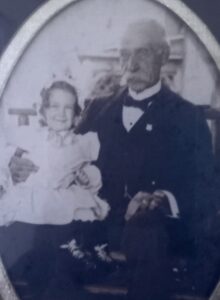 Great great grandfather Noble Rogers and my grandmother Norma
The novel’s protagonist is Dr. Henry Riddle—a rather on-the-nose moniker, I admit—and the story follows him as he attempts to solve the murder of a young newlywed. The book sold well and was reissued several times in paperback format. Anthony Boucher, in a 1945 review for the San Francisco Chronicle, praised the novel, stating that it “should appear with fair regularity on all future reading lists of the whodunit.”
One of the unique aspects of The Red Right Hand mirrors many of today’s bestselling suspense and mystery novels. Like those modern works, Rogers utilizes an unreliable narrator and a type of stream-of-conscious narration that was rather revolutionary in his day.
The Red Right Hand was reprinted in 2020 as part of Penzler Publishers’ American Mystery Classics series, with this edition earning a starred review from Publishers Weekly. The review praised the novel’s “virtuoso mix of terror and fair play” and claimed that it “deserves its reputation as one of the best mysteries of all time.”
 (From left to right) Joel T. Rogers, his sister Ethel, and their first cousin Norma
So how does all of this tie into my own family? More closely than I imagined, in actual fact. At first, I assumed that Joel Townsley Rogers would turn out to be a distant cousin, but in reality he was my paternal grandmother’s first cousin. (I think that makes him my first cousin twice removed.)
This fascinated me, since I didn’t know that there had been a published author—in the mystery field, no less—in my family tree.His grandfather, Noble Harvey Rogers, was also the grandfather of Norma, my grandmother. Norma’s mother, Rosella Rogers, was the sister of Joel Townsley Rogers’s father, Otis Joel Rogers, and thus was Joel’s aunt. So Norma and Joel were first cousins through her mother’s family—a closer connection than I had ever imagined.
This fascinated me, since I didn’t know that there had been a published author—in the mystery field, no less—in my family tree. Interestingly, I also discovered that Joel Townsley Roger’s son, Tom, who writes as T.N.R. Rogers, has also published short stories and a 1988 short story collection titled Too Far From Home.
It seems the writing gene, or “bug,” anyway, came down to me through my grandmother, who is the family member I just happen to resemble the most. (Actually, based on an old photograph, I look just like her mother, Rosella. When he first saw the photo, my husband thought it was me in costume for a theatre production!)
Now that I’ve discovered my connection to Joel Townsley Rogers, I plan to read more of his works, and I hope you will also be inspired to at least check out his critically acclaimed novel, The Red Right Hand.
***