Writing obsession, for me, was about magnifying small things. I believe we all have tiny obsessive tendencies, and I also believe that the world we live in today sanctions them. We exist in an age of instant gratification: next-day delivery; bingeing series late into the night; live updates on those people we’re keeping tabs on. We use—as I mention in the book—the verb “to stalk” in a jovial, non-offensive manner when referring to our casual deep-dives into various profiles online.
In an increasingly algorithmic-leaning society—one in which our more questionable beliefs are often normalized by the echo chamber—is it really any wonder that a low-level thrum of obsession has become prevalent in today’s world?
When I started my research into obsession, and particularly obsessive love, I discovered that unhealthy fixations are often a product of low self-esteem and insecurity. It got me thinking about how these are, inadvertently, the buzzwords of our society. We all follow accounts that create unrealistic expectations and redefine what it means to be “happy.” The accounts that pedal the narrative that if we work just that little bit harder, if we shape and tone and sculpt ourselves, we too can be just like those glossy, airbrushed people we follow.
Comparison is no longer something illicit; it’s actively encouraged: “What I Eat in a Day” videos; “Spend a Day With Me” videos; “How to Get Abs Like Mine” videos. Theodore Roosevelt said that “comparison is the thief of joy” and I think that is correct, but comparison is also the architect of insecurity. And, conversely, insecurity breeds low self-esteem, the basis for obsession. Scarier still, this is not something that is slowing down. Why would it, when it’s the lifeblood for every social media giant out there?
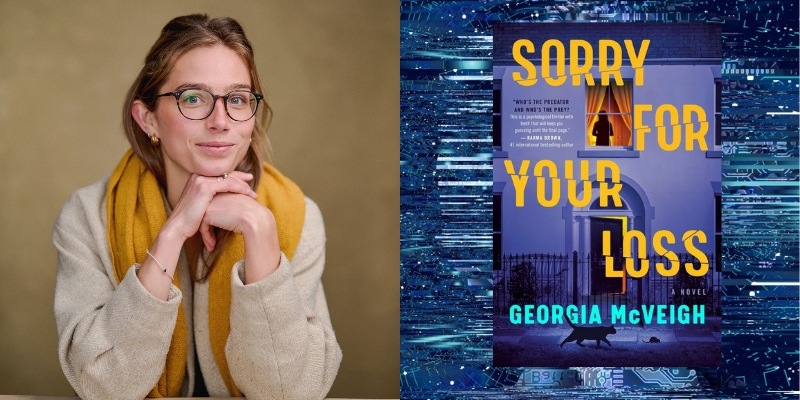
And so, when I sat down to write an obsessive character, this is where I started. As someone deeply insecure in who she is underneath the veneer she portrays, Iris compares herself constantly to those around her and adapts accordingly. She uses social media to mould herself into the person she believes the object of her obsession wants.
She finds it hard to know where the line is, because the line for all of us has become so blurred. For her, following someone home is a tiny escalation on following someone on social media.
At risk of making myself sound slightly too like my protagonist than I feel entirely comfortable with, I found placing myself into the shoes of someone who can magnify a seemingly insignificant encounter into something that might change the course of her life relatively easy. I think we’ve all had moments where we’ve amplified happenstance or read too much into a coincidental connection that later turns out to be nothing at all.
For most of us, this is when we’d let it drop, but for Iris, it was about continuing to push on those fragile instances, to magnify their significance and project the version of reality she wanted onto a scenario.
We see it all the time on social media. Seemingly rational people who become swept up in the excitement a new celebrity post. Look at the comments underneath: declarations of love towards someone who has never heard their name, and most likely never will, all because we have been granted an unprecedented level of access to that person’s life. And because this phenomenon is so new—because it’s constantly evolving—we don’t yet know how to manage these parasocial relationships.
Then there are the darker stories—the ones that appear not on social media posts, but on mainstream news outlets. The man who plotted to kidnap Holly Willoughby from her house as she slept, the man who stalked Lily Allen for seven years, Harry Styles receiving over 8,000 cards and letters to his home in a month.
People are more visible now then they have ever been. We are given access to previously unreachable public figures. We form relationships with these people through a screen, bolstered by the sense that they are letting us into their worlds, giving us a glimpse of their lives behind the glossy magazine spreads and heavily tempered interviews.
For a society that has been taught to always strive for more, to look for something better, to be stuck in a perpetual cycle of dissatisfaction with what we already have, is it really any wonder that some people struggle to determine where the boundaries lie?
And on a day-to-day level, haven’t we all spent longer than is probably healthy comparing ourselves to an ex’s new girlfriend on Facebook or Instagram? Haven’t we all—at some point—checked the online status of a crush’s WhatsApp? Haven’t we all felt that nauseating sense of rejection that comes from two blue ticks and no response?
This is insecurity masked as normality. And if insecurity breeds obsession, then perhaps we’re all more at risk of it than we previously thought.
***