
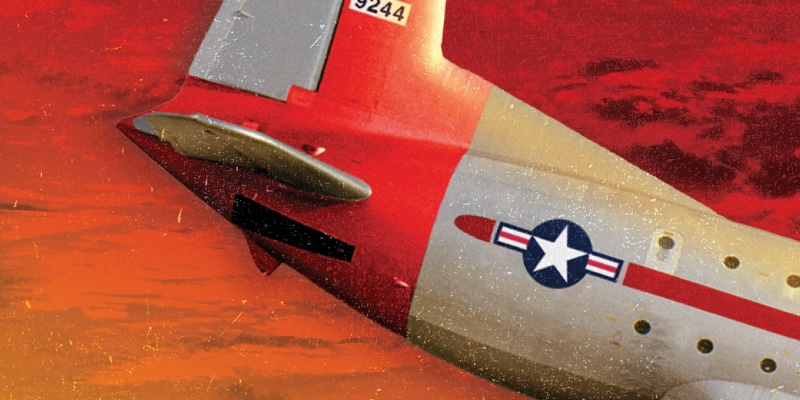
On March 23, 1951, the U.S. Air Force suffered the worst air disaster in its short history. A C-124 Globemaster cargo plane, tail number 49-244, carrying fifty-three passengers and crew, was crossing the Atlantic en route to Mildenhall Royal Air Force Base, north of London, when it disappeared. As far as the American public was concerned, it was just a routine flight. The disaster was easily dismissed by authorities as perhaps the result of bad weather or maybe an equipment failure. After all, Americans had been steeped in the news of one disaster after another in World War II. Military planes go down. Men die. The U.S. Air Force was perfectly happy to cultivate that storyline and ensure it was repeated so often that newspaper editors grew tired of it and moved on to more important events of the day: spy scandals, the war in Korea, the Red Scare, and the constant churn of American domestic politics. After about a week of front-page attention, the story of Globemaster 49-244 steadily drifted onto the inside pages, then into the briefs, followed by no coverage at all.
There were, however, a few details that kept the story alive before it fell into a historical black hole. For one thing, there was a brigadier general on board, Paul T. Cullen, who had garnered heavy attention in World War II for a series of dangerous reconnaissance flights that provided crucial photographic mapping details of enemy emplacements. One of those flights took place when Cullen was based in the Soviet Union with the rare permission of Soviet dictator Joseph Stalin. Cullen became the first American military pilot to take off from a Russian base and land in Ukraine. His mission was to demonstrate to Stalin the value of America’s most modern aerial photographic reconnaissance technology. Cullen’s photo, in his crisp officer’s uniform, accompanied many, if not most, of the early stories about the disappearance of 49-244.
Another key bit of news was that the plane had inexplicably veered almost 300 miles off course before ditching in the Atlantic. For two days, newspaper coverage focused on a single report from a B-29 search plane that survivors on one or more life rafts had been spotted amid a field of wreckage. (Actually, multiple reports came in of survivors, but those reports were kept confidential.)
There were flares and SOS signals. But when U.S. and British ships arrived at the ditching site, they found nothing more than several small pieces of charred, splintered wood pieces, a canvas satchel full of documents, and a Collier’s magazine belonging to Captain Lawrence Rafferty, who had been one of the passengers on board. The search, probably the largest in U.S. naval history at the time, turned up no evidence of survivors. No bodies floated to the surface. Not even life vests. Aside from Rafferty’s satchel, it was hard to identify anything in the wreckage that spoke to passengers and crew having been aboard the Globemaster. They had simply vanished.
The Air Force maintained a tight hold on information about the passengers’ and crew’s backgrounds. Only the basic information—names, ranks, hometowns—were released to the news media. The Air Force did allow the release of information about three officers onboard who were described as traveling to England on routine temporary duty from their base at the headquarters of the Strategic Air Command. As far as the public was concerned, that was the only connection to the SAC. The rest were just on an assortment of transfers and short-duty assignments. There was nothing out of the ordinary in this picture.
What the Air Force didn’t tell the public was this: All fifty-three aboard were attached to the Strategic Air Command on a classified mission related to General Curtis LeMay’s effort to install an atomic attack force in Britain in preparation for imminent war against the Soviet Union. The Globemaster carried two supposedly empty KB-29 aerial-refueling tanks along with assorted cargo items that, on the plane’s manifest, were listed as weighing roughly the same as a “Fat Man” atomic bomb.
These were the kinds of details the Air Force probably had good reason to withhold from the public, for fear of creating a panic. Nothing speaks of global catastrophe like the threat of an atomic deployment against Russia, which was the only other atomic superpower in the world at the time. The Soviets were known to have amassed an estimated 1.5 million troops near the eastern edge of Europe, and fears were running high among European leaders that a military sweep across the continent could happen at any moment. America’s atomic weaponry was viewed by many leaders as Europe’s bulwark against a Soviet onslaught.
Perhaps the biggest fear in President Harry Truman’s administration was that any leakage of the true mission of Globemaster 49-244 would provoke a backlash in Britain, the extremely nervous host of U.S. training missions in preparation for retaliatory strikes should the Soviets invade. Britain had not yet formally agreed to host an American atomic bomb, nor had its leaders prepared the public for any such eventuality.
General Cullen was on the Globemaster flight because he had just been appointed to command the first-ever foreign SAC base, to be headquartered at Mildenhall. Also aboard was Lieutenant Colonel James I. Hopkins, one of the Air Force’s top atomic-certified pilots and the only pilot to have participated in a wartime atomic bombing. He had been the operations officer for the atomic missions against Japan and flew on the mission to drop the Fat Man on Nagasaki, which effectively brought World War II to a close.
For the seventy-five years following the ditching of 49-244 and disappearance of all on board, the Air Force kept tight control over key details about the mission. Some items, particularly those contained in a 42,500-page investigative file still under U.S. Air Force wraps from the early Cold War era, remain classified to this day. What could be so sensitive that it justified keeping a seventy-five-year-old secret from the American people? The full story of Globemaster 49-244 cannot be told unless and until that information is released.
Over the years, in the absence of information, all sorts of conspiracy theories have developed about the flight. What was the background of the key decision-makers and their motivations? Why did America’s military commanders believe that war with Russia was imminent? How did spies and sabotage play a potential role? What did the Atlantic search reveal at the time? And why was it so important that an entire atomic attack force, headed by a brigadier general, needed to accompany a cargo listed as two KB-29 tanks across the ocean?
My research seeks to clarify circumstances by laying out what is known from the historical record hidden in thousands of pages of archival records provided by the Library of Congress Manuscript Reading Room and the Department of the Air Force Historical Research Agency, among hundreds of other sources.
My research required reducing thousands of pages of research material into a readable, engaging format, which necessarily entails reducing highly complex decisions and military operations into a few phrases or sentences. Those decisions were hardly that simple. Leaders had to weigh a wide variety of factors before making any move. No one should be fooled into thinking, for example, that Curtis LeMay was the only decision-maker regarding the movement of atomic weaponry, or that he merely had to snap his fingers to make a deployment happen. My book makes an an effort to describe the complexities of his life and the various pressures bearing down on him. The other major figures faced their own pressures, doubts, and fears. The Globemaster’s disappearance itself might have been misconstrued over time because of all the evidence, presented here and elsewhere, pointing to something nefarious.
It remains entirely possible that the plane experienced a catastrophic series of communication and mechanical failures that caused it to go down all on its own, without the intervention of some external force. That is unlikely, but possible.
Once the historical context comes into focus, substantial evidence—albeit circumstantial in many cases—comes into better focus, helping explain why investigators into the ditching spent inordinate amounts of time looking into possible sabotage as the cause of the plane’s disappearance. The historical context also explains the armed confrontations that led U.S. commanders to conclude, ten years before the Cuban Missile Crisis, that this was no longer a cold war but rather a hot one that deserved a forceful American response. The world was on the verge of a nuclear war, and Curtis LeMay, among others, privately pushed to make it happen. The Soviets were overtly shooting down American military planes over international territory. They were disguising their pilots as Koreans and painting MiG jet fighters with North Korean flags in order to engage U.S. planes in combat. Soviet naval vessels, as we will find, were believed by the Pentagon to have been stationed in the very area where Globemaster 49-244 went down.
Then comes the question of the cargo onboard the plane. The Truman administration, at the highest levels, had approved the transfer of atomic components for preplacement in Britain with the objective of using them immediately upon the start of hostilities should Russia invade Europe. LeMay, among others, was arguing that it made no sense to wait for the start of hostilities, and that striking a preemptive first blow might be necessary to send a clear message to Russia about American military supremacy.
Stalin, of course, had his own messages that he wanted the Americans to receive. He wanted them to know his spies could infiltrate the most top-secret U.S. and British missions with ease. His forces were capable of sophisticated forms of sabotage. He was not above capturing American military men for interrogation and imprisonment. Foremost, Stalin’s message was that there was no such thing as American military supremacy.
Finally, there is the question of how a crucial mission like that of Globemaster 49-244’s final flight could have been infiltrated and sabotaged, if indeed that’s what caused the diversion and ditching. This book will examine in detail one of the most bizarre aspects of the Globemaster story: that Brigadier General Paul T. Cullen was married to two women at the same time and might have compromised the very atomic mission he was chosen to command.
These are the elements behind the unsolved, untold mystery of Globemaster 49-244.
###
From GLOBEMASTER DOWN by Tod Robberson
Reprinted with permission from Kensington Books. Copyright 2026