I first got on Gloria and Sergio’s trail shortly after returning from Africa, where I’d been searching for a Philadelphia file clerk who had disappeared from his job only to pop up, months later, deep in the jungle as one of the leaders of a rebel band fighting to overthrow Congo’s dictator.
“The Clerk Who Would Be King” was one of the strangest stories I’d ever covered and among the toughest to report. I had to track this guy from an apartment in North Philadelphia halfway around the planet and into a part of Africa known as the “Heart of Darkness.” I finally located him and got him to tell me his bizarre tale. The second he was done I thanked him, snapped my notebook shut, and headed for the first flight outta there before the country erupted into war again. When I got home and began catching up with the rest of the world, a message was waiting for me from my former college girlfriend, now a reporter in Mexico:
You see Trevi out there? Sort of kidding. Sort of not.
I called her right away. “Is that still going on?” I asked. “Huge,” she replied. “Interpol has a worldwide arrest warrant out for them: Detain on Sight.” I heard keys tapping on the other end of the line, and then she said, “Check your email.”
I opened it up, and there they were: Gloria and Sergio, staring out from a police advisory. It seemed impossible, like turning on the TV and seeing Jay-Z and Beyonce featured as fugitives on America’s Most Wanted. I was stunned to discover that the story was not only alive but wilder than ever. It had escalated into a vanishing act so bizarre that a seasoned Latin America correspondent was asking, at least half seriously, if I’d picked up on any Gloria Trevi sightings in the African outback.
After we got off the phone, I reached out to an El Paso detective I’d met on assignment years ago and he brought me up to speed on the search along the border. “Forget the criminal case,” he said. “Why isn’t there more urgency to find out if they’re even alive? You know how a lot of these cults turn out – in a pile of bodies. It’s crazy that for months it wasn’t even a priority to check on the safety of those girls. They’ve been gone so long now, we don’t know where to start looking.”
That was all I needed to hear. I called an editor I knew at The New York Times Magazine and made my pitch: If I could run to earth a missing file clerk in Congo, how hard could finding an attention-hungry celebrity be? The police were hampered by all kinds of jurisdictional restrictions, I argued, but none of that applied to me. I could go anywhere and follow any lead without waiting for anyone’s permission. It wouldn’t be easy, but if I started right away, I could be in position when the net began to close around them.
One hour later, I was part of the hunt.
***
“Gangster sperm!” the lawyer repeated.
“I’m aware of the story,” the warden said drily, as he pivoted his gaze toward me. “And the source.”
That wasn’t exactly true. Yes, I’d broken the gangster-sperm story for The New York Times. But technically, the source was a confidential police file I’d been given by a contact in Brazil. My scoop spread like crazy, making headlines around the world and forcing Brazilian law enforcement into the humiliating position of grimly repeating “We can neither confirm nor deny.” They couldn’t deny the story, of course, because one key fact was impossible to hide and growing bigger by the day:
Gloria was pregnant.
Call it a mystery, call it a miracle, but somehow the Mexican Madonna had lived up to her nickname by conceiving a baby behind bars despite being locked for months inside the all-female wing of a maximum security prison.
Gloria refused to reveal the father. Her lawyers implied she’d been raped. Prison guards were swiftly lined up for questioning, but after interrogations and lie detector tests, all of them reportedly were cleared of suspicion. Secretly, investigators were now pursuing a new angle-and that’s what made my story so explosive. Gloria, they surmised, had artificially inseminated herself with semen smuggled to her from another prisoner, using a homemade syringe fashioned from a ball-point pen.
“See? That’s what they’re saying about Brazil on the front page of the most important newspaper in the world,” the lawyer said.
“That’s what he is saying.” The warden tried to fix me with an icy glare, but the dark circles of exhaustion under his eyes just made him look sad. “And that is why I can’t allow him access to interview Miss Trevi.”
“No,” the lawyer said. “That’s exactly why you should.” Once again, the warden and I were united in shared confusion. How exactly does letting a writer for The New York Times into your prison result in fewer articles for The New York Times about your prison? But I knew by now that if anyone was capable of pulling this off, it was attorney Geraldo Magela. I was amazed he’d gotten us this far. I was amazed he was even trying. After all, he wasn’t my lawyer.
He was Gloria’s.
Geraldo had a reputation as a legal wizard, a guy with a knack for conjuring magical exits from impossible predicaments—or at least, that’s what he told me when I first called him late one Sunday on his personal cell in Rio de Janeiro. “How’d you get this number?” he demanded.
I debated how to answer. I wasn’t going to lie and he wouldn’t like the truth. The fact is, I knew that on Sunday nights the Associated Press offices in foreign countries are staffed by rookies. There’s almost never any breaking news on weekends but a million soccer league scores to upload, so new hires always get that grunt-work shift. I waited till about 10 p.m. one Sunday, then called the Rio bureau and told the guy who answered that I was from AP Lisbon (not with, so technically true), and needed the personal number for Gloria Trevi’s lead attorney, stat. I figured the rookie reporter would be so overworked and frazzled, he’d rather make a senior correspondent happy than ask anyone if he was allowed to.
Minutes later, the entire Gloria file popped up in my inbox.
I didn’t know how much of this to tell Geraldo, but before I could open my mouth, he cut me off. “You know what? Good for you,” he said. “You have your methods, I have mine. Let’s leave it at that.”
Geraldo was chatty and charming, and more than happy to share anything about himself but nothing about his imprisoned pop star client. I pushed my credentials – I’m fluent in Spanish and Portuguese after years as a war correspondent for the Associated Press and I write for a magazine with a huge international audience – but Geraldo was a steel fortress.
“We’re hoping Brazil will set her free instead of sending her to Mexico in chains,” he explained. “So until that is resolved, she’s not saying a word.”
I thought that was the end of the road. But soon after I published my story about the Gangster Sperm investigation, Geraldo called me out of the blue. It was nearly ten at night, and I wouldn’t have picked up if I hadn’t recognized the Rio de Janeiro area code on my cell phone.
“Gloria’s life is in danger,” Geraldo blurted.
Brazilian law enforcement was so scandalized by the rumors surrounding her pregnancy, he claimed, that they’d do anything to make the whole thing disappear. As a safeguard against any “accidents,” Geraldo decided it was time to get her story out in the open. I could have the exclusive, but I had to get to Brazil right away. Gloria was due to give birth soon, and she’d just been transferred to a secure hospital ward. No Brazilian prison would ever let a reporter inside its walls, but maybe the hospital would.
“This is our only chance,” Geraldo urged.
Buuuuutttt … there was a hitch. The prison hospital was deep inland in the hard-to-reach city of Brasilia, and in five days, the whole country would shut down for a full week during the massive street festivals of Carnaval. By the time government offices reopened, Gloria might already have delivered her baby and been returned to prison, or—as Geraldo put it– “been eliminated as a problem.”
As soon as I hung up with Geraldo, I started dialing. It was Monday night. Carnaval would begin on Friday. That gave me two days, max, to plane, train, and automobile all 4,230 miles to Brasilia from our farm in Peach Bottom, Pennsylvania. Booking a flight would be rough, I knew, since they’d all be crammed with partiers heading to Rio. This was going to be a nail-biter.
After trying every airline that services Brazil, the best I could manage was standby on a flight leaving at 7 p.m. the next evening out of New York. The sooner I got to the airport the higher I’d be on the waiting list, so I hastily packed a bag, left a message for my editor at The New York Times, and set off before dawn on the thirty-mile drive to catch the first train to Manhattan. By 1 p.m., I had made it to JFK airport and hunkered down for six hours of suspense.
Just after five o’clock, I heard my name called. I leaped to my feet and hurried to the United desk.
“Hmmm,” the agent said, flipping through my passport. “You’ve got a lot of stamps in here. I’m having trouble finding your visa.”
“That’s okay,” I replied. “I’ll get one in the airport when I arrive.”
She stopped searching the pages and looked up at me. “You know it doesn’t work that way, right?”
“No, I’m sure it does.” I was about to list the places where I’d gotten visas on arrival—Angola, Kenya, El Salvador, Mozambique, Burundi, Congo, Uganda—but a sickening realization dawned on me before I opened my mouth. I’d traveled to all those countries on reporting assignments when they were in the midst of extreme upheaval or outright war. In fact, I don’t think I’d traveled anywhere in the past seven or eight years that wasn’t either visa-free or under fire.
“Besides,” the agent continued, “you don’t have room left in your passport. The pages are all full.”
I continued pleading my case—I need this for work! I’ll go straight to the embassy in Rio for a new passport! And a visa! —but the agent kept waving forward the people behind me and issuing them the last available seats. “We can put you back on standby for tomorrow night’s flight,” she offered. “But first you have to sort out your visa and passport.”
I left the airport and taxied to a friend’s apartment in Manhattan. I had a make-or-break decision and decided on a gamble. There was no way I’d ever navigate the jam-packed New York City passport office for fresh pages in time to reach the Brazilian consulate before it closed at noon, so my only hope was to persuade them to squeeze the visa onto the corner of a page that was nearly full. The next morning, I was outside the consulate at 7 a.m., two hours before opening. Already, a line of Carnaval travelers was stretching down the block. When I finally reached the window, I had my argument rehearsed and ready. They needed to give me a visa, even if it meant overlapping on a couple of other passport stamps, because I wasn’t just some tourist: I was a credentialed journalist covering a breaking story.
“Oh, well, that’s different,” the consulate staffer agreed. “In that case, you’ll need a temporary work visa, which requires a letter from your employer to our Department of State. And besides,” he added, “you don’t have enough space in your passport. We need a completely blank page.”
10:27 a.m. I bolted out of the consulate and taxied across town to the Manhattan passport office, the largest and busiest in the country. When I entered, the waiting room looked like a giant gymnasium after a natural disaster, with throngs of dispirited people huddled on seats and long lines that never seemed to move. No way I’d even reach a window before closing.
I took a deep breath and walked all the way across the room, ignoring the hundreds of eyes watching me pass. “Excuse me,” I said to the guy at the front of a line I’d chosen at random. I handed my passport through to the clerk. “Gabe said to add new pages to this one.”
“Gabe?”
“Yeah, that’s what he said. Extra pages. Right away.”
The clerk flipped through my passport. “Who’d you say? Gabe?”
“That’s right.”
“Let me check.”
I leaned an elbow on the counter, acting like I nine-to-fived there every day, wondering what the penalty was for Fabricating a Fake Federal Officer Named Gabe. Criminal charges? Passport confiscation? Or just a get-your-lyin’-ass-outta-here? Five minutes later, I had my answer.
“Here you go,” the clerk said, handing back my newly thickened passport. Gabe, wherever and whoever he was, had just done me a massive favor. I ran out to the street, flagged a cab, and sped back to the Brazilian consulate. Thirty-seven minutes to go. The lines were still crazy long, but I couldn’t even attempt to cut this time because there were only two clerks and one of them now knew I was a journalist. No Gabe could help me now. I got to the end of the second line and inched along, angling my body away from the clerk who could out me.
At 11:57, I was the last to reach the window. The clerk skimmed my paperwork. “Tourist?” he asked.
“Yes, sir.” I half whispered, afraid the other clerk might recognize my voice.
“Can I see your airline ticket?”
“I’m standby.”
“So you have no proof of your return flight?”
“Well … “ I thought desperately. “Not proof proof, but you can see from my passport that I travel a lot. For pleasure! I’m not trying to relocate anywhere. Just Carnaval and then it’s right back home.”
He glanced at his watch. “You might have to—” He mumbled something I couldn’t catch, clearly done with all of us last-minute party planners cutting into his lunch hour so we could dance in Rio while he was stuck in an office. I took a seat next to a raucous gang of vacationers, trying to blend in and remain invisible. It didn’t matter because one by one, travelers were called to collect their passports and go, leaving me exposed.
Suddenly, a very large security guard materialized by my side. I hadn’t seen him approach because I’d kept my face toward the wall. “Mr. McDougall?” he said. I hesitated, won-dering whether the smart move was just to deny it and get out of there before I found myself calling a lawyer from a holding cell for lying on sworn travel documents. The security guard pointed toward the window, where the clerk was waving my passport.
“Bom viagem,” he called. “Enjoy your trip.”
Even though it was nearly 1 p.m. and I hadn’t eaten all day, I headed straight for the subway and returned to JFK to get back on the standby list. Six hours later, I was taking off for Brazil, never so happy in my life to be crammed into a middle seat in the back of a plane for a twelve-hour fight. I made it to Brasilia with twenty-four hours to spare, but despite every-thing it took to get there, I still had one dealbreaker demand:
“The interview has to be just me and Gloria,” I told Geraldo. “I can’t have you in the room massaging her answers. Even if you keep quiet, it’s just not acceptable to have you stage-managing the conversation.”
Surprisingly, Geraldo agreed. But he did have a condition of his own. “When we get to the hospital, don’t tell any-one you speak Portuguese,” he said. “The warden and I both speak English. Keep your ears open and your Portuguese to yourself.”
It was a weird request but an easy one to grant. Only later, when things got crazy, would I discover what Geraldo was up to.
***
“I can’t keep having these wild stories flying around about Miss Trevi,” the warden was telling us, pushing aside all the documents Geraldo had submitted on my behalf as a sign it was time for us to exit his office. “Maybe we can revisit this after the situation quiets down.”
“You’ll get slaughtered that way,” Geraldo retorted. “How do you put out a fire? Do you feed it one log at a time? Or do you dump on all the logs and let it blaze out for good? Remember what the Bible tells us: When the wood runs out, the fire dies.”
Geraldo turned to me. “Proverbs. You can look it up.”
To the warden he said, “One last article. We let The New York Times weigh in with one big story, then the wood is gone and the rumors die out.”
The warden wasn’t buying it. He and Geraldo were still arguing when three men in black uniforms with no insignia appeared in the door. One flipped open a federal government ID, then squared his hands on his hips, pushing back his jacket to reveal the pistol holstered on his waist. He barely glanced at me and Geraldo and instead focused all his bristling intensity on the warden.
“We need an extraction of amniotic fluid from Trevi,” the Man in Black said. “Don’t tell her what it’s for. Just get it and give it to us. We need verifiable DNA on the child before it’s born.”
“Ay ya!” Geraldo leaped to his feet again. “Ay ya! Absolutely not! That’s unconstitutional! It’s an invasion of her privacy.”
“You want an invasion?” the officer said. I don’t know if he thought Geraldo and I were hospital staff, but he couldn’t care less. “I’ve got a van full of men outside. We’ll take this place by force if we have to.”
Cell phones appeared all around. Geraldo had several Supreme Court justices on his speed dial. The warden, shaken, called the health minister who oversaw the prison medical unit. I couldn’t hear who the Man in Black was talking to because he kept his hand cupped around his mouth.
“Ha!” Geraldo yelled. He handed his phone to the Man in Black. He listened for a moment, grunted a reply, then slapped the phone back into Geraldo’s hand and led his two partners out.
The court had granted a stay.
“Oh! Deus! Meu!” Geraldo moaned. “Oh. My. God!”
The warden quietly finished his own call, then hung up and slumped back in his chair. He raised both hands in a gesture of surrender. “Okay,” he told Geraldo in Portuguese. “We don’t need any more scenes while this reporter is around. Go on in, and let’s get this over with.”
To me, the warden gave a weary smile. He switched back to English. “Enjoy your visit,” he said. “Miss Trevi is very—”
He paused, reflecting. “You’ll see.”
___________________________________
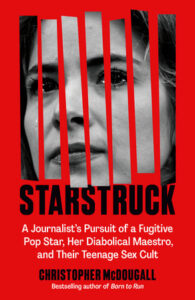
Excerpted from Starstruck: A Journalist’s Pursuit of a Fugitive Pop Star, Her Diabolical Maestro, and Their Teenage Sex Cult, by Christopher McDougall. Copyright, 2026, Christopher McDougall. Published by Vintage. Reprinted with permission. All rights reserved.