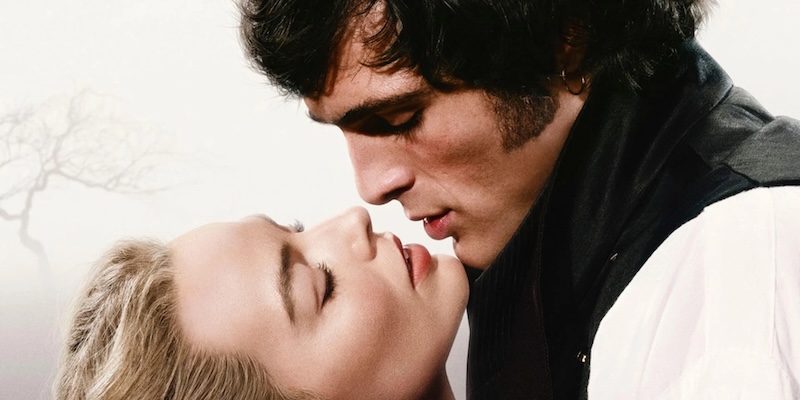
Emerald Fennell’s new film, Wuthering Heights opens with sounds of moaning and heavy breathing, which are revealed to be emanating from a man being executed by hanging, rather than in the throes of sexual ecstasy. His post-mortem erection causes an outpouring of emotion, including sexual arousal, in the rambunctious crowd. Among the audience witnessing the bizarre spectacle is the young version of the heroine of the film, Catherine Earnshaw.
As Fennell explained in an interview: “it was important to acknowledge early on that arousal and danger are kind of the same thing, and it was important that the first thing we see is Cathy, this young girl, seemingly frightened but then actually delighted. It tells us so much about who she is, but so much about Brontë, too…”
Notably, this scene is not in Emily Brontë’s 1847 novel, but it is uniquely Fennell, and also ensures the film falls squarely into the genre of Gothic Romance. The Oxford-educated Fennell is additionally making an allusion to another novel of Gothic Romance, Daphne du Maurier’s My Cousin Rachel, which opens with the narrator looking back on a moment as a seven-year-old when he witnessed a man who had just been hung. “See what a moment of passion can bring upon a fellow,” his guardian tells him.
The disturbing juxtaposition of sex and death lies at the core of Gothic Romance, and, indeed, Victorian society, as well as our own. In her article “Sex and Death in Wuthering Heights,” Maria Kosikinen observes that both sex and death were perceived as threats to rational Victorian attitudes and thus both were highly regulated and ritualized. Fennell makes her audience as complicit as the onlookers in the perverse opening scene, revealing and shocking our own 2026 sensibilities as well.
Arguably, the most important aspect of Gothic Romance, and the Gothic more broadly, explains its lasting appeal, which can be summed up by the great (Gothic) writer, William Faulker: “The past isn’t dead. It isn’t even past.”
The term Gothic as it applies to literature was first used as a largely pejorative descriptor in the late eighteenth century, with the publication of Horace Walpole’s Castle of Otranto in 1765, followed by Ann Radcliffe’s Mysteries of Udolpho (1794), and Matthew Lewis’ The Monk (1796).
The Gothic is famously hard to define, but similar to Supreme Court Justice Potter Stewart’s famous assertion about what constitutes obscenity, we often know it when we see it. Characteristics include an environment of fear, wild, isolated settings with old, ruined castles or crypts, and, relatedly, the intrusion of history/the past on the present in either explicit (through ghosts and the supernatural, family curses) or psychological ways (evidenced in heightened emotions, acts of revenge and murder, or non-literal “haunting.”)
Of course, proto-Gothic literary elements predate eighteenth-century texts, with similar themes prominent in Shakespeare’s tragedies such as Hamlet and Macbeth, as well a much older tradition of myths and fairy tales.
Gothic romance, a subgenre, is described by gender historian Michelle Massé in her article, “Gothic Repetition: Husbands, horrors, and Things that Go Bump in The Night” as the following: “a terror-inflected variant of Richardsonian courtship narrative in which an unprotected young woman in an isolated setting uncovers a sinister secret.” Gothic Romance is often associated with the image of a young woman in a negligée fleeing a sinister-looking mansion, variations of which graced the covers of paperbacks from the early-60s to the mid-70s when popular writers such as Mary Stewart, Victoria Holt, and Virginia Coffman ushered in a new wave of Gothic Romance novels.
The reissuing of older and publication of new Gothic romance titles were financed by Ace editor, Jerry Gross, according to Grady Hendrix’s nonfiction book, Paperbacks from Hell. The peak period of these books, from 1960-1974 not only coincided with Angela Carter’s 1973 proclamation that we were living in “Gothic times,” but there are many parallels between that time and the United States today, including political unrest and divisiveness, debate over international intervention, suspicion about new technologies, existential threats from disease and weapons of mass destruction, and clashes over women’s rights.
Gothic Romance was appealing then as it is now for a variety of similar reasons. Victorian society wished to repress what it feared most, sexuality and death, leading to a paradoxical situation whereby public repression led to private obsession, as Freud argues in his writings on the uncanny, or the return of the repressed. The figure of the vampire is the embodiment of the return of the repressed, the late nineteenth-century fixation on desire and death personified. In addition to vampires, ghosts and other supernatural figures were similarly not at rest, wishing to communicate messages to the living.
Similar to the women portrayed on the covers of paperbacks, in a typical Gothic Romance, an innocent young heroine is seduced and unknowingly drawn toward something menacing, another form of love and death being pulled together, like the striking Death and The Maiden image evoked in the final frame of the 2024 film, Nosferatu. During the course of a typical Gothic Romance story, the young heroine is put through trials and tribulations, whether at the hands of an individual man or a family.
The setting in these stories is often a derelict castle or other lavish edifice that harbors ancestral sins and underground passageways, its labyrinthine architecture a metaphor for its twisted inhabitants (See Poe’s “The Fall of the House of Usher”). In some versions, the heroine’s romantic interest is also her hidden antagonist; in others, a victim of greater, structural forces himself.
Such stories may be considered stand-ins for larger themes of the domestic and societal horrors of being a woman—physical and emotional vulnerability to abuse within her family, her marriage, or patriarchal society in general. Sometimes, the horror is more psychological, preying on the woman’s entrapment within her own body and mind, as in Charlotte Perkins Gilman’s 1892 short story, “The Yellow Wallpaper.”
Gothic Romance as a genre and trope remains alive and well, with a growing impact across different media. The past eleven years have seen a proliferation of Gothic romances. Recent publishing phenomena include Mexican Gothic, the sublime third novel by Silvia Moreno-Garcia, and Trang Tranh Tran’s She is a Haunting (2023), which both explore typical Gothic Romance themes through a post-colonial lens.
Other hugely successful recent titles are Danielle Trussoni’s The Ancestor (2020), as well as Sarah Perry’s Melmoth (2018) and The Essex Serpent (2016). In February 2026 Orenda Books published historical novelist Essie Fox’s Catherine, a feminist retelling of Wuthering Heights, from Cathy’s perspective eighteen years after her death, narrated poignantly by Catherine herself exhumed from the grave.
Gothic Romance is having a moment in high fashion, too, and Margot Robbie’s method acting Wuthering Heights “tour drobe,” a concept she pioneered with Barbie, represents just the beginning. Jenna Ortega graced the 2026 Golden-Globe red-carpet in latter-day Gothic designer Dilara Findikoglu’s black fringed velvet high-necked lace dress, of which her character Wednesday Addams on Netflix’s hit Addams-Family-spinoff would have approved.
Phantom of The Opera, Andrew Lloyd Webber’s 1986 musical drenched in Gothic Romance (based on Gaston Leroux’s 1909 novel), retired from Broadway in 2023 but revived on London’s West End in 2021, has been reincarnated in New York as Masquerade, billed as “an immersive production of the world’s most haunting love story.” Said immersive experience has a strict dress code of formal attire and has been wildly popular.
Speaking of music, Gothic Romance has recently infiltrated the pop music world, in arguably the biggest resurgence since Kate Bush’s Wuthering Heights came out in 1978. Charli XCX’s romantic and dark soundtrack to Fennell’s film feels appropriately haunting, and takes its place among other extremely popular gothic romance artists of the moment: Florence Welch, Lady Gaga. The accompanying music video to Last Dinner Party’s 2023 hit Nothing Matters seems to be in direct conversation with Fennell’s previous Gothic-Romance laden film, Saltburn.
But Gothic Romance is showing up nowhere more prominently than in the film world. The past ten years have witnessed an explosion of gothic romances on the screen. The Dracula/Nosferatu story was adapted in 2024 as Robert Eggers’ Nosferatu and later this year, French blockbuster director Luc Besson’s Dracula: A Love Story, will premiere in theaters. Guillermo Del Toro’s 2015 Crimson Peak represents the apex of the Gothic Romance trend, with last year’s Frankenstein leaning heavily into the territory as well.
Gothic Romance really made it to primetime a few weeks ago, in Emerald Fennell’s heavily discussed adaptation of “Wuthering Heights,” based on one of the major texts of the Gothic, and Gothic Romance in particular.
Examining Wuthering Heights, alongside the two Del Toro films, Frankenstein and Crimson Peak, these three films are peak Gothic Romance (pun intended.) All three films, set in fantasy Victorian times rather than historically accurate ones (which may well be Fennell and Del Toro’s winks toward Gothic excess), center around stories replete with dualities, passionate emotions, love triangles, revenge, and murder.
Another less frequently discussed element which evokes the Gothic and ties the three films together is the impact of family—and more specifically, intergenerational trauma. In Crimson Peak, it is not the ghosts but rather a set of abusive parents, pictured in enormous portraits on the walls of the dilapidated family mansion, that caused the incestuous Sharpe siblings’ dysfunctional relationship with each other and the outside world, as Del Toro recounts in an interview about the making of the film.
In the same interview, he argues that the key to gothic romance in Henry James “Turn of The Screw” is “the clash of the future and the past and the ghosts represent the past.” He further states that gothic romance, to which he has always been drawn, is “birthed out of a melancholic gaze towards the past.” The film’s titular crimson clay appears onscreen to be blood bleeding from the past into the present, similar to the ghosts of Thomas’ Sharpe’s murdered wives.
In Frankenstein, the scientist Victor’s father neglects and negates him, leading him to inflict the same abuse and repudiate his own monstrous creation. And in “Wuthering Heights,” Fennell merges two characters into one: Cathy’s brother Hindley with her father, to create a portrait of an aging narcissist, gambler, and alcoholic (played to brilliant effect by Martin Clunes.)
These three films keenly understand one of the core underpinnings of the genre, trauma—a key way in which the past impacts the present is abuse which gets passed down. This is perhaps particularly appealing to our modern sensibilities, because according to many psychology studies, parental neglect and verbal and/or physical abuse trickles down, and leads to dysfunctional relationships in adult life, whether domestic abuse on one end of the spectrum, across to avoidant dating culture and situationships.
It is therefore perhaps ironic that readers and women are once again turning to fictional Gothic romances and even dark romance, with its emphasis on taboo and transgression, to the past, for yearning and love they feel is missing today. The wild success of the Fifty Shades of Grey and now Colleen Hoover franchises show the popularity of Dark Romance.
In part it is Cathy’s question to Heathcliff on her deathbed that explains the enduring appeal of this kind of love story. “Will you forget me?” and his response, “Do you reflect that all those words will be branded in my memory, and eating deeper eternally after you have left me….you know that I could as soon forget you as my existence….” He continues with his famous line: “Haunt me then!”
Del Toro’s Frankenstein contains a love triangle, too, with the Gothic heroine, Elizabeth, who falls for the Frankenstein creature. As she is dying, she whispers to him (also played by Jacob Elordi): “Love is brief; I am glad I found it with you,” recalling Cathy and Heathcliff’s mutual obsession and destruction.
This sense of a unique love beyond time and space is particularly appealing in an era of endless options, when, as a New Yorker piece from July 2025 notes, “casual sex can be arranged as efficiently as a burrito delivery from DoorDash.” Indeed, Romance novels in all their forms have once again become popular and notably less stigmatized, with themed bookshops devoted to the genre cropping up all over the US, including The Ripped Bodice in Brooklyn and LA, Cupid’s Books in Philadelphia, and the brand-new Partners in Crime in Chicago, a Romance and mystery themed store.
The longing for longing has inspired a proliferation think-pieces by Millennials and Gen Z-ers, among them Jean Garnett’s very excellent and very viral July 2025 New York times article, “The Trouble With Wanting Men,” which notably popularized the terms “hetero-pessimism” and “hetero-fatalism.” “Lately, I have been bruised by the ambivalence of men, how they can first want me and then become confused about what they want,” Garnett writes. And later, “There must be something wrong with the way I desire.” A former lover tells her, “Maybe the problem is that you’re a romantic.”
Say what you will about his character, but the only “ghosting” one can imagine Brontë’s Heathcliff doing is the literal kind, which perhaps explains his lasting appeal, even if the Byronic hero is still being blamed for today’s dating woes. In Olivia Petter’s excellent Vogue article from January, “My Love for Wuthering Heights Is Why I Also Love Terrible Men,” she blames Heathcliff, whom she deems “literature’s original fuckboy,” for inspiring her frustrating pursuit of toxic men: “The bar is absurdly low…men will get a round of applause for texting us back or booking a restaurant. Where are the ones who’ll cry for us on the moors and dig up our graves? They might not be healthy, but at least they’re interesting.”
If this reminds one of Jane Austen’s Northanger Abbey’s poking fun of the (mostly) women readers gleaning romantic ideas and getting into trouble for reading (mostly gothic romance) novels, then so be it. Yes, even in Jane Austen’s time, clichés of gothic romances were at once being satirized and at the same time blamed for contributing to societal ills.
Fennell’s Wuthering Heights, like the lauded 1939 adaptation, does not feature the second half of the novel, which deals with the aftermath of Cathy and Heathcliff’s toxic love-story. It therefore delves more into the romance, rather than the Gothic aspects of the plot and the repercussions of the first on subsequent generations. Why only adapting the first half of Emily Brontë’s novel was permissible in 1939 but not now is anyone’s guess.
Even without her own interpretation of the complex second half of Brontë’s original text, Fennell has left quite a bit of Gothic romance in here, and also clearly done her homework—there is plenty of intertextuality in the movie to delight film nerds and English Literature connoisseurs alike. As noted, the first scene quotes the opening sequence of Du Maurier’s My Cousin Rachel, the author’s less well-known but equally Gothic romance-saturated novel than Rebecca.
And before anyone rushes to argue that there is negligible romance in Brontë’s original “dark tale darkly told,” the word Gothic here is an important modifier. Iconic Gothic Romances of the silver-screen include the 1944 film Gaslight, from which the modern psychological terminology takes its inspiration.
Indeed, one of the most important Ur-texts of Gothic Romance is actually not a classic Hollywood film or even an eighteenth-century novel, but rather a dark folktale. The Bluebeard myth was first recorded in Charles Perrault’s 1697 collection Contes du temps passé but refers to a much older traditional story.
In Bluebeard, a young woman marries a wealthy, older nobleman and moves away to his castle in the countryside. After their wedding, he announces that he needs to leave on urgent business, and leaves the castle keys with his new wife, saying she is welcome to open any room, except for one that he forbids her from entering. When he is gone, she eventually is overcome with curiosity and enters the forbidden room, which is filled with the bloody corpses of Bluebeard’s previous wives. Bluebeard returns and finds the bloody key, but before he can murder her she is rescued by her own family.
Similar iterations of the Bluebeard myth are found across cultures, including Fitcher’s Bird, one of Grimm’s fairy tales. It is also related to another folktale that is a similar metaphor for domestic unpredictability, Beauty And The Beast, which contains similar warnings but a happier outcome.
Bluebeard is a source-text for two of the most famous gothic romances, Jane Eyre and Rebecca.
Angela Carter herself reworked the Bluebeard myth in her story, The Bloody Chamber, and the noble husband in her tale is merged with yet another Gothic writer, the Marquis de Sade.
Fennell places additional Easter Eggs throughout her film that reference some of her other influences. In special programming for the BFI, she made a list of love stories that “challenged and subverted the conventions of the genre…show[ing] love in all its freaky, gory detail.”
Among the films listed? Controversial French auteur Catherine Breillat’s own take on Bluebeard, along with another film ironically titled Romance.
In Brontë’s book, the innocent Isabella, Cathy’s young sister-in-law, marries Heathcliff, despite Cathy’s warnings about his dark nature. In a letter written right after her wedding, she explains her predicament to housekeeper and Wuthering Heights narrator Nelly Dean, inquiring whether Heathcliff is a madman or a devil. Isabella, marrying Heathcliff, becomes a Gothic heroine, swept up by love of a man into a web of deceit and trauma.
While Bluebeard cautioned women to beware of who they married, the “demon-lover” was a common trope in early modern English and Scottish traditional ballads, and similarly warned women to heed whom they gave their hearts to. This trope was notably reprised later by American Gothic Writer Shirley Jackson in stories including the titular “Demon Lover” and “The Tooth.”
In Brontë’s Wuthering Heights, Isabella flees Heathcliff’s abuse and reestablishes herself and her son in a new home. In Fennell’s film, Isabella takes a different sort of agency. Rather than shrinking into a mere willing if unwitting victim of Heathcliff’s abuse, Isabella (a coloratura Allison Oliver) engages in consensual BDSM pet play during a visit by Nelly Dean in one of the movie’s more controversial scenes.
Love or hate it, any film that revives public discourse, notably among young people, around a Victorian novel written by a woman two hundred years ago can be seen as a win, especially in a time when Humanities and English departments are at all-time low enrollment.This is a refreshing take on a disturbing episode in the book, where Heathcliff proudly boasts about hanging Isabella’s dog. Is animal abuse really what book traditionalists would’ve preferred to see on screen? Most likely it would’ve taken away any sympathy whatsoever for Heathcliff’s character in 2026.
Both Isabella and Cathy, two different types of Gothic heroine are thwarted in the book, in keeping with women’s struggles at the time: women at the time were persecuted and had little power of their own until rescued by a man. Instead, in Fennell’s film, both Isabella and Cathy are recast as powerful characters with agency, boldly in charge of their sexuality.
Love or hate it, any film that revives public discourse, notably among young people, around a Victorian novel written by a woman two hundred years ago can be seen as a win, especially in a time when Humanities and English departments are at all-time low enrollment.
In Gothic fiction, repressed things from the past return to haunt us. In today’s world, amidst new technologies including AI, and a far-reaching digital record, the secrets in our individual and collective pasts have never been more ephemeral, and, paradoxically, more immortal. What could be more Gothic than that?
***