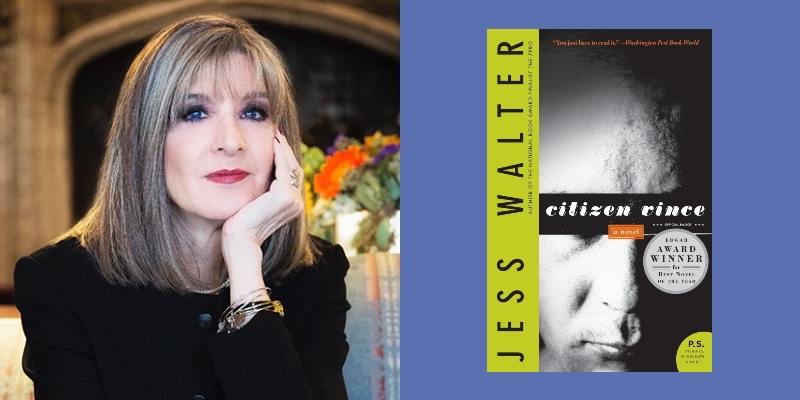
Before I reach out to an author about an interview, I entertain myself by trying to predict what novel—or at least what subgenre—they might pick to talk about. I tend to assume that an author of gritty police procedurals will gravitate toward something in the same vein, while a writer with a splashy thriller on the bestseller list will suggest a similar title. I find myself continuing this habit even though I’m usually wrong, and even though the pairing of writer and beloved backlist novel almost always takes me by surprise. This is one of the delights of talking to people about their favorite books, and it’s never been more true than when I sat down with Hank Phillippi Ryan, author of All This Could Be Yours, The House Guest, and many others, to talk about Jess Walter’s genre-bending 2005 Edgar winner for Best Mystery, Citizen Vince.
I knew it would be a great conversation, because Ryan is such an adept interviewer herself. She’s had a remarkable career as an investigative journalist (winning 37 Emmys) and is the USA Today-bestselling author of sixteen psychological thrillers that have won just about every award in the business, as well as an instructor for the International Thriller Writers’ Online Thriller School.
Why did you choose Citizen Vince by Jess Walter?
Several years ago, I was asked to review it as part of an assessment of winners of the Edgar Awards. As soon as I read the opening page, I realized that I’d never read a book like this, and I was torn between trying to turn the pages as fast as I possibly could and slow down to the slowest pace imaginable. I didn’t want to miss a word or a thought or a metaphor or an allusion, and I definitely didn’t want to miss the layers and layers of emotion and deeper meaning. It’s an iceberg of a novel, where what’s on the surface is only the tiniest bit of what’s underneath, and I felt a responsibility to read it slowly enough to so that I could see all this buried subtext and the deep emotion at its core.
I always tell my classes that a standalone novel—like this one—should focus on the most important thing that ever happened to this character. The novel is presenting a slice of their life, and the reader needs no more and no less than this to understand who they are. In this case, Jess Walter has excised this turning-point moment in the main character’s life and offered it to us so it can be a turning point in our lives as well. It’s hilarious and it makes you cry at the same time, and it’s an absolute tour de force of character and plot and writing and emotion.
It’s hard for me to describe how good this novel is, and I want to be really careful about that, because we’re all effusive about so many books. “Oh, it’s brilliant, oh it’s wonderful, oh it’s fabulous, I couldn’t put it down!” There’s this affection inflation where the praise has to get bigger and bigger and bigger, and I want to make it clear that I mean it when I say that this is just a flat-out terrific book in every way. It is unforgettable, it is instructive, it’s thought-provoking, and now, twenty years out from publication, it seems prescient in the way it predicts our political moment. It’s just as fresh and just as relevant right now as it was in 2005, and that’s quite astonishing.
It’s difficult to talk about the main character of this novel without giving spoilers, but we do know from the beginning that Vince is somewhat of a shady character: he sells marijuana, engages in low-level credit card fraud with the help of a friendly mailman, and makes his legitimate income working as a baker at a doughnut shop. At the same time, his voice is irresistibly appealing. Do you have any thoughts on how Walter does that?
I wish I knew, because isn’t that the Holy Grail for all of us: to have a character who is multi-layered and so likeable, even though he’s not entirely a good guy. The opening pages are instantly sad, instantly thoughtful, instantly funny. There’s instant attitude, when we see Vince pop his cuffs, and you can feel his physicality. He has a worldview from the very beginning. It’s a master class in point of view, where we’re seeing the world through Vince’s experience even though we don’t even know what that experience is. We’re joining in with something in the middle, and we don’t mind the uncertainty, because Jess Walter is such a good writer that we trust that we will know what we need to know at the time we need to know it. We can just relax and let the joy of the book wash over us. I call it writing with confident hands. You know immediately that Walter knows what he’s doing, and he’s so confident that he could break every single rule that you would ever teach any student of writing and the reader wouldn’t care.
As likeable as Vince is, we never lose sight of the fact that he’s a tough guy. He’s a criminal, but he also has a vulnerability about him, a searching quality. He’s been given an opportunity to have a second chance, and he’s contemplating what that means, and that presents the reader with the question, “Can someone really change?” This is a novel about the search for truth, whether you’re searching for the right candidate to vote for or the meaning of life. What is the reason for one person’s existence on this planet? That’s the biggest question you could possibly imagine, and yet, because Vince is thinking about it in such a personal way—in such a heartbreaking, vulnerable way—our lives are changed as his life is changed. A reader will never look at the world the same way again after having read this book. And isn’t that what books are for, to make us think and change our lives?
The novel is set in 1980, just before the election in which Ronald Reagan defeated Jimmy Carter. What were your thoughts on how that historical context informed the story?
I remember that election. I was working as a television reporter in Georgia, where Jimmy Carter was from, so I was very aware of that debate, and the hostage situation at the time, just as Vince is in the novel. Vince has decided that he’s going to vote in this election for the first time in his life, and he’s not going to make decisions willy-nilly. He’s decided that this one vote in this election is going to be pivotal, and it’s going to matter, and then he will matter. This vote will mean that he exists.
It is so heartbreaking, because we all take voting for granted, and some people even complain about it. For Vince, it’s totally new and unfamiliar, and yet he’s going to persevere. The book asks us to reflect on how the role of the president evolves because of how the public changes, and again, it seems so prescient in the context of 2025. It’s a master class not only in craft, but also in the larger questions of what human beings need and what they hope for.
As you said, Vince becomes increasingly interested in the political process, befriending a candidate for local office and trying to educate himself to make an informed choice at the ballot box. A lot of reviews from the time of publication used words like “hopeful” and “redemptive” to describe Vince’s engagement with the democratic process—words that are certainly difficult to reconcile with our current political environment. Do you think the book reads differently in 2025 than it would have in 2005?
That’s a good question. In a way, this book has come true, which is a funny thing to say about crime fiction. It’s come true in the same way that Stephen King’s The Stand has come true. Does that make it less redemptive or less inspirational? I don’t think so. We all live in our own moment, and sometimes that moment feels like it’s going to last forever. But public sentiment ebbs and flows and changes. One of the things that makes this novel so powerful is that it shows us what’s happening at a particular moment in time, but it also gives us a sense of the flow of history, and there’s no escaping that we’re all in it together.
I read your piece about the novel on Criminal Element, where you wrote, “Is this a mystery? The Edgar for Best Novel is usually a mystery, that’s the point, of course, but if this is or this isn’t, I don’t care.” Can you say more about what you meant?
This novel isn’t a whodunnit. There’s no mystery as such, except that backstory and motives are revealed as the story progresses. But the crime, some of it quite gruesome and graphic, is all on the page, and we understand it. We know who the bad guy is and who the good guy is. We see the themes of revenge and retribution. There is a detective who comes in later in the story, and he’s a terrific character, but we already know more than he does. I have a difficult time fitting it into the mystery category, but again, I don’t care, because this is a book about human beings deciding whether to be good or bad, and whether they can change from one to the other. And what you see over the course of the story is that some people can and some people can’t.
I wasn’t familiar with this novel before you mentioned it, and I’ve always thought of Jess Walter as a writer of literary fiction. This novel was published by Regan Books—not an imprint known for crime fiction—and the edition I read is very arty, with ornamental designs on the chapter openers. Do you think readers react differently to a crime novel published in this way?
I think it straddles genres. It’s like Fear and Loathing on the Campaign Trail meets Dashiell Hammett. It’s a philosophical political novel about a criminal, and I think any reader will appreciate its quality, even if it’s not what they usually read. When I reread it for our discussion, I still laughed out loud at the same places as if I’d never read them before. I was still touched by certain passages, and I was still blown away by the spareness of the writing. There’s a timelessness to being completely immersed in a character’s mind, and there’s a timelessness to our search for understanding about our place in the world. This novel happens to be set in the world of criminals and gangsters, but it’s just as revealing as any book could possibly be. The reader senses that things can’t end well, but Walter keeps us rooting for Vince every step of the way, even as our own hearts are being broken.
In the same piece from Criminal Element, you also wrote, “in the pantheon of main characters…Vince Camden sits up there with Bosch and Reacher and Millhone and Holmes.” I can’t think of a better compliment for a crime writer, but it’s interesting that all the characters you mentioned occur in detective series. Since the novel came out in 2005, it’s safe to say that Walter probably isn’t planning a sequel, but do you think Vince could have been a series character?
No, I don’t think so. This is the moment in Vince’s life when he makes his life-changing decision, and he was not the same person before the book, and he will not be the same person after the book. A series is different stories about the adventures of a central character, and we love the character so much that we want to go on more adventures with them, but we know they’re not going to die at the end of the book. We know that they’ll solve some problem and then go on to solve another problem. That’s how I see a series. I think I am happy with being with Vince for this chunk of his life, and I am willing just to let him go. And I think that the sign of a perfectly realized story is that even though I love this book beyond description, I don’t need any more of it because just Walter has written exactly the right amount of Vince, and we’ll just leave it at that.
I should also mention the fact that we come full circle with the ending in a really beautiful way. We learn early in the novel that Vince is trying to impress a girl he likes by having a different book with him every time he sees her, but he doesn’t have time to read the whole book, so he only reads the beginning. And then he decides that it’s better to only read the beginnings of books, because a book can only end in one of two ways: one is artfully (which may feel contrived), and the other is realistically, with death or the acceptance of the human condition. Walter has telegraphed the entire book in that passage, and he’s also gesturing at the essence of noir. It cannot end well, and we don’t want to get there, but yet at the same time we can’t wait to get there.
Do you know Jess Walter in real life?
I only crossed paths with him once, and that was on Zoom. I put a note in the chat saying how much I loved Citizen Vince, and he wrote back that he had read the article that I had written about the book, and that was lovely. Maybe someday we’ll meet in person and I’ll get to tell him, again, what an admirer I am.
Is there anything else you learned from this novel that you might come back to in your own work?
One of the things that has become supremely important to me is conveying the emotional levels of my characters in a way where I’m revealing their decisions and encouraging you to wonder what they mean, and what in their experience fed those choices. Because it’s not only what’s on the surface that matters; it’s what it means to the character. It’s extremely difficult to convey the nuance of characterization on this level and keep the story moving ahead at the same time, and of course that’s critical for crime fiction. You don’t want to drown the reader in backstory, so they have to be fully formed on the page in the present moment. When that’s done well, you’re living the character’s life as them. That’s what I take from Citizen Vince, and that’s what I think about every day in my writing.
Vince’s experience in the voting booth is a good example of this. He’s realized that in his role as a citizen, he’s been granted a power, and he’s thinking about the responsibilities that go along with that. Vince is infinitely aware of the power of power, and he believes that if he puts down on paper what he thinks, that makes a difference. It means he exists. He may be a small-time criminal, but he’s such a good and thoughtful person at the same time, and that’s what makes us love him so much.