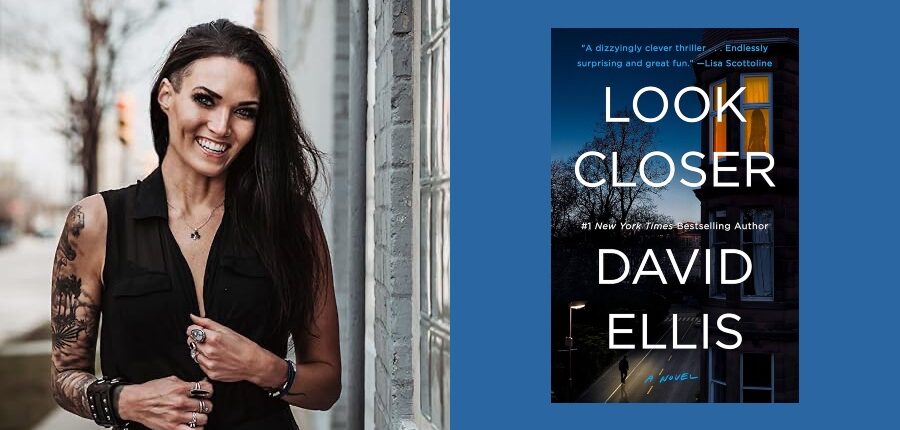
Anyone who’s ever been around a group of writers knows that we’d rather talk about craft than almost anything—more than gossip, more than movie deals, more than complaining about the publishing industry. That’s why, when the novelist Hannah Morrissey described hanging out with the novelist David Ellis drinking cocktails and talking about pacing and multiple points of view, it didn’t surprise me at all: I just wished I’d been at that party too.
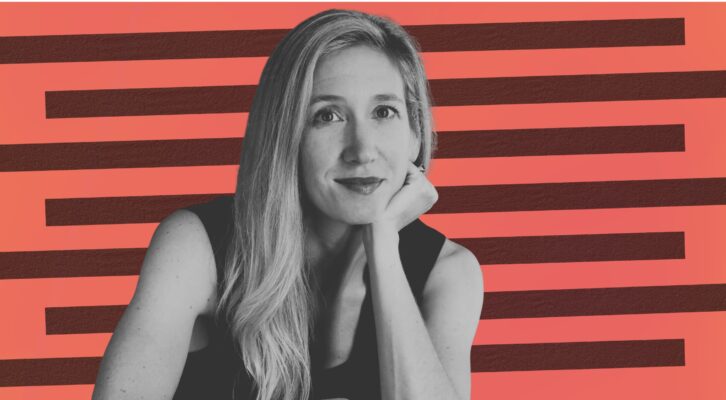
As soon as I read Hannah Morrissey’s work, I knew that she was a writer I would love to talk about craft with. Her Black Harbor series has all the things I most love in a mystery—great characters; a dark, moody setting; and an incisive, unsparing look at how crime affects the lives of women. In this interview, we sit down to talk about a very different but equally satisfying work: Ellis’s twisty psychological thriller, Look Closer.
Why did you choose Look Closer by David Ellis?
There are so many reasons. I absolutely love this book for so many reasons, but I think I chose it because it’s such a great example of the psychological thriller. Sometimes books get marketed in a certain way based on what the publisher wants them to be, and that’s always disappointing, but this is an example of a book that delivers on its expectations. If I’m going into reading a psychological thriller, I want it to be a total mindfuck. I want to look back and think What did I just read?
I read for enjoyment, but also, as a writer, I’m reading for craft and trying to figure out how they did what they did. When I was reading this novel, I was just so blown away and so impressed by how he put it together, especially the use of the unreliable narrator and multiple points of view.
In the New York Times, Sarah Weinman called the novel “wildly entertaining”—every writer’s dream quote! What makes it such a fun read?
I think it has a lot to do with the pacing, and that’s something that I always struggle with. Thrillers need to be pacey, but there’s also a mystery element, so you’re laying out these breadcrumbs, and trying to make sure that your reader can pick up on them but they’re also not too obvious. There are so many moving parts, so I’m always trying to make sure that the pacing is fast enough without sacrificing the story. I want to write a heart-racing, page-turning story but not at the expense of the characters. It’s hard to do, and I think that’s something David pulls off so well in Look Closer.
It sounds like you know David Ellis personally. Have you gotten a chance to talk with him about craft?
I do know him, and he’s become a really good friend. He doesn’t live that far from me, and we definitely talk about craft when we get together. He co-writes legal thrillers with James Patterson, and he told me that when they write together, there’s a hard limit of fifteen hundred words per chapter. That’s the max. David isn’t quite that rigid with his own books, but I think that’s why his books are such page-turners. He’s learned how to really keep things moving. We were having a conversation about this last year, and he said that he’ll end a conversation in the middle of a chapter if he needs to in order to make that goal.
Have you tried that in your own work?
Yes and no. My books are a little bit more atmospheric, I think, but once I’ve written the manuscript, I will go through and do a word count chapter by chapter, and if any of them come out to two thousand or twenty-three hundred or whatever, I start to think about splitting up or cutting down. It’s a good reminder to spend the time cleaning up your prose.
It’s a hard time to ask questions about this novel without giving spoilers, but the central plot revolves around Simon Dobias, a law professor in Chicago, and his wife Vicky. What do you think of these characters and how they’re revealed over the course of the novel?
I don’t know if I liked them, but I loved watching them. I loved Simon’s snarkiness. I know that David used to be a lawyer, and I love when authors put their own professional experiences and background into their characters. I felt like I was learning something about the law and the courtroom without it being heavy-handed. I also love their unreliability. The characters don’t trust each other, and as a reader, you know that you shouldn’t trust them either. One of my pet peeves is when an unreliable narrator lies to the reader, because I feel like that’s breaking a basic rule of how fiction works. But I think the unreliability is really effective here, because the characters aren’t lying to the reader; they’re lying to each other, and that’s totally fair. The title works so well in that regard. With any psychological thriller, we’re studying the clues so closely because we always want to figure out the mystery before it completely unfolds. We’re looking closer, but even then, I don’t think anybody could see where this story is going.
You mentioned that David Ellis was trained as a lawyer (he’s now a judge), and I know you worked as a police transcriber. How important do you think it is for a crime writer to actually have some like firsthand experience of law enforcement or the justice system?
I don’t think firsthand experience is necessary. It’s kind of a lot to ask, since novelists already have a job. But I do think it’s interesting when you come across someone like David who does have that experience. It’s integrated into how he sees the world, so it doesn’t feel like info-dumping. I learned so much about phone pinging from this novel! As a transcriber, I’d typed reports that mentioned phone pinging, but it’s different having it explained to you in layman’s terms.
I do think that if you don’t have firsthand experience, research is super-important. I don’t know how someone can go and pants a whole crime novel without talking to law enforcement or medical examiners. My greatest fear would be for a cop to read my book and be like, “Ah, we don’t do that.” And when I say research, I mean talking to real people. They’re so generous with their insights, and a lot of times it’s the mannerisms and the nuances that make things really sound authentic on the page.
You and I both write about small towns, but this novel is set in one of those enviable suburbs where, looking in from the outside, it’s easy to assume people live perfect lives. How did the setting contribute to the novel as a whole? Could you ever see yourself writing about people or places like this?
I don’t think I know those kinds of places well enough to write about them. If I tried to write about Chicago, I’m sure I would get so many things wrong. I will say that I was in the Bahamas recently, and I was like, “Damn, I should set a book in the Bahamas. Why am I always writing about these cold Midwestern places?”
The twists in this novel are definitely effective, but I’ve talked to some writers for this series who feel that psychological thrillers have become too reliant on more and crazier twists. Do you see that as a problem, or do you feel that the twistier a novel is, the better?
I’m totally fine with twists being over the top. With a psychological thriller, I know that things are probably going to get unhinged at some point, and that’s just the nature of the beast. But I wouldn’t describe this novel that way, because it’s so well-constructed. He’s planting clues all along the way.
This is also a book I love to reread, because there’s so much I can learn from David about pacing and timing. He’s ten steps ahead of you at all times, and he’s also keeping track of these multiple points of view and what each character knows and doesn’t know.
This novel reminded me of Alex Finlay’s work, and he told me once that he writes one character’s point of view all the way to the end and then does another point of view, etc. Do you know if David does that as well?
I’m not sure, but I know that Mary Kubica does that too. That sounds like a great, clean way to do it, but I don’t think my brain’s that organized. I’m not a big outliner. I’ll usually write three quarters of the first draft, and then I just start over. It’s a lot of work, but I like being surprised when things come up that I didn’t see coming. I love when things organically come together and it feels like one of those kismet moments. I think, “Oh, this was meant to be,” and then I know I’m on the right track.