As someone who taught high school Literature for thirteen years, I am not proud to admit that the research component of novel writing is not my favorite. I need that momentum, that pure excitement, to carry me through the forty-three-thousand-word slump, and I cannot think of another way to describe something as “frightening” or “dark.”
While much of Dark Sisters is rooted in personal experience—particularly Camilla’s timeline—I knew that in crafting a novel based in three distinct historical perspectives, research would be inevitable.
The single consistency during my teaching years, aside from at least one student per year calling me a bitch to my face, was teaching Arthur Miller’s The Crucible. To establish context for my students before reading, I would guide them through a series of primary sources, ranging from Jonathan Edwards, Henry Elson, and Cotton Mather to the actual court transcripts from the Salem witch trials.
I turned back to these texts while writing Anne’s timeline. Greeted them like old friends. Used them (plus a few influences from Nathaniel Hawthorne’s The Scarlet Letter) as a foundation for the realities a witchcraft accusation placed upon single women with land or money during that time.
Those primary documents also reminded me what often happened to women who used nature’s healing properties. They inevitably saw their own grace and empathy turned against them, and their self-sufficiency and independence vilified in the name of greed.
While I practice some components and have a longstanding fascination with witchcraft, I turned to several texts I’d skimmed in my baby witch days to deepen my understanding. Additionally, for Sharon’s character, I wanted an accurate representation of what a more modern witch may look like.
The reality of her practice rather than the stereotype of black magic and signing her name in the devil’s book. Instead, I wanted to explore the truer belief in energy, how it bends and shifts, and how one can use the natural flow of it in magical practice.
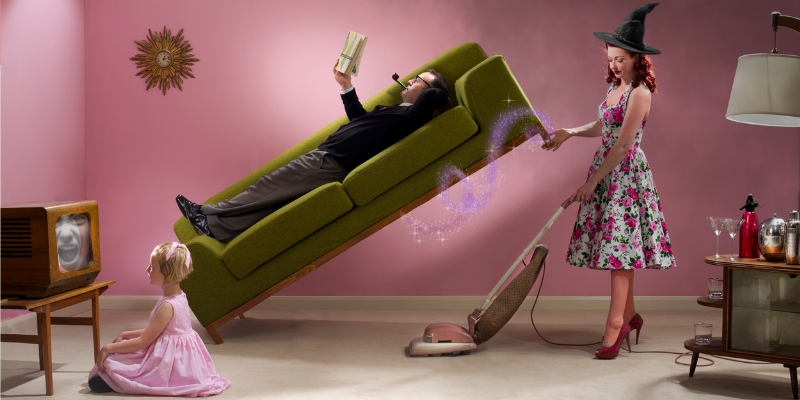
Both Mary and Camilla’s timelines carry echoes of Anne’s. Those old prejudices are so much the same despite wearing a different face. The role of the traditional housewife still takes center stage in the Dark Sisters’ 1950s timeline despite a burgeoning awareness of the need for equality and individual expression. Mary’s sections required the most research before I began writing because I wanted to be certain I was honest in exploring her experience.
It would have been easy to view her life, her feelings, through a singular lens. The drudgery, limitations, and abuse of the 1950s housewife have been exhaustively explored in culture and media.
It’s not to say all those things weren’t prevalent; they were, but in crafting Mary, I wanted her as fully realized and truthful as possible. Caught somewhere on the precipice of tradition, her religious upbringing, and the rising tide of feminism. A representation of a woman’s ambitions and desires caught in the iron grip of structures women longed to cast off.
In writing Dark Sisters then, I turned to several books to help create these three powerful women. They served not only as touchpoints but also as inspiration, and, let’s be honest, in the case of Shirley Jackson, pure entertainment.
*

Raymond Buckland, Buckland’s Complete Book of Witchcraft
Long considered to be among a seminal text for those interested in beginning practice, Buckland’s Complete Book of Witchcraft offers a comprehensive overview in Wicca and Witchcraft. This is an incredibly hands-on text: including illustrations, step-by-step instructions, and a thorough glossary, providing definitions of any potentially foreign terminology. It was the first book on witchcraft I purchased, and it sits on my shelf, well-worn and still frequently consulted.
Beginner friendly and incredibly usable, Buckland’s book also provides historical context while covering instruction in spell work, divination, herbalism, channeling, sabbats, and much more. It’s not without its 1980s gendered flaws, but Buckland’s book serves as a thorough guide for both the novice and the more practiced. The sort of text every witch should read at least once.

Christopher Penczak, The Inner Temple of Witchcraft: Magick, Meditation, and Psychic Development
While Penczak’s book also offers historical explorations on the philosophical and practical foundations of the craft, he brings it into the twenty-first century by aligning those ancient beliefs and practices to modern, scientific theories. It’s the sort of book for those who like their woo-woo mixed with more practical, scientific approaches.
What I find most valuable in The Inner Temple of Witchcraft, however, are the lessons within. With clear instructions, Penczak divides the remaining chapters into step-by-step guides regarding meditation techniques that run the spectrum from serenity, protection, and healing, to things such as energy work, visualization, and astral travel.
So much of magic derives from the energy generated in the self, and Penczak’s book is a powerful starting point to honing such skills in a noisy, chaotic world. I’ve turned to its teachings again and again as I struggle to maintain a meditation practice that is far too easy to ignore in favor of reality television.

Sheila Hardy, A 1950s Housewife: Marriage and Homemaking in the 1950s
Hardy’s book provides biographical insights into the day-to-day expectations and duties of a 1950s housewife. As told through firsthand accounts, Hardy provides an unflinching, honest perspective of the rigid systems held during the 1950s meant to ensure women fulfilled the role of traditional wife and homemaker.
There is much of this book that certainly casts a nostalgic lens over the idea of life in an “era gone by,” but it was useful for me to have a deeper understanding of the daily schedules of women such as Mary Shephard, and that while many women stayed home, there was a small contingency encouraged to work at jobs in offices, so long as they were deemed “feminine.”
While most of those women were single gals on the go, there were a few who found positions after receiving permission from their husbands. Jobs such as typists, the job Mary takes before meeting Sharon, was one such acceptable position.
This book served as inspiration for the first chapter featuring Mary, in which she hurls her second, freshly baked loaf of bread of the day into the woods.

Stephanie Coontz, A Strange Stirring: The Feminine Mystique and American Women at the Dawn of the 1960s
Following the publication of Betty Friedan’s polarizing book The Feminine Mystique, many women claimed it was the book that changed their lives. It upended the expectations they’d always lived under and showed them a path toward liberation.
Coontz takes those stories and evaluates them from a fresh perspective, examining how Friedan helped to usher in not only awareness, but a new generation of women determined to find and live in their power. She explores the idea that the dissatisfaction with their lives did not come only from themselves, but from a social and political climate that had never asked their permission or their opinion.
Sharon’s character in Dark Sisters was the embodiment of this growing awareness among women regarding such disparity and outright misogyny. Her insistence on living her life exactly as she pleased despite outward pressure embodies the ideologies explored not only in Friedan’s book but also Coontz’s.

Laurence Jackson Hyman (editor), Shirley Jackson, The Letters of Shirley Jackson
A collection of correspondence spanning three decades, Jackson’s letters are a brilliant, insightful glimpse not only into the working mind of one of America’s most brilliant and prolific writers, but also an examination of how she balanced the traditional elements of being a working housewife and mother while writing.
While not strictly traditional, Jackson’s marriage to Stanley Hyman and her children feature heavily throughout her letters. I turned to Jackson, not only because she is my self-declared, posthumous mentor but also because I wanted a full perspective on the pressures and fears she may have experienced as a woman of serious ambition in a decade that did not allow for it. How she might hold such vastly different desires in the same hand.
I wanted glimpses of that longing in Mary’s story in Dark Sisters, and Shirley, as always, was a delightful path to it.

Shirley Jackson, Life Among the Savages

Shirley Jackson, Raising Demons
I don’t mean to paint these two memoirs with the same brush, but they feel as if they belong together. Companion, complementary works that can be separated but perhaps shouldn’t.
Similarly to her collected letters, both books closely examine, through episodic tales, Jackson’s life raising her children. Told with a wry, tongue-in-cheek humor, these books served as another sort of informative reality for what it meant to be a wife and mother at the time. And the dichotomy presented is what held my fascination: the want to fit the role of good mother while also chasing darker dreams.
That split, those conflicting wants, is something I’m still personally fighting.
***