When I first started publishing books, my biggest challenge was the lack of agency in my female characters. Specifically, the lack of feminist agency. I clearly remember my editor’s words: The plot is happening to her. What is she doing to move it forward? As it turned out, nothing.
But as a millennial and a student of the early 2000s, surrounded by classic gothic literature and on a steady diet of Twilight, sexist chick flicks treating women as a problem to be fixed (She’s All That, anyone?), and a political and social landscape pinning blame on women, gothic heroines tended to blend into the landscape rather than change a single branch of it. Bella, anyone?
Writing contemporary gothic mystery and suspense—historical, no less—posed a unique challenge: how do I give agency to a class that historically never had it and who were portrayed as such in the classic gothic and even contemporary literature and pop culture?
In the words of Jane Austen, herself an author of a classic gothic novel: “It is a truth universally acknowledged, that a single [wo]man in possession of [her agency/life/whatever], must be in want of….” No, not a husband, but a business—one at the beating heart of the gothic mystery.
*
Tea Shops & Other Businesses
Once I began looking for it, many female heroines in many gothic novels own tea shops and other businesses.
Genevieve, in Judith Merkle Riley’s The Oracle Glass, is roped into a business reading futures through a water glass at the seventeenth century French Court. Agnes, in Laura Purcell’s The Shape of Darkness, owns a silhouette-making business in Victorian Bath. Ellie Winter, in The Other Side of Midnight, by Simone St. James, makes her living in 1920s London using her psychic gift to find lost items in her shop.
In The Crescent Moon Tearoom, by Stacy Sivinski, the Quigley sisters own a magical teashop in late 1800s Chicago. Madame Burova has a fortune-telling business out of a booth on the Brighton seafront, from the 1970s to the present, in Ruth Hogan’s The Moon, the Stars, and Madame Burova. And Red, in Laura Shepherd-Robinson’s The Square of Sevens, has a traveling fortune-telling business in Georgian England.
Owning her own business gives the heroine some agency, but connecting the business to the gothic mystery solidifies it. As my editor had wisely told me, agency can only exist if the character is moving the plot forward.
And for a female character, that is even more critical, especially in a feminist story. A business doesn’t just give the heroine independence and a living, it catapults her into the main plot of the story, rendering her—a woman with historically no power—an active participant with power. The above heroines, their businesses, their abilities, their very power, are connected in this way to the gothic mysteries at the core of those novels.
*
Séances & Spiritualist Practices
Likewise, inspired by the real nineteenth-century spiritualist movement, many female heroines make their business out of séances.
Vaudeline D’Allaire, in Sarah Penner’s The London Séance Society, is a spiritualist from Paris to Victorian London. Also in Victorian London, in B.R. Myers’ A Dreadful Splendor, Genevieve is a fake spiritualist who swindles wealthy mourners by holding séances; and Violet Wood, in Lucy Barker’s The Other Side of Mrs. Wood, is London’s premier medium who must outperform visiting American mediums’ fantastical visions. Two fraudulent sister spirit mediums come back to 1866 Paris for one last con in Carmella Lowkis’s Spitting Gold. And in Agatha Christie’s 1920s short story, “The Last Séance,” a Parisian medium, Simone, conducts one last séance.
Spiritualism was founded by two teenage American girls, the Fox sisters, who claimed to communicate with and summon spirits. Mediums were often women who not only made a living from their mediumship but held significant power over their clients with their claimed knowledge and ability.
Like heroines with tea shops, the medium heroines mentioned above, their mediumship power and spiritualist abilities, are directly connected to the gothic mysteries, giving them not only agency as women, but as primary participants in these stories.
*
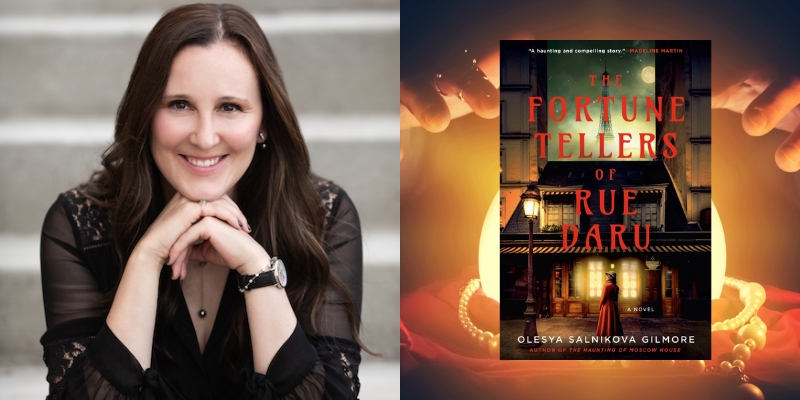
The Fortune Tellers of Rue Daru Has Both
When I started my newest gothic mystery, I wanted to write a multi-generational, feminist tale about a family of émigré fortune tellers living in Jazz Age Paris. Of course, they would be women, and they would have fortune-telling abilities. And in the case of my main character, Zina, also a hidden talent for holding séances. It made sense, given the post-World War I 1920s was filled with grief and a return to spiritualism. This was augmented for the Russian émigré community living in Paris at the time, given all the death they’d seen in the 1917 Revolution.
I found the existence of such women fortune-tellers in the Russian émigré communities in the real 1920s Paris. A fortune-telling business was good, as it would give my lady fortune tellers a way to support themselves and make a living, which is already pretty feminist for the time, but it would place the power and the agency with their clients.
If, however, my characters owned a shop, a tearoom, and this tearoom would not only serve tea, but allow them to tell fortunes, hold séances (for added power, given the novel’s time and place), and call the shots with their clients, rendering them self-reliant and independent, that would give them more agency. And if this tearoom, a setting for the practice of their powers and abilities, could also be where the gothic mystery unfolds, that would give them the feminist agency I envisioned for them in the story.
At beginning, the murder of Zina’s mother in the tearoom years before casts a pall over Zina and her grandmother, Valya. Even more so when an exiled Romanov princess and her brother seek Zina out to hold a séance to summon their dead father. To her surprise, she does so. But the spirit she summons is vengeful and starts to haunt her grandmother’s shop, all while knowing something sinister about her mother’s death. This is the beating heart of my gothic mystery.
Zina’s agency is to unearth the hidden past events and her family’s dark secrets that led to the mystery, and Valya’s agency is to banish the spirit with her magical and fortune telling abilities. But she is not a spiritualist. Her granddaughter is. And this isn’t just a mystery. It is a story about a grandmother who needs to let go of her granddaughter and join forces with her to beat the spirit and save the tearoom.
And it is about a girl who must grow into her power as a woman, fortune-teller, and medium. Only Zina and Valya can do this, and in a historical time and place that made it difficult for women to succeed, alone, as sole business owners, and as victims of a generational tragedy that threatens not only their livelihood, but their very lives. Still, they have to try. And they do.
And voila! Feminist agency.
***