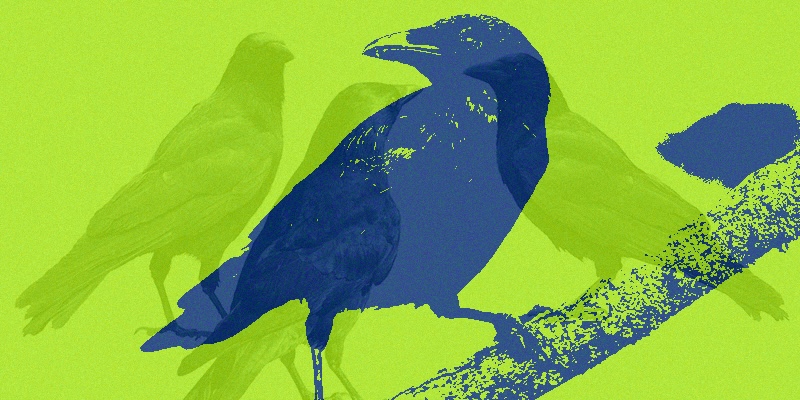
Corvids! They’re everywhere—stealing shiny objects, remembering their enemies’ faces, holding funerals for their dead, and stealing all the tourists’ fries on the Whole Foods patio at Sixth and Lamar (that last one’s a reference to Austin’s beloved trash birds, otherwise known as grackles. I have an enormous tattoo of one on my leg and I regret nothing).
Ravens, crows, and magpies are also all over fiction these days, and not the way we used to talk about them. I’m thinking of Robert Jordan in particular, who made all the ravens messengers of the bad guys and inspiring generations of clap-backs defending these fascinating, intelligent creatures. What is Game of Thrones, after all, but a pro-raven response to Jordan’s anti-corvid agenda? And if you look at the stormwings of Tamora Pierce’s world, they’re monstrous carrion eaters that feast on the battlefield’s many dead BECAUSE THEY HATE WAR, OKAY? They just want us to give peace a chance. By reminding us that they will happily consume our destroyed bodies before they even begin to rot…But I digress!
Today’s new wave of corvid-coded literature features plenty of badass birds, some working to save individual humans or even all of humanity, and others bent on vengeance against the humans who have mistreated their species for so long. I do not promise that these books are free from dead birds. There is, sadly, no website titled doesthecrowdie.com. That is the place of dogs and cats in our society, rarely birds. And certainly not these species of birds. But times are changing for nature’s weirdest, sneakiest little cacklers, at least in their fictional depictions, and I’m happy to present this list of books I have recently read that honor the members of the corvidae family as they deserve.
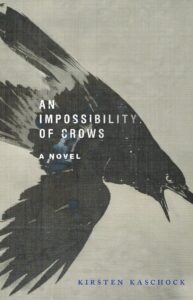
Kirsten Kaschock, An Impossibility of Crows
(University of Massachusetts Press)
A biologist returns to her ancestral home to breed a giant, talking crow, and if that premise wasn’t bonkers enough to hook you already, Kirsten Kaschok executes her bizarre vision impeccably (get it? im-peck-ably?). This book is literary horror at its grotesque best. I won’t spoil the plot, except to warn you: it will spoil your appetite.
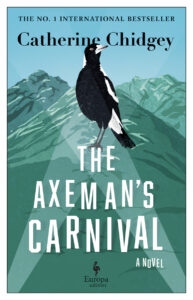
Catherine Chidgey, The Axeman’s Carnival
(Europa Editions)
Told from the perspective of a magpie (the Antipodean version, not technically a corvid but with lots of corvid-coded behavior), The Axeman’s Carnival eloquently narrates a bird’s eye view of humanity, hypocrisy, and ecological collapse. When Tama is found as a fledgling, fallen from the nest, farmer’s wife Marnie takes the tiny creature home and nurses him to adulthood, in the process turning the magpie into a social media star. As tensions between Marnie and her husband escalate, Tama becomes frantic to protect his human savior, even as he turns against humanity at large.
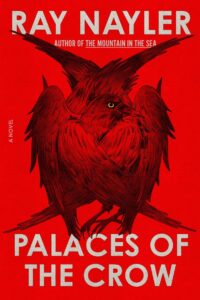
Ray Nayler, Palaces of the Crow
(MCD)
So, I never thought “crows in a Polish forest saving children from the Nazis” would be on my 2026 bingo, but here we are, and trust me: this book is exactly the anti-fascist narrative of mutual aid that you need this year. It’s beautiful. It’s haunting. It’s full of crows. What more could you want?
Quick warning: this book will make you sob. The ending is, as it should be, devastating. But it’s also hopeful, in a way I don’t usually find acceptable in WWII settings. Perhaps that’s because the idea of divorcing from humanity through mutual aid with forest creatures is so damn appealing, and so representative of the forms of caretaking we most need in the contemporary world.
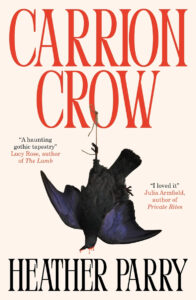
Heather Parry, Carrion Crow
(Pushkin Press)
What a truly disturbing tale! Heather Parry’s Carrion Crow is based on an infamous French case that you’ll recognize instantly if you, like me, are on Wikipedia late at night looking through the most messed-up crimes in history. At the start of the novel, Parry’s locked-in-the-attic heroine remains cheerful, despite her circumstances—she’s only up there to get a little paler, to lose a little weight, to make sure her morganatic marriage to a struggling solicitor has the highest chance possible of success. As she stays in the attic longer and longer, getting weaker and weaker, she begins to think her mother has lured her up the rickety stairs for a more nefarious purpose—one involving not rest and preparation, but captivity and abandonment. Check out Parry’s previous novel, Orpheus Builds a Girl, for more feminist body horror with a historical twist!
Also, if you were wondering why the book was on this list: crows serve as the Greek chorus witnessing the degradation of the main character, gazing into her attic prison from the roof above, showering her with attention and (I presume) occasional droppings.
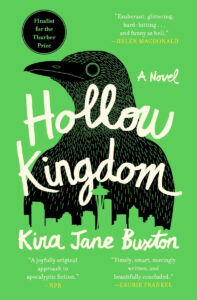
Kira Jane Buxton, Hollow Kingdom
(Grand Central)
A foul-mouthed domesticated Cheeto-loving crow tries to save all of humanity from a terrible apocalypse, in this first of a trilogy that has swiftly attained cult status. Hollow Kingdom walked so that all other books on this list could fly. I mean, the crow in Hollow Kingdom still flies. Probably quite directly, from point A to point B. I’ll see myself out.