
Middle class. To my grandparents, it meant a college degree paid for by the GI Bill, a mortgage payment of under a hundred dollars in the rapidly expanding suburbs, and a Buick Riviera parked in the driveway. Fast forward a generation, and my parents worked hard to achieve yuppie status: that Buick became a Saab and the mortgage grew five times higher. They put two kids put through college and went sailing on Lake Michigan for two weeks every summer. (My father even had a t-shirt—a gift, he swears, and never worn–that perfectly captured the unapologetic aspiration of the 1980s: Whoever has the most toys when he dies, wins.) And today? What do we want? An even higher mortgage, maybe a trip to Europe every few years? An SUV in the driveway?
A nice place to live, education, travel—these are good, wholesome things to wish for. Yet for authors penning thrillers, a comfortable middle-class life has long been the stuff of nightmares. What is it about that most fundamental American Dream that can, in the right hands, prove so terrifying?
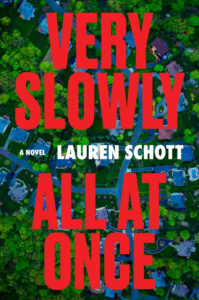
Knowing it’s out of your reach, for starters. Standing on the outside, our noses pressed against the window, watching fellow Americans enjoying the spoils of capitalism is a form of torture right up there with Annie Wilkes’ ‘hobbling’ Stephen King’s hero in Misery. In my debut thriller Very Slowly All at Once, Mack and Hailey Evans know this feeling well. They have a brand-new house in an exclusive neighborhood, white-collar jobs, and a membership to a fancy country club, but they also have a profound sense that this life is not quite theirs yet. Their working-class roots mean they can’t take anything for granted, and they’re both having serious troubles at work that threaten to knock them right back down the socioeconomic ladder. Their desperation to hold on to what they’ve only just managed to achieve was my jumping off point for the novel.
Ashley Elston’s heroine in First Lie Wins is an outsider too, a grifter since she was a teenager. Raised in a trailer, she and her mother daydreamed of a house of their own, but this protagonist’s life working for a nefarious employer is incompatible with her middle-class aspirations. She worries that she might just be too good at doing bad things to ever find a way to enjoy the fruits of her shady labor, and it’s the temptation of her latest mark’s charming home on a tree-lined street with manicured flower beds that Elston uses to increase the danger and up the stakes.
Then of course there’s perhaps the ultimate, tens-of-millions-of-copies example of that yearning for the good life you can see but not attain: The Girl on the Train. There it is, the quintessential (British, in the novel; American, in the film) middle-class home with all the trappings, laid out before our voyeuristic commuter who cannot have it but feels its absence so achingly. Her own flaws, perhaps, have put this lifestyle out of reach, but she can’t turn away, even and especially when things take a dark turn.
These novels expose that vulnerability that exists when we want something so badly and for so long, and the dangerous resentment that comes from being denied what we have been led to believe we should be able to attain. Add in the self-loathing that this failure is our own fault, and you’ve got a character that’s sure to find trouble, or cause some.
But what about the characters who do make it, the ones who are more comfortably ensconced in the middle-class dream? In many a thriller, these protagonists discover that it’s not all it’s cracked up to be. That in itself is terrifying–all that striving and you can’t even (safely) enjoy the rewards. Money and assets can’t keep fundamental human flaws at bay, and the task of keeping everything hidden from the Joneses makes it worse. Murderous neighbors, scandalous affairs, buried family secrets: these thrillers tap into our deepest fears about what lies beneath the surface of shiny middle class life, and how that life, once attained, can unravel in a single act—an altercation at a fundraiser for “the best” school, (Big Little Lies) or a fire—in fact a series of small fires—lit in a nice house in a fancy suburb (Little Fires Everywhere.)
There’s also the disappointment of finding yourself in the wrong kind of middle class, like Nick and Amy Dunne in Gone Girl. Their version of the American dream was living in the epicentre of New York media in the late 90s, and when they have to swap this out for a rented McMansion in a half-abandoned development outside of Nick’s Missouri hometown, someone else’s idea of the good life becomes their hell, and their behavior spirals accordingly. Who knew plush carpet and a driveway lined with red peonies could feel so sinister.
In Very Slowly All at Once, my financially strapped couple are newcomers to an upscale neighborhood that has its fair share of scandal, and quite early on in the novel the scales begin to fall from their eyes. Eventually they realise the house, the country club, and the private schools won’t fix their problems—in fact paying for all this will make things a lot worse–and that the place they’ve chosen to raise their young family in has a darker edge to it. I wanted the reader to feel their desperation and disillusionment, to use this as a springboard.
Some of my favourite thrillers offer yet another twist of the knife: yes, the characters can achieve their dream, and the spoils even seem like they might have lived up to the hype—if only it weren’t for a dark, sinister force that’s pulling the strings. Take John Grisham’s iconic 1991 thriller The Firm: Mitch McDeere has slogged his way through Harvard Law School and is then duly presented with a first-class ticket to the good life. The small firm of Bendini, Lambert, and Locke will give him a house, a BMW, and more money than he’s ever dreamed of. (In fact, this offer is almost an express train though the middle class, since they promise to make him a multi-millionaire by forty-five.) It’s such a good deal that no one ever leaves this firm… at least not alive. This shadowy organisation and the untouchable people behind it make the perfect monster, ready to gobble up all of Mitch’s hard-won dreams.
A literal monster works too. In Pet Sematary, King’s hero Louis Creed has finally found a way to impress his in-laws; he’s got a new job at the University of Maine and a new colonial with a sprawling lawn to go with it. But darkness lurks in the surrounding woods, and he’ll come to rue the day he didn’t run from the town of Ludlow at the first sign of trouble.
Even when the story doesn’t tip into horror, the relentlessness of the forces working against our dreams of comfort and prosperity can feel supernatural. In Very Slowly All at Once, my characters are offered a lifeline in the form of mysterious checks that arrive in the mail from a company they’ve never heard of. They need this money to keep on living the way they are, but this means that a faceless, unknowable entity has them at its mercy. No matter how hard they struggle, they can’t seem to escape the malevolence that has come out of nowhere to crush their dreams. No spoilers here, but it’s worth thinking about what it is that casts a similar feeling of desperation over our own lives in the real world. Is it the bankers behind our huge mortgages? Inflation? Capitalism? Or are we, and our relentless aspirations, the real monsters?
***