When I was in my twenties, I went on plenty of scary dates. Sometimes they were funny-scary. Other times, they were just scary. These dates, even if they didn’t pan out to be a love connection, always made for a good story. I’d recap my woes to my friends over drinks, like a poorer and less fashionable version of Samantha from Sex and the City. My friends would laugh at my misfortune, or on occasion, they’d grow quiet and say something along the lines of: “Kirsten, that sounds kind of bad.”
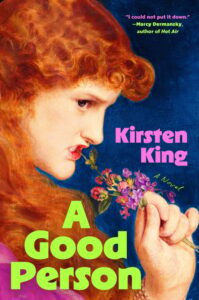
When you date a new person, you’re assuming some risk. You’re agreeing to meet a stranger, taking them at face value, and hoping that they don’t deceive you–though maybe you’re deceiving them a little, too. Maybe your photos have been edited a bit, or maybe you’re not as into classic films as you said you were. Almost everyone is an unreliable narrator in the dating world. It’s this unreliability that inspired my debut novel, A Good Person. I was fascinated by the ways we deceive each other in courtships: the fronts we put on and the lies we tell, either intentionally or unintentionally, all in the hope of finding love.
When plotting my novel, I found myself revisiting the bad dates from my past. One particularly bad date came to mind with a man we’ll call “Tim.” (Mostly because I can’t remember his real name. For all I know, it might actually be Tim.)
Tim and I met on a dating app. He was artistic, funny, and covered in tattoos. He looked like he would be the ‘bad boy’ guest star on an early aughts soap, which I guess was my type in men at the time. The day we were set to meet, Tim told me he was teaching his little sister how to play guitar. He sent me an audio file of her playing something to show her progress. I’m not a very musical person, but it sounded good to me. It felt like a green flag. He was family oriented. He was spending time with his sister.
When I got to the bar, Tim looked slightly different than he had in his photos. His hair was a big shaggier, his clothes unironed, and the ‘bad boy’ vibe from his dating profile just seemed sort of ‘bad’ in person. He was twitchy and anxious, and he fumbled with his credit card as he handed it to the bartender. Despite all this, I gave him the benefit of the doubt. Maybe he was nervous.
After about ten minutes of stilted conversation, I asked Tim how his sister’s guitar lessons were going. Tim furrowed his brow, confused. “I don’t have a sister.”
Had I confused Tim with someone else? Had I saved the wrong number in my phone? I excused myself to the bathroom to double-check our chat history and there it was: The audio file Tim had sent of his “sister” playing guitar, along with the details and timing for our date that night. Why would Tim lie about something like this? And who the hell was I on a date with?
When I got back to the table, I excused myself, citing a work emergency. Tim was immediately angry that I was cutting things short. He didn’t understand what kind of non-news media job required you to work that late on a Friday night. I didn’t either, so I mumbled a poor excuse and rushed out, blocking his number on my walk home.
Ultimately, I’m still not sure what happened with Tim. Maybe it was a miscommunication. Maybe it was a bold-faced lie. Maybe he was nervous. Maybe Tim did have a sister. Maybe he didn’t. I’ll never really know the truth. But the unreliability of strangers in the dating world is something that most people worry about. Will they be a good person? Will they look like their pictures? Will they hurt me? Will we fall in love? Will they kill me?
Will they be a good person? Will they look like their pictures? Will they hurt me? Will we fall in love? Will they kill me?
Contradicting perspectives in both real life and literary thrillers provides for unnerving narrative tension. In Gone Girl by Gillian Flynn, Amy and Nick Dunne have entirely different experiences of their marriage. Amy uses her cunning nature to present a likeable front, getting police and readers alike on her side before her true nature is revealed. On the other hand, Nick lies by omission, presenting a more faithful version of himself to readers. Neither counterpart in the couple can be trusted, but their manipulation makes for a great mystery.
In Creep by Emma Van Staaten, protagonist Alice is faithfully falling in love with Tom, a man she’s never met and who employs her as his cleaner. Similarly, In You by Caroline Kepnes, protagonist Joe Goldberg can easily convince himself that a shared glance means shared attraction. In the miniseries, Baby Reindeer, the protagonist is being stalked by a woman named Martha, who firmly believes he is welcoming her advances. Alice, Martha, and Joe are all not living in reality, but their refusal to abandon their delusions make them brilliant antiheroes.
The tradition of employing unreliable narrators to propel a mystery forward has been around for a long time. In Tell Tale Heart by Edgar Allen Poe, his unnamed narrator desperately tries to convince the reader of his own sanity, even as he accounts, in great detail, how he’s brutally murdered someone. This unreliability in a protagonists’ retelling of events amps up the stakes, as it becomes the reader’s responsibility to discern a lie from the truth. In all these narratives, reality lies somewhere in the cracks. The plotting comes almost secondary to the characters, and it works, because the same morbid curiosity that gathers friends around a table to listen to a dating horror story, also keeps readers turning the pages. Rather than focusing on fingerprints, red herrings, and clues, the reader has to answer the same question one asks themself on a date: Can you trust the person telling you the story?
***