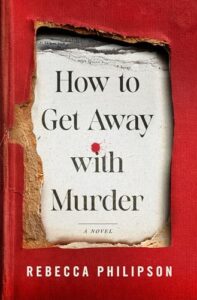

I never thought, being an author of a book called How to Get Away With Murder, that’d I’d see pieces of me in the finished novel. My book is a serial killer thriller, after all. The story of a self-proclaimed murderer named Denver Brady, writes a ‘how to’ guide for aspiring killers. When Denver’s book turns up at a crime scene, Detective Sam Hansen must find out who Denver really is. It’s a book within a book and the reader follows both Denver’s ‘guide’ and Sam’s investigation as she tries to identify the man behind How to Get Away With Murder.
As the woman who is actually behind How to Get Away With Murder, I hope it goes without saying that I myself, am not a serial killer. Nor am I a police detective. Yet when my nearest and dearest read my novel they all said the same thing to me: that bit is so you.
So me? Which bit?
I definitely did not intend to see myself in my novel at all but I sat down and gave it another read with their comments in mind. Sure enough I soon came face to face with the tiny pieces of me that had somehow made their way onto my pages. How’d that happen? I wondered to myself and does it happen to all authors?
As a scholar I have always argued against autobiographical readings of novels. I’ve always seen them as works of fiction. I could not accept a theory I read recently about Charles Dickens’ dissatisfaction with his own mother and how this influenced his representation of mothers in his novels, yet is it possible that any author might intentionally or not, write their own thoughts, ideas, problems into their work? It’s certainly an interesting question and my thoughts on the topic were set until I saw myself doing this very thing. That is not to say that every opinion expressed in How to Get Away With Murder is my own – far from it – but there are some tiny pieces of me in there whether I intended it or not.
Feminist Rage
I had no idea I was a feminist until I became a mother. I found myself increasingly angry at the world my girls were growing up in. From a bottom grabbed in a pub, to cat-calling, harassment and fear felt walking home in the dark, I became more and more outraged at what they might face.
How to Get Away With Murder did not intentionally become a feminist read, yet one reviewer said this:
“I enjoyed the multi-layered mysteries that kept me guessing to the end. Sam was a fantastic detective and I found it really clever how the case and clues became clearer as she became well again. Her experience as a woman in the police was very universal to female experience today and I very much felt some feminist rage, rooting for Sam all the way through.”
Sam is not only a victim of SA, but also witnesses domestic abuse and struggles with misogyny in a variety of forms. While the specifics of Sam’s experiences are not my own, her anger about VAWAG is definitely my own. A tiny piece of me.
Wow! – You’re a Tall Lass
I can’t tell you how many random people (men) have said this to me. I’m (mostly) sure it was never ill-intended, but growing up as a 6ft girl in the 90s wasn’t easy and constant comments from strangers about my leg length were dreadful. I once went out in 1cm heels and called my Mum from a payphone and begged her to drive to me with flat sandals (she did it, bless her), so overwhelming was my self-consciousness around my height.
When I wrote How to Get Away With Murder, I made my detective, Sam, my height and my age. Again, I didn’t really intend it, she just kind of happened. I had Sam experience tall people problems and comments from people too. Unlike me though, Sam isn’t self-conscious of her long bones, although, honestly, I’m still working on that confidence. To be clear, Sam isn’t based on me – not at all, this was just a tiny piece of me that ended up in her character. Similarly, Sam’s age is pretty close to my own and it was tempting to knock a few years off Sam and make her (us?) younger, but I resisted. Why shouldn’t a 6ft, 40+ woman be incredible?
Here I Go Again
When I was 12 my uncle gave me his old gig jacket. It was a cool-looking denim piece that he’d handstitched. Whitesnake, it read across the back – an old rock band I’d never heard of – maybe I’d give them a listen. That was how I discovered rock music. Bon Jovi. Journey. Bryan Adams. I could not get enough of it.
When I was older, I applied to host a local rock radio show. My co-presenter and I travelled all over England interviewing bands from Machine Head to the Scorpions and The Calling. My tastes got heavier but wildly varied and my playlists would include the most random of choices: Buddy Holly, Metallica, Alice Deejay and MCR.
When my detective, Sam, is struggling, on the verge of a panic attack or needing some release, she turns to music. My music. She uses these bands to soothe her and block out the world, just as I do. Another tiny piece of me that I didn’t expect to see on the page.
Even Denver includes a random music clue in How to Get Away With Murder – I wonder who’ll be the first reader to spot that one!?
Convent Girl
I am a convent girl and always will be. The convent I attended was nestled in a tiny village in Weardale and I have generally happy memories of my time there. The nuns who taught us, I remember fondly and I spent a lot of time when I should have been learning, scribbling down stories to share with friends or daydreaming. I felt safe there and I don’t think I realised how much that meant to me at the time.
Why then, did I bring my serial killer to the convent gates? Not just any convent, when I reread How to Get Away With Murder, I was surprised by how heavily my writing was influenced by my personal memories and littered with those little pieces of me.
When my serial killer, Denver goes to school, he attends a college near a convent and of course, he is drawn to the gates by the ‘heavenly creatures’ inside. He sees the girls, who wear the exact uniform I did. Denver describes our attire as a “truly disgusting garb,” which matches the sentiment of the hurtful things said to us by kids from other schools, as we huddled together on the bus stop each morning. In my novel, Denver’s victim plays rounders – a sport we regularly enjoyed at lunchtime and later in the novel, a nun plays an important role in Sam’s investigation into Denver.
Despite being a dark and twisty serial killer thriller, How to Get Away With Murder does have a sense of humour. This mainly takes the form of sarcasm or observational one-liners.
Now that How to Get Away With Murder is out in the world, I’m pleased that these tiny pieces of me slipped among its pages. Lots of early readers have talked about how relatable the characters are, especially Sam, and how they’ve even found pieces of themselves in my novel too.
***