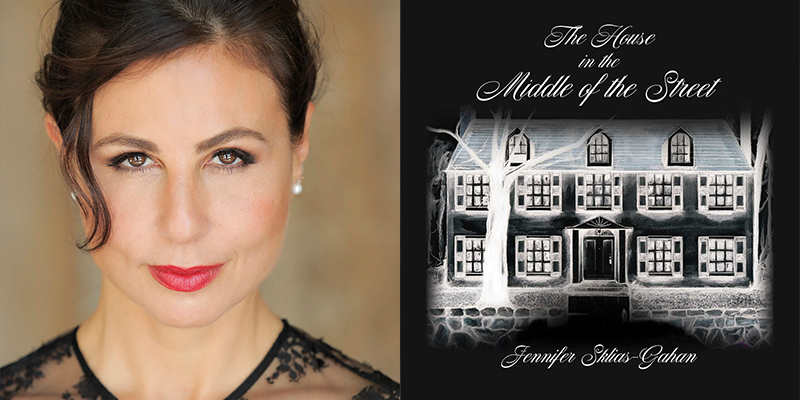
I learned at a young age how transformative storytelling is; it led me to build a career as an actress and writer.
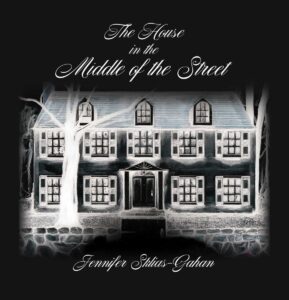
My new book, The House in the Middle of the Street, is my winter tale about a house, its occupants, and a yearly visit made by a boy and a girl on New Year’s Eve. It is the first in a series of Gothic tales.
As a child I found solace and freedom in reading. Growing up in New York as a first generation Greek-American, my family intimately embraced the oral tradition of storytelling, both classic Greek mythology and village folklore as words to live by. The gods, goddesses, and creatures that frequently engaged with the common man represented the highest parts of us and our darkest sides as well.
My Gothic tale came out of a larger world that begins at a historic time in 19th-century New York. It encompasses many of my personal experiences placed in a different time and a different place, where magic and myth rule. I invite you into my world of fairy tale.
Our humanity breaths more truthfully in the extremes of creatures, shadows, and magic rituals that have the power to release our family curses. Below, you’ll find a brief list of some of the stories that have spoken to me and taught me a little more about myself, my fellows, and this mysterious world that we live in.
“The Signal-Man,” by Charles Dickens (1866)
There is a reason why in 2026 we still revere Charles Dickens’ writing; he’s the master of Victorian Literature, painting a world with brilliant personalities and ghostly happenings that captivate me with their incredible suspense and terrifying social commentary. Dickens’ stories always seem perfectly suited for reading aloud and performing which as an actor and audience I am drawn to. In “The Signal-Man,” he has created a quintessential ghost story.
It takes place in the confines of a railway cutting in rural England. The Signal-Man watches over the trains pushing in and pulling out, a solitary job most nights. One quiet night, he sees a man at the mouth of the railway tunnel standing by a red light, violently waving his arm, warning that danger is approaching. When the Signal-Man goes to meet this helper of sorts and find out more, the figure always vanishes.
Dickens’ storytelling drenches me with dramatic visuals and the telling is so perfect. I have seen this storyline told over and over in contemporary ways and Dickens is still the most satisfying, hands down. Classic and timeless for a good reason.
The Vampire Lestat, by Anne Rice (1985)
The second novel in Anne Rice’s decadent Vampire Chronicles. I immediately fell into Rice’s universe with her opening novel, Interview with the Vampire, but, ohhhhhh, when I got to Lestat the fun had just begun. Lestat is the villain with a soul searching for what is good, what is evil and what might be the meaning in the immortal life of a vampire.
In my gothic tale, The House in the Middle of the Street, Ellie Boread, a main character in the story, reveals her intimate perspective through her narration just as Lestat does in Rice’s Gothic novel. Lestat walks you through 1980s New Orleans, where he has just reawakened. He chronicles his life from 18th century France to his present time, divulging the origins of Vampires and the desires between them and mankind. It has beauty, love, showing our ravenous needs and our broken pieces (whether we are immortal or not).
“A Rose for Emily,” by William Faulkner (1930)
I was introduced to William Faulkner’s writing when I was a 19-year-old New Yorker living in the Southern United States. In “A Rose for Emily,” he brings us into the crumbling world of recluse Miss Emily Grierson, a fading aristocrat. Her descent into madness is fueled by her undeniable loneliness. Emily shows us the depths we might go to in order to control our world, no matter what we become. Faulkner has created a perfectly tragic and iconic Southern Gothic Heroine in Emily.

Rosemary’s Baby, by Ira Levin (1967)
Set in a Gothic revival apartment building in New York City, where a young wife becomes pregnant after a series of odd happenings and a deeply disturbing sexual dream. Ira Levin brilliantly draws a terrifying description of the bones of this apartment and its imprisoning
landscape.
This novel was very famously made into a film directed by Roman Polanski (1968), starring Mia Farrow and John Cassavetes. The film with its epic visuals became a huge cult classic. I watched it multiple times before reading the book by Ira Levin. In the end, Levins’ storytelling is so masterful that I preferred it to the film.
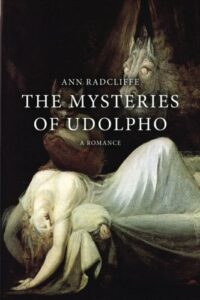
The Mysteries of Udolpho, by Ann Radcliffe (1794)
Ann Radcliffe, the mother of Gothic literature, certainly led the way for so many gothic writers to follow her: Edgar Allan Poe, Jane Austen, the Brontë sisters, Mary Shelley, Walter Scott etc… It is interesting to me that so many women writers in the 19th century wrote Gothic tales so well and so successfully. In this definitive tale by Radcliffe, an orphan named Emily St. Aubert is trapped in the grand and grim Castle Udolpho under the imprisonment of the Count Montoni. Emily struggles to keep her independence and desire to reunite with what and who she loves in the face of the dangerous world that surrounds her. Ann Radcliffe sews both sides of human nature together in the virtues, delicacy and beauty of Emily and the vile cruelty, greed, and fear that Count Montoni commands.
***