My debut duology, the Divine Traitors, was a Jamaican-inspired high fantasy about sisters, dragons, gods, and war. The book, which I wrote for young adults, was inspired by the story of Joan of Arc and my close bond with my own sister.
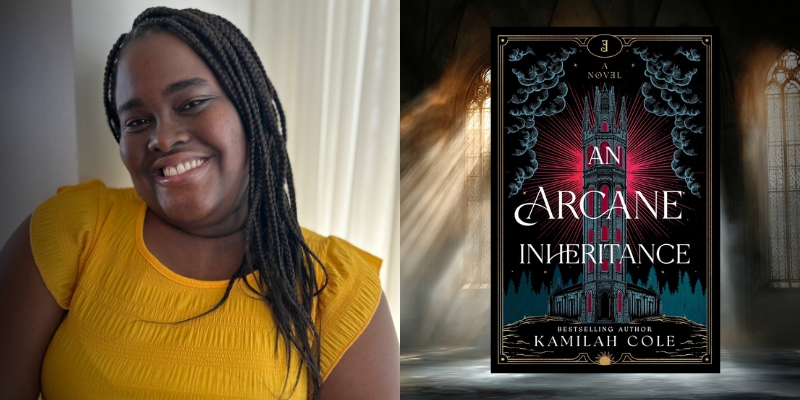
But when it comes to my adult debut, An Arcane Inheritance, I went in a completely different direction. It’s contemporary fantasy, featuring a heroine who is an only child, and the only war to be found is the one between expectations and reality—or her and the secret society that has been watching her.
So Let Them Burn focused largely on Faron, a post-war Chosen One struggling to move on. This Ends in Embers focused largely on Elara, a people-pleasing older sister desperate for peace. An Arcane Inheritance focuses largely on Ellory Morgan, an immigrant who would love to be in a college sitcom and instead found herself in the center of a dark academia fantasy.
Considering that dark academia is both a genre and an aesthetic, it’s hard to state, definitively, what the requirements of such a story are. Is it simply a dark fantasy, thriller, or mystery that’s set at an academic institution? Should there be a murder—attempted, suspected, or executed—and a huge wealth disparity between the students?
Academic rivals (perhaps to lovers)? Ghosts, demons, monsters, or sinister magic, if it’s a fantasy? Secret societies, scholarships, toxic relationships, or deadly secrets, if it’s a thriller?
Some mix of all of the above, where the main character, and the reader, doesn’t know what’s real until they reach that final page…if even then?
Suffice to say, I read widely. A Lesson in Vengeance by Victoria Lee. An Education in Malice by S.T. Gibson. Ninth House by Leigh Bardugo. Babel by R.F. Kuang. An Academy for Liars by Alexis Henderson. The Atlas Six by Olivie Blake. Basically, if it was making those dark academia lists, then I was picking it up to get a feel for the genre expectations—and for a space I could occupy that wouldn’t feel too much like treading the exact same ground.
But it wasn’t all about research. I’ve always a huge fan of dark academia. Like Ellory, I am a first-generation Jamaican-American, which makes academics very dark indeed.
In theory, education is meant to be the great equalizer, the means by which anyone can get any job and unlock any future. In practice, invisible barriers are erected that prohibit everyone from gaining the same value out of their education. Race. Class. Gender. Connections. Prospective students can do everything “right” and still fail because they don’t fall into one of the correct categories upon which they are being unfairly judged.
Now, add to that the fact that many of our stories academic institutions were founded on slavery (did you know that the first university to publicize its ties to slavery was Brown University…in 2006?) and exclusion (did you know that college used to be free until California Governor Ronald Reagan proposed charging tuition to “get rid of undesirables?”). Suddenly, those immaculate lawns, hallowed halls, and prestigious traditions become whitewashed, until pride becomes more important than equity.
It was into that conversation that I interjected my heroine, Ellory Morgan. She’s twenty-one-years-old and starting as a freshman because, as a member of the shrinking middle class, she couldn’t qualify for any needs-based scholarships.
She was born in Jamaica but raised in America, sent by hopeful parents to what they thought was a better life and buckling under the weight of their expectations. She is struggling toward a lucrative degree that she doesn’t even want, while trying not to be seen as struggling because of the sacrifices that were made to get her this far. And she is haunted by a magic she doesn’t understand but will have to learn to wield if she wants to survive the school year.
An Arcane Inheritance has many hallmarks of the genre. There is a secret society. There is a sarcastic academic rival. There are murders and wealth disparities, ghosts and deadly secrets.
But these tropes are made new when filtered through the lens of a first-generation Jamaican-American immigrant: The secret society is full of culture vultures who are targeting her specifically because of her ties to Jamaican spiritualism; her academic rival is a biracial African-American boy whose disdain for her makes her question her own Blackness and reflects the ways in which he upholds white supremacy as long as it doesn’t affect him; the murders are of BIPOC who, even more, are statistically less likely to receive justice; and the wealth disparities and deadly secrets are layered across various people who may be culturally diverse but are Americans—i.e. individualistic—first and anything else second.
Now, it’s coming out at a time when book bans have become increasingly prevalent, when literacy rates in the United States are declining, when books are being pulled from libraries in DEI purges, and when our history is being sanitized and erased before our very eyes, inhibiting us from learning from it and progressing forward.
I am proud that it gets to share shelf space with books like The Incandescent by Emily Tesh, Higher Magic by Courtney Floyd, The Library at Hellebore by Cassandra Khaw, Society of Lies by Lauren Ling Brown, all of which tackle inclusive experiences with their representation in the genre. In a world that hopes to silence these voices, my voice, the only thing that can be done is to be louder, so that even one person out there knows that they’re not alone.
At the end of An Arcane Inheritance, Ellory realizes that the magic she needed to achieve her dreams was inside her all along, waiting for her to claim it. If my entry into the dark academia space leaves readers with nothing else, let it be that.
***