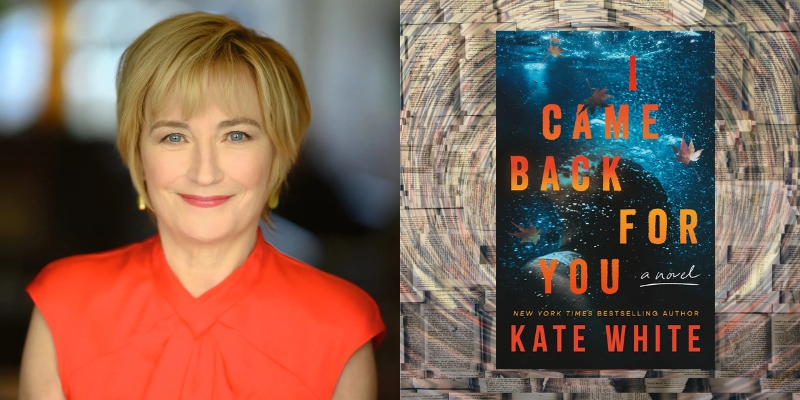
A champion of the gutsy, go-getter approach to work (and life), Kate White knows that one of the best ways to get what you want is to give something in return.
It’s a great way to get ahead in business—and books (which are also a business). At the time she penned her first suspense novel, 1997’s New York Times bestselling If Looks Could Kill, White was also editor-in-chief of Cosmopolitan. The magazine became the nation’s most successful in single copy sales during her fourteen-year tenure, which followed a string of successes at other periodicals. Before stepping down to prioritize her own creative ambitions, she wrote seven additional mysteries (and a few non-fiction career titles), proving that you can do it all—and that if you give readers what they want, they’ll keep coming back for more.
White’s newest, I Came Back for You (Thomas & Mercer; March 1, 2026), is her eleventh standalone novel and nineteenth overall. The book introduces Bree Winter, who lost her daughter, Melanie, to an act of violence ten years ago and has only recently found renewal and romance in Uruguay.
But Bree’s hard-won sense of peace is shattered when her daughter’s alleged killer, Calvin Ruck, makes a dying declaration that he is innocent of the crime. Wanting to believe this was one last act of cruelty on his part, Bree nevertheless suspects Ruck’s statement to be true. After all, he willingly admitted to four other murders—including two the authorities were previously unaware of.
In search of answers, Bree reluctantly leaves her South American sanctuary to return to the collegiate New York town where Melanie was a student at the time of her death. Not only must she face the fact that her daughter was living a life she knew little about but an unavoidable reunion with her ex-husband, Logan, whose infidelity led to their divorce.
Once again united, this time in their shared desire for justice, and with old feelings and unsettled business resurfacing, Bree is unexpectedly torn between the past and present. Yet despite the distractions, she remains steadfast in her purpose: unmasking a killer—even if it means putting her own life on the line.
Now, Kate White discusses infusing her suspense stories with style and substance.
*
John B. Valeri: In I Came Back for You, Bree is forced to confront the possibility that her daughter’s alleged killer may be innocent (of that crime) and that the real culprit is still at large. Tell us about the deeply conflicting emotions this stirs up in her. How does she approach finding a balance between self-preservation and loyalty to her daughter?
Kate White: It’s definitely tough for Bree. Calvin Ruck, the serial killer believed to have murdered her daughter, admits on his deathbed that yes, he killed several college-aged women, but Melanie wasn’t one of them. As far as Bree knows, he just wants to see and her ex-husband twist in the wind, but what if he’s telling the truth? She feels she has no choice but to return to the college town where her daughter died in search of answers.
It turns out to be deeply unsettling for her, leaving her really frayed around the edges. But at the same time she knows that in the long she can’t continue to heal from her daughter’s death unless the real killer is identified.
JBV: As a mother yourself, how did you endeavor to inhabit such profound grief and then render it both believably and sensitively on the page? Was it difficult to write such emotion without becoming overwhelmed by it? Assuming so, how did you maintain your equilibrium while staying true to Bree’s reality?
KW: Oh, yes, writing about losing a daughter was hard and I had to totally detach myself from some of it because I have a daughter myself. At the same time, I needed to feel Bree’s pain. In the last few years I’ve lost two of my younger brothers, which was devastating for me, and I used the prolonged grief I’ve experienced to guide me. And I think in a little way it helped me personally.
JBV: Bree is forced to reconnect with her ex-husband, Logan, who she divorced after Mel’s death. In what ways is their reunion amplified by the circumstances – and how does their shared history, coupled with the passage of time and their physical distance, threaten to disrupt the lives they’ve forged independent of one another?
KW: Bree needs to spend time with Logan because they’re both invested in finding their daughter Melanie’s killer, and on the one hand it’s good to have him as an ally. But there was never any closure at the time of their divorce—Logan cheated on her within a year of Mel’s death, trying to deal with his guilt—and so Bree is also discombobulated by his presence. Though she thinks she’s worked out her feelings towards him, she’s still angry and misses him and their marriage. And having that desire stirred again definitely creates problems for her.
JBV: You and Bree share a fondness for Uruguay, which is where she found sanctuary in the aftermath of tragedy. How have your own experiences in South America influenced her healing journey? More broadly, in what ways can sharing an alternate culture (language, food, topography, etc.) expand a reader’s worldview?
KW: I have spent winters in Uruguay for over a decade now—we bought a house here after I decided to leave my job running Cosmopolitan magazine. I’ve read some wonderful thrillers recently that are fully or partly set in foreign places, like The Paris Widow by Kimberly Belle and We Were Never Here by Andrea Bartz, and so I thought if I set a few chapters here, readers would be intrigued in a similar way.
And Uruguay has definitely helped Bree. As I say in the novel, she finds the beautiful vistas of green rolling hills to be both soothing and stirring. That’s exactly how I find them to be.
JBV: Much of the book takes place within the collegiate world that Mel inhabited. How does revisiting Mel’s school allow Bree a better understanding of who her daughter was as and what may have precipitated her death? In what ways does the use of this setting lend itself to mystery, given academia’s insular nature?
KW: Bree had a difficult relationship with her daughter, which pained her a great deal. It surely would have changed over time, but Mel was prickly during her teen years and distanced herself from her parents. Bree is reminded of this when she returns to the campus and also of a particularly sad parents’ weekend when Mel was especially critical of her. But being back on the campus allows Bree to discover things about Mel that eventually help her learn what really happened.
JBV: There is a common perception that writing is a solitary endeavor (which, to a large extent, it is). While you are the one with fingers to keypad, you also have a team that helps with social media and other things that are necessary but can distract from the work of writing. How do you go about finding these people and determining what can be delegated? In what ways does having a trusted group such as yours play into making the best, and most visible, book possible?
KW: I do have a social media manager who I found through word of mouth (always the best way in my opinion), but I write my own posts and also do all my own research for my books. I actually enjoy that aspect because during the years I was at Cosmopolitan, where I wrote my first eight suspense novels, it was always so tough for me to sneak out at lunchtime and research. I was always doing it on the fly. It’s been wonderful to have the ability to do deep dives at this stage.
I guess what I’m saying then is that writing is still a pretty solitary experience for me, but being an author isn’t. I have a great group of author friends that I’m in regular touch with. In the last few weeks I’ve zoomed with Lisa Unger, Wendy Walker, A.J., Finn and Karin Slaughter, all of whom I adore. Friends like them help make this such a great profession for me.
JBV: You (like Bree) have a background in editing, albeit as editor-in-chief of several popular lifestyle magazines. How has this influenced your approach to the conception and execution of stories, regardless of genre? In what ways has that career informed your relationship with your own editor(s)—and with receiving critical feedback in general?
KW: Funny you should say that. My editor just told me yesterday how much she enjoyed working with me and how receptive I was to her guidance (which, by the way, has been terrific). And she said she assumed that it had to do with the fact that I was an editor myself.
That’s absolutely true. As a former editor, I totally respect editors (though not the one I had years ago for one book who told me, “Oh, I didn’t know he was going be the killer. I wanted x to be the killer. What do you think of changing it?”) Good editors help you see the forest for the trees when you’ve lost your way, as we all do at times.
I also really like having my protagonist have jobs in the media world or something adjacent that I’m also familiar with—like PR or trend forecasting. This allows me to write as authentically as possible.
I once read a thriller about a woman who was the editor-in-chief and the writer clearly had done no research. Maybe I was one of the few people who noticed, but it bugged me as a former editor and chief and I just want to be sure. I’m always presenting the job as accurately as possible because some of the things that drive a protagonist relate to who she is because of her profession.
JBV: In addition to crime novels, you have also written business books–a common theme of which is the need to be gutsy to get ahead. Given that there are no guarantees in writing/publishing, what encouragement or guidance would you offer to those who are hesitant to pursue their own creative ambitions?
KW: I’m a big believer in being gutsy and asking for what you want, but I’ve always said it’s important when you’re asking to have a sense of what the other person wants too. For instance, when you’re asking for a promotion, don’t sit there simply thinking you deserve it. What does your boss need from you and how do you plan to deliver it in this larger role?
Likewise I think it’s important for aspiring authors to be paying attention to the needs of the agent they hope to acquire and the marketplace they hope to star in. Don’t make it just about you. What is that agent looking for? What is the marketplace looking for?
***