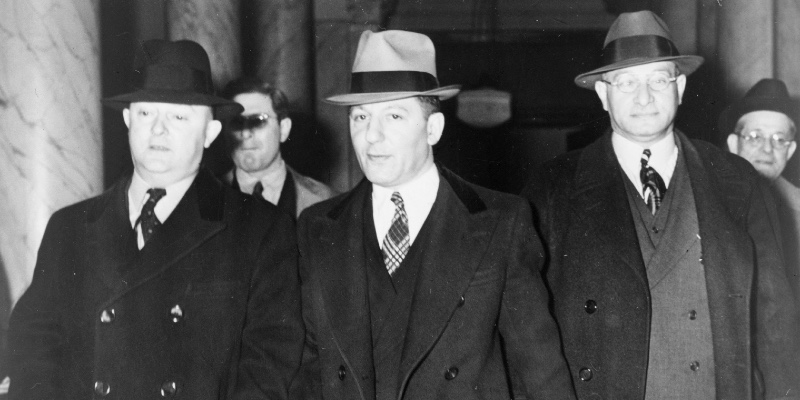
Louis “Lepke” Buchalter did not have the wit to avoid being the first and only mob boss to have been executed by the State of New York. If Lepke hadn’t been overheard by an eager-to-testify underling when ordering the murder of Joe Rosen, a former truck driver who had refused to join a Lepke-controlled union, he may have gone on ordering murders into his old age. As the boss of Murder Inc., Lepke used the murderous means at his disposal to get rid of someone who could testify against him.
While the hitmen of Murder Inc. had itchy trigger fingers, their bosses Lepke and his partner Jacob Gurrah Shapiro were impatient to kill those who got in their way. Known as the Gorilla Boys, Lepke and Gurrah (he earned his middle name because of his frequent inarticulate angry growls) were a frightening pair who were said to order murders as easily as ordering dinner. Murder was one of their means of taking over several small businesses as well as labor unions, including ones in the garment industry, baking industry, poultry industry, and trucking. In addition to Gurrah, Lepke ran Murder Inc. with Albert “The Lord High Executioner” Anastasia, who ordered murders more impulsively than his partners. For example, when Anastasia saw Arnold Schuster on a local TV news program telling a reporter that he had spotted escaped prisoner and bank robber Willie Sutton and reported it to the police, a furious Anastasia immediately ordered a hit on Schuster.
When not murdering business owners and union members who stood in their way, they got fellow gangsters to join unions they wanted to control and then the new members voted to have their unions run by Lepke and Gurrah. During the Great Depression, law enforcement officials estimated that the Gorilla Boys were taking in twenty million dollars annually from their labor rackets. When ordering hits, Lepke established a hierarchy of command so that his name would never be associated with either the hitman or the victim. To wit: he would give the contract to either Gurrah or Anastasia, who would pass it on to one of their lieutenants, who would give it to a chosen hitman, who would not be able to testify against Murder Inc.’s bosses if he were caught.
In addition, Lepke, more than his partners, believed he was protected by politicians. However, Democratic governor Herbert Lehman was under pressure from Republicans and some newspaper publishers to hire a Republican special prosecutor to go after the mob. The governor knew he should not appoint a Democrat, since it was well known that organized crime controlled Tammany Hall, the seat of Democratic power in New York City. Four prominent Republican attorneys turned down Lehman’s offer, but all recommended Thomas Dewey, who quickly agreed to take on the job. Shortly after being retained, Dewey hired sixty investigators. After going after Dutch Schultz and Lucky Luciano, Dewey set his sights on Lepke. His laser-like focus could not be interrupted or deterred by political pressure, bribes, or threats. Dewey was as determined as a guided missile and kept lining up witnesses who would testify against Lepke, who—in turn—arranged for all potential witnesses to be killed by members of Murder Inc. More than sixty bodies, shot, knifed, ice picked, garrotted, and even burnt to a crispy blackness, were found in vacant lots, along creeks and bays, in tenement basements and deserted garages in Queens and Brooklyn and upstate New York. To remain uncuffed, a paranoid Lepke went into hiding, ate himself into adiposity, and grew an undistinguished mustache. He became invisible to the law. A frustrated Dewey got New York City to offer a twenty-five-thousand-dollar reward for Lepke, dead or alive. No prospective bounty hunters were foolish enough to put their names down as potential victims of Murder Inc.
Abe “Kid Twist” Reles visited Lepke daily. He would inform his boss of potential witnesses, and Lepke ordered them killed. To make sure that Lepke remained invisible, Anastasia moved him from one location to another. Dewey’s frustration resulted in angry tirades and demands that his investigators find Lepke. His investigators might have done just as well searching for Zorro or the Scarlet Pimpernel. To put pressure on the Mob, Dewey ordered that every mob-run activity in the city should be closed by the police: betting parlors, gambling dens, whorehouses, saloons, mob-owned businesses in the garment and food industries. Many low-level gangsters were arrested on charges of being vagrants. The pressure finally got to the members of the Commission of the National Crime Syndicate. Luciano and Tommy “Three Fingers Brown” Lucchese decided that Lepke must give himself up to Dewey. However, that was easier said than done. They would have to deputize a trusted turncoat to convince Lepke of the advantages of doing the right thing for his fellow mobsters. They chose Morris “Moey Dimples” Wolensky, a friend whom Lepke trusted to his later regret. Moey was instructed to dangle a carrot of an easy-to-serve prison term to Lepke. It was something he could do standing on his head. As I wrote in Big Apple Gangsters: “Buchalter had to believe that if he gave himself up to the FBI, he would be tried on federal charges and serve only a few years in a federal prison. By the time his sentence would be completed, Dewey would be out of office and state charges would have vanished for a lack of witnesses. Buchalter would be a free man.” (1) Moey told Lepke the fix was in. So, in August 1939, Lepke said he would go forward with the plan, but he insisted that he turn himself over to none other than FBI director J. Edgar Hoover: one boss dealing with another boss. Anastasia was furious that Lepke had agreed to such a deal. He tried to convince his partner that he could continue to hide for years, well beyond the time when Dewey had left office. By then, the right people could be bribed to make Lepke a free man. However, a resigned, yet determined, Lepke said he would give himself up to Hoover.
Frank Costello, the politically well-connected prime minister of the underworld, was designated as the go-between. He called his friend, New York Daily Mirror columnist Walter Winchell, who agreed to bring Hoover to 28th Street and Fifth Avenue, where Lepke would meet the FBI director. On August 24, 1939, at 10 p.m., Anastasia drove Lepke to meet Hoover. He parked directly behind Hoover’s car. Winchell exited from a back door, walked to Anastasia’s car, and escorted Lepke to meet Hoover. The two men got into the FBI car, with Lepke seated next to Hoover. Winchell introduced the two: “‘Mr. Hoover this is Lepke.’ ‘How do you do’ said Hoover. ‘Glad to meet you,’ replied Lepke.” (2)
Buchalter went to trial, and on January 2, 1940, he was found guilty on federal charges of drug trafficking and sentenced to fourteen years in prison. He figured he could be out in seven to ten years. It was not to be: he was turned over to the State of New York and tried for labor racketeering and extortion. Someone would have to pay for this betrayal. And sure enough, Moey met his end in a hail of gunfire.
On March 2, 1940, Lepke was found guilty on fifteen counts of extortion. As a four-time loser, he received a sentence of life in prison. He would serve fourteen years or so in Leavenworth, then the rest of his life probably in Sing Sing.
However, fate had another indignity in mind for Lepke: in September 1940, New York district attorney William O’Dwyer discussed with US attorney Harold Kennedy about having Lepke delivered to Kings County, where he would be tried for the murder of Joe Rosen. The victim had been driven out of the trucking business for refusing to join Lepke’s corrupt union. Rosen opened a candy store in Brooklyn. Angry at Lepke, Rosen agreed to testify against him. As soon as Lepke heard about Rosen’s threat, he ordered a hit on the rat. Unfortunately for Lepke, the order was overheard by Allie “Tick Tock” Tannenbaum, who later agreed to testify against his Murder Inc. cohorts. O’Dwyer believed that he had been dealt a winning hand and flew to Leavenworth to meet with Lepke. He offered the prisoner a deal: testify against Murder Inc. members, and O’Dwyer would drop the murder charge for ordering the death of Rosen. Lepke refused. Instead, he ordered the killing of other possible witnesses. Some men are prisoners of their habits.
On May 9, 1941, a shackled Lepke appeared in court to be arraigned for the murder of Rosen. The frozen-faced Lepke received a note from his former partner Gurrah, who had written, “I told you so.” He was referring to the fact that Lepke and other members of the National Crime Commission had rejected the assassination of Dewey and instead had murdered Dutch Schultz, who was a lesser threat than Dewey. Gurrah and Anastasia, who had wanted Dewey killed, were out-voted. It was too late for regrets. Lepke was sentenced to be fried in Old Sparky in Sing Sing prison. The sentence would be delayed by a series of appeals filed by his lawyers. All the appeals, including one to the US Supreme Court, were denied and the forty-seven-year-old Lepke was slowly escorted by seven guards down the Last Mile to Old Sparky. His legs and head had been shaved. He was placed on the chair, his arms and legs firmly strapped in place to which electrodes were attached. A cap with a saltwater sponge was placed over his head. Lepke had no last words, and so quickly received a painful jolt of 2500 volts, followed by a second charge of 1500 volts. After his body cooled, he was unstrapped and taken to the prison morgue. Death had come for him on March 4, 1944. Mobsters across New York all agreed that Dewey should have been assassinated. A chill went through the underworld: if they could fry Lepke, they would get anyone. Though mob bosses would come and go, some dying of old age, some shot by those who wanted to replace them, no other mob bosses followed in the footsteps of Lepke down the long Last Mile to Old Sparky.
Having been in the same prison with Lepke, the Pulitzer Prize-winning poet Robert Lowell wrote about him in a poem titled Memories of West Street and Lepke. He described Lepke, whom he named Czar Lepke, as being flabby and lobotomized. He wrote: “where no agonizing reappraisal/jarred his concentration about the electric chair.” (3) Lowell had been convicted for being a conscientious objector during the 1940s. In the movie Romeo Is Bleeding, Lepke and Lowell have a brief conversation. Lepke confesses that he is in prison because he killed someone; Lowell responds that he’s in prison because he didn’t kill someone. (4)
Though the tabloids focused on Lepke as the first mob boss executed in New York, there was little written about his partner Gurrah. Along with Lepke, Gurrah had been convicted in 1936 and sentenced to two years in Sing Sing Prison. Gurrah, not a fan of confinement, went on the lam for two years. He was not exactly living the life of a tourist going to the world’s most exciting resorts. After two years of worry, misery, fear, and boredom, he turned himself over to FBI agents on April 14, 1938. He thought he would be able to enjoy life once he was free, but on May 5, 1944, he was convicted of extortion and conspiracy (his trademark tactics) and sentenced to fifteen years to life in prison. Locked up, he often let it be known that Dewey should have been assassinated. It became like a mantra for him, emphatically repeated following the execution of Lepke. In 1947, Gurrah died as the result of coronary thrombosis.
Murder Inc. had left hundreds of dead bodies as testimony to its mission of killing. Dewey left behind two bodies of men responsible for all those other dead bodies.
Notes
1 Jeffrey Sussman, Big Apple Gangsters: The Rise and Decline of the Mob in New York (Lanham, MD: Rowman and Littlefield Publishers, 2020), 71.
2 Paul R. Kavieff, The Life and Times of Lepke Buchalter (Fort Lee, NJ: Barricade Books, 2006), 132.
3 https://poets.org/poem /memories-west-street -and -lepke
4 https://imdb.com /title /tt0107983/faq/ Romeo Is Bleeding (1993)-FAQ-IMDb.