I pledged my allegiance to patriarchy long before I knew its name. As a born and raised Mormon girl, I was steeped in patriarchal institutions of power––only we called it the “priesthood.” I stood in the pews and sang “We thank thee O God for a prophet,” my heart pounding with love for a gray-haired man I believed was ordained by God himself to tell me what to do in every aspect of my life. I sat in closed-door interviews with middle-aged men I barely knew answering questions about sex and my body as young as eight years old. I knew from Sunday school lessons that there was a direct chain of command, a hierarchy of men from the local bishop who determined my worthiness up to the highest echelons of the church in Salt Lake City. And every single link of that chain was a man.
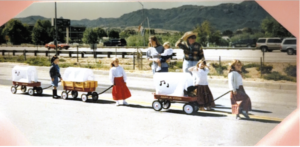 Photo 1–Walking as a kid in a local parade in California dressed as a Mormon pioneer. Little Linda, pulling the wagon in front.
God made it that way. We didn’t know why, don’t ask questions. Men and women had different but equal jobs—men with the priesthood and women with motherhood. Priesthood was the power of God to bless and perform ordinances, to lead in all positions of power, and to make all final decisions. Women were just as important I was told—we made babies. It me many years to realize that if I had to be told I was equal, I wasn’t actually equal.
In every subtle or obvious way, men were over me. They all received the priesthood, special roles, leadership, extra care. I received lessons on modesty and that it was better to be dead than lose my virtue. Men were the leaders I stared up at every week on the stand of the chapel. I sat in the pews while the boys my age passed the sacrament trays—something I could never do simply because of my gender. Men ranked up, and women accepted “we couldn’t do it without you” as equality.
Most chilling of all was polygamy—a practice of men taking multiple wives from the nineteenth century that continued to invade Mormonism from the grave. I was taught that one day, the practice would be resurrected. In heaven, I would be a polygamist because it was required for salvation. There wouldn’t be enough righteous men in the next life so my future husband would need to marry the extra single women. My husband would use his priesthood to create earths and populate worlds. I would be one of his many wives that would bear him spiritual children, never allowed to speak to my offspring. Somehow, I would be perpetually spiritually pregnant along with my sister wives, one eternal family building a kingdom for our husband who would be our god.
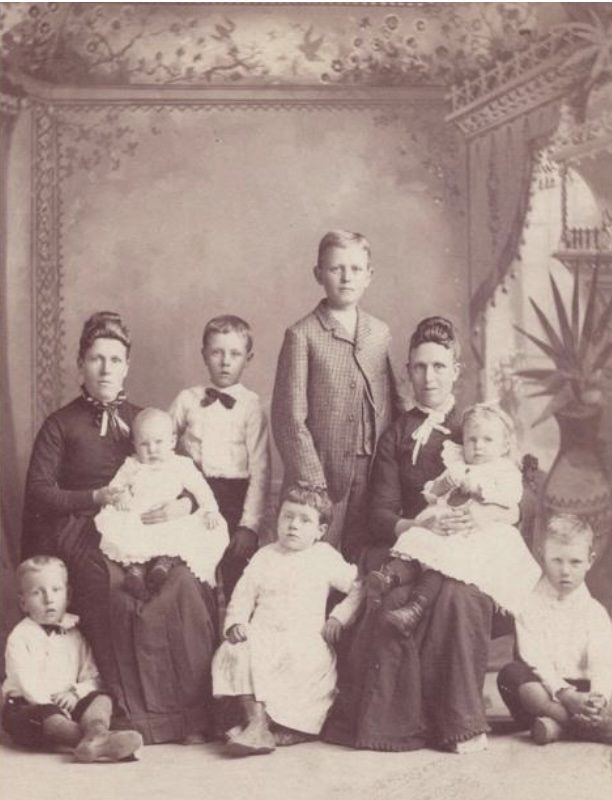 Photo 2: My ancestors, Mary & Sara Russon, with their children. Both were married to the same man in plural marriage.
The church doesn’t like to talk about those foundational doctrines much anymore. They pretend it’s not there while simultaneously never taking steps to disavow and replace it. Mormon heaven is patriarchy and polygamy. I was primed since a little girl to obey my eternal inequality, to worship it even. Patriarchy was God’s way, the way of salvation and eternal life. Loyalty to the men who dictate everything from what underwear I wear to what God says in scripture was paramount.
And for far too long, I believed it.
We’re told not to worry about it or even speak about it, and certainly not to research about the history of it. But I stepped out of line and opened a book. Many books. As the real, horrible history of polygamy came to life before me, the foundations of patriarchy that created and supported it crumbled. I could no longer look at the priesthood as from God. The scales fell from my eyes and I saw in all its true colors the beast of patriarchy that raged and controlled my life. That trapped me in a cage and called it godly. That saw me as nothing but a womb to be used and an object to collect and subjugate.
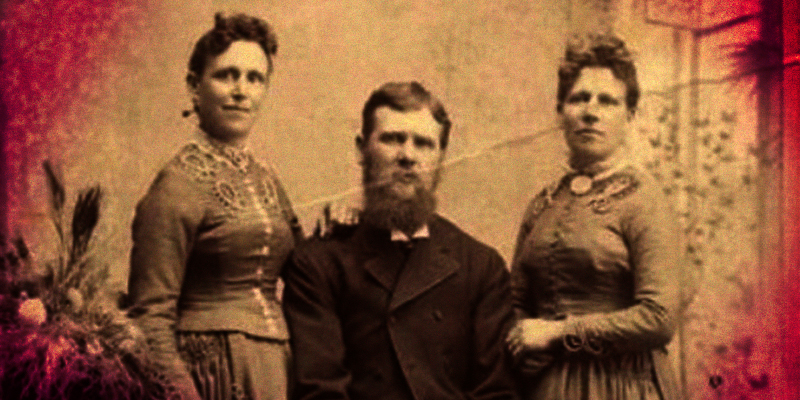
I wrote my way through my deconstruction. The pulsing need to share the story of Mormon women, patriarchy, and polygamy motivated me. My own polygamous ancestors inspired my story and the questions I explored. Where were the women in the narratives of polygamy? So many of them were silent, their lives lost in a sea of male-dominated histories. I wanted more than anything to give them a voice, and in doing so reclaimed my own.
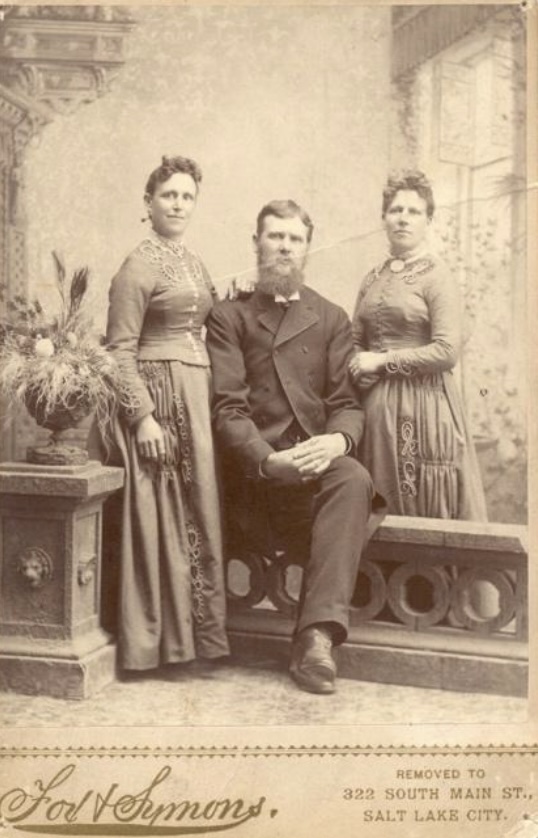 Photo 3: My ancestors George Kirkham and his wives, Mary & Sara Russon. Neither wife mentioned the other in their brief memoirs despite living together their entire lives as polygamous wives.
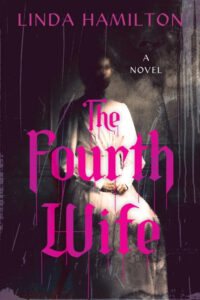
The horror genre and the Gothic are a way we can examine and critique the true monsters lurking in our lives. For Mormon women both living and past, polygamy is that beast and patriarchy the leviathan. I wrote The Fourth Wife to sort through my generational trauma and religious demons. The ghost, creepy mansion, and terrifying mystery are the thinly-veiled stand-ins for the real horrors—religious patriarchy.
In The Fourth Wife, my main character Hazel becomes the fourth plural wife of a man she’s never met because a church leader she’s been raised to obey tells her to do so. Like the many women she represents, she obeyed a man without knowing how to trust her own decision-making. This suppression of instinct and self-preservation is a terror of its own and often the catalyst for horror plots. Hazel’s new husband then takes her to his crumbling mansion at the edge of Salt Lake City, where she meets his three other wives. Isolation, another classic horror trope, mirrors a form of patriarchal abuse that pushes women into small, defined roles that cut off their true selves.
Hazel’s fears that something stalks her at night and that the house is alive mimic the unspoken reality she must slowly come to grips with—that her husband is not what he seems. That she’s been manipulated and used to further a man’s religious and physical prosperity. This house of horrors is one polygamy built, structured by a religion that makes men as gods in this life and the next. Hazel and her sister wives can only be free when they leave the house of patriarchy to burn.
Gothic horror gives us a gift of seeing oppression from a different perspective. The things that go bump in the night are not as scary as the real terrors they reveal. Seeing our realities reflected in horror can help us realize what we might not have wanted to see before. Polygamy still stalks Mormonism. Patriarchy stains its every theology. In The Fourth Wife, I hope readers will come away with a better understanding not only of Mormonism’s patriarchal abuses but the ways these same issues exist in many religious and secular institutions. I hope they will also see themselves, like Hazel, as a capable conqueror of these nightmares.
***