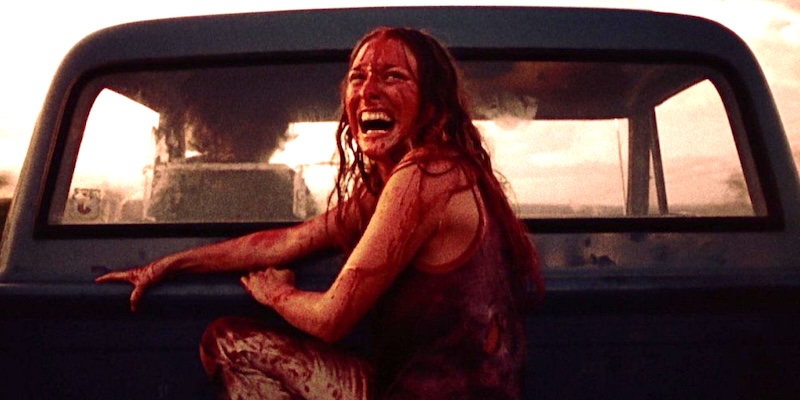
For decades, the slasher taught us the rules:
Girls screamed. Girls ran. Girls died.
The Final Girl lived, yes—but survival was her only reward. She didn’t get joy. She didn’t get closure. She didn’t even get rest. More often than not, she got sequels: Laurie Strode returning again and again in Halloween, Sally Hardesty screaming her way out of The Texas Chainsaw Massacre only to remain forever trapped in its orbit—endless variations on the same violence, the same man, the same knife. She lived long enough for the credits to roll.
We were told this was victory.
But survival is a low bar. To live within the rules is not the same thing as to win outside them.
Throughout horror history, women have been relegated to hysterics, monsters, hags, witches, and worse. In slashers, we were reduced to a brutal economy of virtue and punishment—the virgins and the sluts, the worthy and the dispensable. Even the Final Girl, canonized as a feminist triumph, remained a role shaped by constraint. Her body became a warning. Her trauma, a narrative function—proof that the system still worked. Proof that violence could continue as long as one woman lived through it.
The Final Girl was the genre’s alibi. A way to say, See? She lived, while continuing to discard every other woman along the way.
Before the Final Girl became a symbol, she was just a body.
Proof that desire came with consequences. Proof that curiosity carried a price. Proof that stepping outside a prescribed role invited erasure. Franchises like Friday the 13th and A Nightmare on Elm Street didn’t just kill women—they sorted them. Some were spared longer than others, their bodies arranged into lessons meant for the women in the audience to absorb: don’t be a slut, don’t be nosy, don’t go asking for trouble.
The Final Girl pretended to be the exception. Smarter. Cleaner. More agreeable. She lived because she followed the rules—not because the rules served her. She survived by being palatable. Presentable. Acceptable.
And this is where the trope becomes a cop-out.
The existence of a single female survivor allowed horror to keep sacrificing women wholesale while congratulating itself for progress. The genre didn’t stop killing women; it simply learned to point to the one left standing. The Final Girl didn’t challenge the violence—she made it easier to swallow. After all, if a woman could survive, it’s really not that bad, is it?
Though she survived, the Final Girl’s story was still one of endurance rather than agency. She didn’t choose to fight; violence cornered her and demanded a response. Power wasn’t something she claimed—only something she borrowed at the last possible moment. Survival came at the cost of everything else.
The Final Girl was allowed to exist, but not to transform. She didn’t get a future. She got a memory. Her purpose was to remember the horror so the story could justify itself—so the audience could leave reassured that the old rules still worked.
It wasn’t enough.
The most meaningful evolution in the slasher isn’t that women learned to survive it. It’s that we stopped mistaking survival for victory.
We’re pushing away the roles of hysterics, monsters, hags, witches. We’re no longer interested in earning our survival through restraint. We’re reclaiming our femininity, our complexity, our softness—not as weakness, but as tools. We’re refusing the false choice between villain and victim.
We’re both.
We’re neither.
And we’re done accepting the terms altogether.
Women creators are no longer content to revise the Final Girl. We’re dismantling her entirely. A growing wave of women are reshaping the genre from the inside out, shifting the focus from reaction to intention. The new breed of Final Girl is no longer confined to running. She doesn’t just escape violence—she strips the slasher of its inevitability. She refuses the moral narrowness of the role. Refuses to be good—or grateful.
Female-driven slashers ask a more dangerous question: What happens when a woman doesn’t want redemption?
What happens when she wants control?
This is where female rage enters the genre—not as hysteria, not as breakdown, but as a force with narrative weight. In contemporary horror—in works by authors like Rachel Harrison, Gwendolyn Kiste, Rachel Yoder, Mona Awad, and many more—women are allowed to be furious without apology.
Their anger is not framed as a problem to solve. It’s treated as rational. Earned. Useful. These works may not all wear the slasher’s mask, but they operate on the same blade—reclaiming violence, agency, and female interiority from a genre that once denied them.
The slasher becomes a framework where women explore power, control, and consequence on their own terms—without asking permission.
This shift doesn’t require a monster in a mask any more than it requires a male body to oppose. In many of these narratives, the conflict exists entirely within a feminine ecosystem—between women, within women, or between who a woman is and who she is expected to be. The pressure isn’t always external. Sometimes it looks like tradition. Like concern. Like the quiet choreography of acceptable womanhood.
Here, the Final Girl is no longer the opposite of the slasher.
She is not the answer to violence.
She is the author of it.
When a woman occupies both roles, the genre changes fundamentally. Violence is no longer a moral lesson or an interruption—it becomes expression. Choice. Craft. The knife is no longer borrowed or symbolic. It isn’t a punishment and it isn’t a prop. It’s a tool of agency, of ownership, of authorship.
These stories aren’t asking who deserves to die.
They’re asking who gets to decide.
This is where pink horror thrives—not as irony or novelty, but as strategy. Femininity, long treated as artificial and disposable, becomes material. Performance becomes camouflage. Domestic spaces become stages. Bedrooms, bathrooms, kitchens, PTA meetings, elementary-school playdates—spaces once coded as safe or trivial or “womanly”—are transformed into sites of power and control.
In my novel Dollface, the slasher is no longer something a woman escapes. It’s something she inhabits. The violence is shaped by performance, by expectation, by the suffocating pressure of being pleasing and presentable—and by the fury that blooms when that pressure becomes unbearable. The woman at the center is not redeemed by survival. She is clarified by choice.
And she is not alone.
In today’s horror landscape, women are reclaiming the genre not just as survivors, as Final Girls, but as villains—as slashers. Their violence is intimate, observant, and deeply personal. It understands the social architecture it moves through because it—we, the women writing it—were raised inside it. These stories don’t imagine women becoming monstrous. They recognize that we’ve always been paying attention.
Women don’t just survive horror anymore. We’re writing it.
And we’re done pretending we’re not furious.
***