The following is an excerpt from The Most Wonderful Terrible Person: A Memoir of Murder in the Golden State. Author Debra Miller provides a personal account of California’s infamous murder trial of her mother, Lucille Miller—and the decades of emotional wreckage it left in its wake.
*
I did not witness the events of October 7, 1964. What I would come to know of them came from my mother’s version later that morning and transcripts from her trial.
This was her version: As my brothers and I slept that night, four months after we’d moved into our new house, my father asked my mother to make him a cup of hot chocolate. She told him that if she did, she wouldn’t have enough milk for us kids to have cereal in the morning.
There was a store not very far away, but she didn’t want to drive the several miles by herself at night to get the milk. She was afraid of the dark; also, she had poor eyesight, and the only prescription glasses she wore were sunglasses, which did little to help her night vision. Glasses were not fashionable in those days, so vanity might have been her reason. She always made fun of herself for wearing those sunglasses at night instead of just buying regular glasses, but she never did anything about it.
Though my father was huddled in a blanket on the couch, feeling sick as usual, he offered to go with her to the store.
She drove while my father, wrapped in the blanket, curled up on the passenger side. He gave her his wallet, which she placed on her lap, then he promptly fell asleep. After checking to make sure the door on my father’s side was locked—he was leaning on it, and she was afraid he might fall out—she carefully backed down our steep driveway.
Woody’s, the closest market, was about five miles away and was closed by the time they arrived. The lights were still on, and since my mother knew the manager, she banged on the glass door, but no one appeared.
Mayfair, a twenty-four-hour market, was another two or three miles down the road. With my father still asleep, with his wallet lying in her lap, my mother drove there, walked inside, and bought a half gallon of milk. Then she began the trek back home, turning north off Foothill Boulevard onto Sapphire, then right onto Banyan and Carnelian, which was not her usual route to our house.
Given my mother’s fear of the dark, going that way was an unusual choice. Most of the streets near our house had lights, but Banyan did not. It was pitch-black. This became an issue during her trial—why had she gone that way, when normally she never did?
According to my mother, our Volkswagen suddenly lurched to the right onto the berm separating Banyan Street from the orange groves running parallel to it. At the same time, the back seats burst into flames. Terrified, flames singeing her hair, my mother jumped out of the car.
When she turned around, she realized to her horror that flames were consuming my father, who remained slumped against the car door, the blanket wrapped around him melting. She ran to open his door, but when she grabbed the door handle, it radiated so much heat that it burned her hand. She had forgotten she had locked it to keep him safe; now he was trapped in a flaming car.
My mother didn’t give up trying to get him out. She ran over the berm into the first row of orange trees searching for something, thinking in her panic she needed to break a window and find a thick branch to push him out of the car. Not knowing what she was doing, she threw a rock barely capable of shattering ordinary glass, much less smashing a thick windshield.
Then my mother remembered a woman who lived in the orange grove and she began running toward what she believed was Carnelian, screaming, “Somebody help me! My husband is burning!” She saw a car ascending a street in the distance, but it was too far away to hear her cries.
Just then, she thought it was taking too long to reach Carnelian. Believing she must be running in the wrong direction, she turned around and began running the wrong direction. As she approached our burning car, she witnessed my father’s blackened figure leaning against the passenger window of our Volkswagen. Sobbing, she kept running.
Finally, she came to a house and pounded on the door. The woman who answered found my mother incoherent, begging for help, trying to choke out what had just happened. Mrs. Swenson, the woman who answered the door, pulled my mom inside, sat her on the couch, and used her kitchen phone to call the local sheriff’s office. She then asked my mom if she wanted her to call anyone. My mother asked her to call Harold Lance, a friend from church.
This became the first of my mother’s actions that would be scrutinized later. She thought she was calling a friend who happened to be a lawyer. Investigators believed she called a lawyer who happened to be a friend.
While Mrs. Swenson and my mom waited for Harold Lance to arrive, they sat on the couch; my mom rambled on, mentioning what a tough year it had been for our family. Mrs. Swenson smelled burnt hair and noticed a scorched white scarf my mother held. Although my mother’s face and hands were smudged and her clothes rumpled, Mrs. Swenson did not see any other dirt or disarray in her appearance.
When Harold Lance arrived, my mom and Mrs. Swenson met him outside. Mom ran up to Harold crying, “My God, it’s terrible, Harold. Cork’s dead. He’s all burned.”
Harold said he wanted to return to the accident, but my mom could not initially remember the name of the street the car was on. The Alta Loma Fire Department received a “fire call” from Mrs. Swenson. Because the chief had not been told where the car was, he ended up at the Swenson house just as Harold Lance and my mom were backing out of the driveway, in Harold’s silver Porsche, to return to Banyan Street. The chief walked to the passenger side of the car, and Harold introduced himself as a lawyer.
I have always wondered what might have happened if he’d simply introduced himself as a family friend.
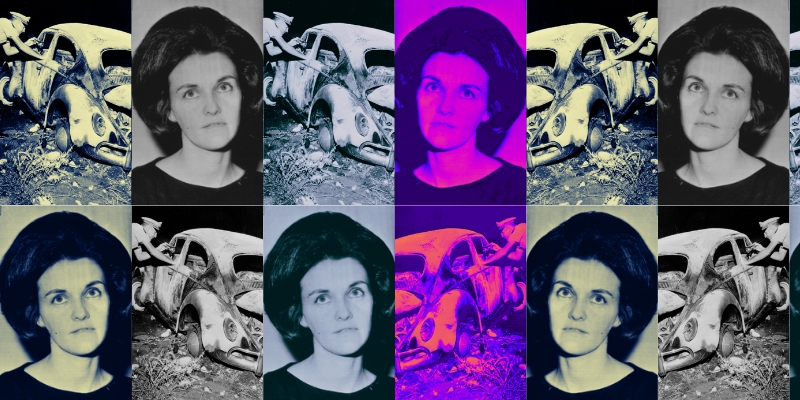
Both parties drove to Banyan, the chief following the silver Porsche. When they found the car, it was still burning. My father’s charred remains were slumped against the window, a blackened skeleton, about to disintegrate into a heap of ashes. This image would remain imprinted on my brain because one of my brothers later acquired a detective magazine that included a sensationalized version of what happened that night, including a photograph of my father slumped against the window burnt so badly that he was unrecognizable.
Around 2:00 a.m. the morning of October 8, Harold left the scene with my mother to pick up his wife, Joan. When they returned later, three detectives were still there, one of them a homicide detective from the San Bernardino County Sheriff’s Department.
Harold, a personal injury attorney, immediately understood the implications of their presence. From an investigator’s perspective, only a woman with murder on her mind would have failed to crawl through flames to save her unconscious and burning husband, the father of her children. Harold Lance continued to survey the scene while my mom and Joan shivered in the shadows. He called his brother, Bud, a criminal attorney, and asked him to drive over to meet him.
When Bud arrived, he and Harold stood off to the side watching how the sheriff’s department was investigating. They knew that my mother would be suspected of foul play. It was clear the cops were getting ideas. The investigating team began muscling the lawyers out of the picture, unwilling to give them any information about their inspection.
There were things the cops couldn’t make sense of, however. They didn’t like the position of the car in relation to the embankment at the side of the road. They wondered why the Volkswagen’s parking lights were on. How had the car burst into flames when the gasoline tank wasn’t ruptured? Why hadn’t my father sprung from the car? When the police found an empty, blackened gas can lying on its side in the back seat, Harold whispered to his wife, “Get Lucille out of here. Take her back up to the house.” Harold remained at the scene.
By early morning, my father’s body had been removed from the car. The darkness drifted away, leaving the coolness of dawn. Harold Lance stood at the scene of the accident, pale and exhausted. The whole thing seemed less spectacular as daylight slowly unveiled the roof of a house here and there, orange groves neatly ordered, stretching away from the sides of the road, the expanse of gray sky dulling the impact of the wreckage of a little black car.
At around six in the morning, Deputy Barnett arrived with the coroner. They wanted to question my mom, who was at home. Harold’s brother, Bud Lance, also refused Barnett’s request to speak with her, telling him that my mom was in no condition to answer questions.
“We’re not going to await her convenience,” Barnett responded. “We’ll question her even if we have to arrest her.”
But they did not leave to arrest her just then.
That came later.
***