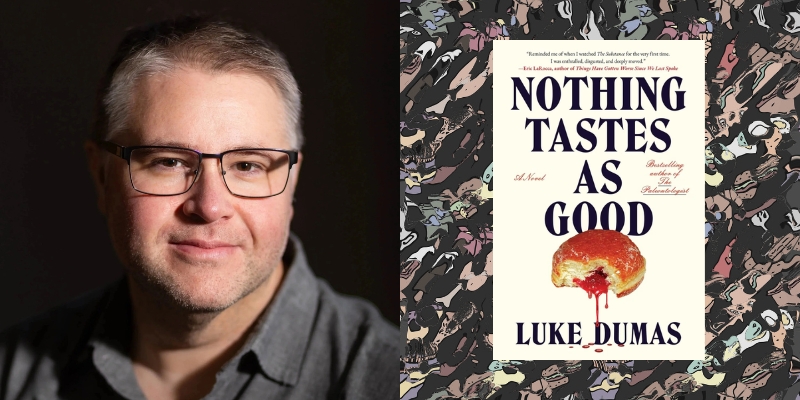
It feels weird to admit that of my novels, my cannibal weight-loss horror is by far my most autobiographical. Sure, I’ve done a lot of questionable things to lose weight, but the Human Meat Diet isn’t one of them.
Like my three-hundred-something-pound protagonist, Emmett Truesdale, I’ve been fat pretty much my whole life, and for most of that time it was an all-consuming concern. Years before drugs like Ozempic and Zepbound were a thing, I was just another chubby gay kid starving himself on Mom-approved fad diets, losing five or ten pounds before regaining everything I’d lost and more. It was a vicious cycle of deprivation, self-loathing, and comfort eating, one that would continue well into adulthood.
At the start of Nothing Tastes as Good, Emmett is stuck in the same cycle. At a dead end and out of options, he enters a clinical trial for what sounds too good to be true: a revolutionary new weight loss treatment called Obexity. To his surprise, it works better than he believed possible. Never mind that Obexity is possibly turning him into a cannibalistic monster. With results this good, getting off it is easier said than done.
Despite its relevance to the current weight loss drug craze, this book has been knocking around my head for more than twenty years, ever since I devoured Stephen King’s Thinner at the age of thirteen.
I found the mass market paperback in the horror section of my local secondhand bookstore. The cover wasn’t all that interesting—a man’s face in a purple handprint—but the title alone was enough to make me pick it up.
It was the first grown-up book I ever read, and I was obsessed. It had curse words! Sex stuff! Terrifying horror! A fat-guy main character!
This last part was especially surprising. As a child of the nineties, I was used to seeing overweight males portrayed only as stereotypical bit players in the stories of thin, good-looking straight people. People like me were only allowed to take the stage as idiots, clowns, troglodytes, and funny fat friends, depicted flatulating or consuming huge quantities of junk food, often the dumbest and least self-aware person in the room.
In the nineties, fat was never neutral; it was a symbol of a character’s deficiency—whether of willpower, intelligence, or desirability depended on how they were being exploited to advance the thin hero’s story.
And so it surprised me to read a novel in which an obese man was the focus and his desperation to lose weight mirrored my own. More enthralling still was idea of shedding pounds as he does: superfast, no matter how much he eats, with no control over the horrifying consequences. It was my childhood fantasy turned nightmare.
As I entered my twenties, I hungered for more stories that centered this perspective, but I came up short. While I loved and related deeply to Roxane Gay’s Hunger: A Memoir of (My) Body and Lindy West’s Shrill—books that explore fat from a feminist lens—it felt like the only guys writing about fat were straight, Midwest, average-joe comedians making jokes about how dumb and lazy they were, playing into the stereotype for an easy laugh.
Even Thinner, when I reread it as an adult, left something to be desired from that perspective. After all, Stephen King isn’t a fat guy, and his main character doesn’t really identify as one, either.
For as long as I had wanted to be a writer, I’d wanted to write something like Thinner—a be-careful-what-you-wish-for tale about dramatic weight loss—but as with so many of my projects, I sat on the idea for years, hung up on how to pay homage to my inspiration while making it feel original and something only I could write.
Through the perspective of the main character, I started to see how I could make the story my own. My protagonist would not just be fat; the reader would get a sense of his lived experience of fatness. The chokehold of constant vigilance and insecurity. The consuming health-related paranoia resulting from constantly being reminded that diabetes and heart disease are in his future. The alienation of being large-bodied amid the six-pack obsession of Southern California and the gay community. The crushing hopelessness of believing he can never—that he does not deserve to—find love, success, or happiness while fat.
And how all of that fuels his food addiction and undiagnosed binge eating disorder, for which the medical community has traditionally offered little to no acknowledgement or support.
My book was one in which the horror of out-of-control weight loss was at best equal to the horror of life without it, in a society that both reviles fat and offers no real solutions to it except judgment and shame.
At some point over the past ten years—coincidentally, given the cultural moment we’re currently having—I decided the main vehicle for my plot would be a clinical trial for a new weight loss drug. Like Emmett’s underrepresented perspective, that medical, sci-fi overlay felt distinct enough from Thinner that I could easily make it my own. Then Ozempic burst onto the scene, bringing with it questions about the drug’s safety and—more unsettling still—who should be allowed to access it.
The first time I ever heard of Ozempic, I was driving home from work when a talk radio story came on. The hosts were discussing these new drugs that had been created to treat diabetes, had been popularized as a weight loss solution by Hollywood celebrities, and were now in such high demand that diabetes patients were struggling to get their prescriptions filled.
The implication was that fat people, who were too lazy to lose weight the old-fashioned way, were gluttonously hogging all the drugs for themselves, reaping the rewards of a slimmer physique without putting in any effort, while leaving the poor diabetics without their life-saving treatments (ignoring the fact that eighty to ninety percent of adults with type 2 diabetes are either overweight or obese, a Venn diagram with a bulging midsection).
Here we go again, I raged. Yet another example of our society typecasting fat people as lazy, greedy, mindless consumers, then acting surprised when they reached for something to help them slim down. We shamed people for being overweight, made them feel so defective and subhuman that they clamored for drugs like Ozempic, happily profited off their desperation, then judged them for not losing weight “the right way.” There was no winning as a fat person in America, and not nearly enough people were saying it.
I had the POV. I had the plot. And now I had the central themes of my weight-loss horror. More than two decades after Stephen King’s book put the bun in the oven, Nothing Tastes as Good was fully baked in my mind—and demanding to be written.
It was, in many ways, the most effortless writing process of my career so far. The story poured out of me. I never had to second-guess how people would treat Emmett, or how he would react, because I had lived it a thousand times. I knew his hurts and traumas and hopes and dreams because they were my own.
I may not have sought revenge on my abusers in the form of a cannibalistic murder spree, but the emotion behind them—the hurt and rage and hunger for acceptance—I had lived with it for more than thirty years.
Like Emmett, this book thought it wanted to be Thinner—but what it really wanted was to take a bite out of the world.
***