Crafting a crime novel in a small town is rewarding, but also comes with a unique set of challenges. For one, the setting needs to be a secondary character in the story. Small towns are famously close-knit with their own brand of quirks, characters, and inside jokes. As such, they are a personality all their own, and a place like that needs to feel lived in.
When the reader steps into a small town world, they need to feel like they belong. Like the personalities are people they could imagine meeting, and they’re in on the jokes and pick up on the banter.
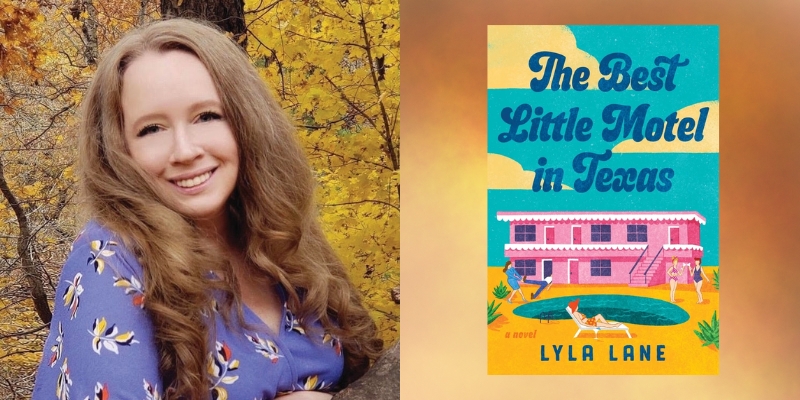
In my novel, The Best Little Motel in Texas, I wanted the town of Sarsaparilla Falls to feel cozy, warm, and welcoming. So that when a murder does take place there, the shock of it would be felt that much more. Especially because small towns are supposed to be places where everyone knows everyone and no one locks their doors.
One of the ways I did this was by building a town with people who are recognizable to anyone who’s been to one of these places. They know the town librarian, the bar with the burned-out neon sign, the church at the center of all social activities, and the town gossip. These are all hallmarks of a local community.
Another way I built this town was by modeling some of the places of business in it on the small town where my grandparents lived, along with some of the small towns in my own state that I’ve explored when doing research for this book. The diner where Cordelia and the chicks go after running into a suspect is based on the diner in my grandparents’ town. The seventies style wallpaper, chipped Formica tables, and scent of fresh brewed coffee baked into the walls is something I can still feel when I close my eyes.
Another place I drove through had a handwritten sign on the door that said “Delilah Sommers is NOT allowed in here.” Which is still a running joke between me and my daughters, and will be included in upcoming books.
Having little touchstones like that based on own experiences makes the small town I created feel more alive. The details of the town are made up of pieces of places I’ve been mixed with places I always wished I could’ve called home, which set the perfect cozy scene.
Another challenge to overcome in writing a small town is that everyone has known each other all of their lives. Then, all of a sudden, there’s a murderer among them. But in order to have several suspects, several people have to be keeping secrets. Not something easy to do in a place famous for news traveling faster than wildfire.
So it was imperative for me to build multifaceted characters who behaved in unexpected ways. My town librarian wasn’t quiet or meek; she was outspoken and openly butted heads with the victim. The town nurse wasn’t nurturing or caring; she was possessive and quick to anger. The town bully had a soft and scared side.
Creating characters with layers to them made it easier for me to build a believable suspect list. And give them full personalities would make them more memorable to readers.
Overall, I don’t think my premise could’ve worked in a big city. The Chickadee brothel is very much an institution of the town, and the chicks who work there are beloved members of the community. They donate to local causes and are on good terms with their clients’ wives. Everyone in the town knows who they are and what kind of service they provide for the town.
And while small towns can have their prejudices, the tightness of the community makes it easier for them to accept the elderly sex workers as their own. It’s less judgmental because of the personal association, which I wouldn’t have if I’d set this book in a big city.
Another reason why this premise couldn’t work in a big city is that my main character was returning home to claim an inheritance (the Chickadee Motel) from an aunt she didn’t know. She’d spent the last twenty years living in a big city that allowed her anonymity, and returning to her small hometown forced her to stand out in ways she wasn’t comfortable with at first. It threw her into a fish-out-of-water scenario, which increased the conflict in the story.
It also set the stakes for her motivation to solve the murder. Not just to absolve the chicks, but to prove to the town she’d left behind that she wasn’t like her mother.
Small towns are a great setting for mysteries for a number of reasons: the quirky characters, generations of families congregated in one place, and a cozy, community vibe, but it all comes down to what setting fits the story best. If I were writing a dark and gritty police procedural, a big city might work better. Or if I were writing a gothic mystery, a crumbling old manor might be the best setting.
Since I knew I wanted to write a cozy with plenty of humor and heart, a small town made the most sense to me. And as someone who has lived in both small towns and big cities, I love the undeniable charm of a small town.
The Best Little Motel in Texas has all the best parts of small town life. The easiness between people, the shared history, the lore, and jokes that only make sense to those who live there, and as the author, it was a pleasure to write this little slice of Texas heaven. My hope is that readers feel welcome in Sarsaparilla Falls and want to stay for a while.
***