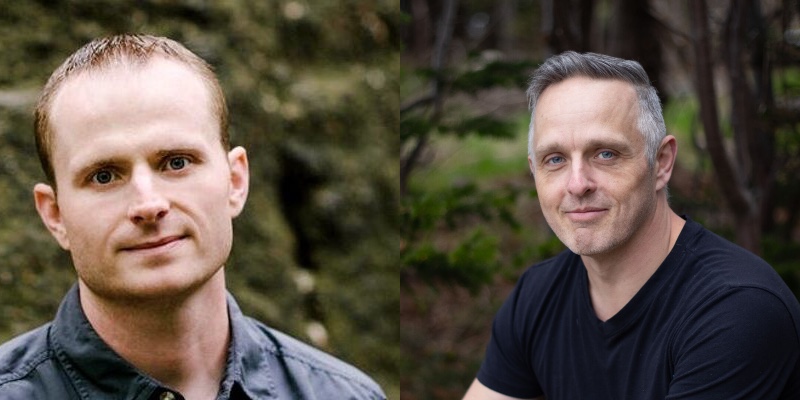
Michael Koryta is a New York Times-bestselling author whose work has been translated into more than 20 languages and has won or been nominated for the Los Angeles Times Book Prize, Edgar Award, Shamus Award, Barry Award, Quill Award, International Thriller Writers Award, and the Golden Dagger. They’ve been selected as “best books of the year” by numerous publications. He also publishes under the name Scott Carson.
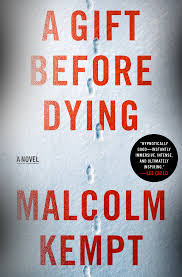
Malcolm Kempt worked as a criminal lawyer in the remote Arctic for seventeen years before leaving to write full-time. He now lives on the island of Newfoundland. His debut novel, A Gift Before Dying, is now available from Crown.
KORYTA: I want to start with setting, because you’re masterful in the way you turn place into a character. Tell me a little about your background in this world, and when you began to think about the story potential it offered?
KEMPT: During my first few years in the Arctic, I was staying in a rundown hotel in Cape Dorset when a blizzard hit. There were five guests including myself: an elderly Inuit man and his teenage granddaughter who both spoke no English, an odd tradesman who only spoke Quebecois French and the shady, drunken Anglophone cook who lived in the building. When the power went out—and the furnace with it—we all congregated in the common area unable to effectively communicate and with nothing outside the windows but darkness and cold. I thought, if one of us turns up dead, this would make a great novel. That was the beginning of my obsession with capturing the Arctic in fiction.
KORYTA: You know the physical world here but also the story world, having experience in criminal law. How important is the verisimilitude to your work? Are you one of those readers who will put down a book that screws up the details of the process, or are you patient with fictional takes on law enforcement and the courts?
KEMPT: Cape Dorset now has full cellular service and is staffed by six officers, but I wrote the town like it was when I first visited in 2004. It can be hard to find shows or books that are completely accurate. However, there are many realistic aspects of law and policing that are boring and don’t really make for good fiction. I’ve had whole days in a murder trial where the gallery is practically falling asleep, and a lot of policing is just paperwork. I recently read a best-selling crime novel where the cops all talked like college professors, and anyone with even a basic knowledge of law enforcement would have cringed at the plot twists. It was beautifully written, but I kept getting jarred out of the narrative. I try to be patient because I know I can get things wrong too. I know you split your time between different geographical locations as I do. How much does your physical location impact your headspace? Can you still write deep, dark horror in a café in Bloomington, or do you need to be hunkered down in the backwoods of Maine?
KORYTA: The space does matter. I need it to be a bit of a sensory deprivation chamber. I rent an office in Camden, Maine in the basement of a law firm so I can have a detached space with no wifi. The most important things to me are an ability to shut the world out completely and access to a beautiful walk as quickly as possible. Walk, write, walk, write. Those are my ideal days. I do feel a bit of tension over the transition between Bloomington and Camden when I’m in the middle of a book. That jars me a bit, because I feel like the draft belongs to the place. I always try to finish a draft before making the big trip in either direction. You moved from the Arctic to Newfoundland to Indiana, my home state. What keeps you on the hunt for fresh gray skies?
KEMPT: I’m not sure if you noticed, but my stuff is pretty grim. I can’t be writing this material in a place where the sun is always shining. Speaking of which: I still think about Rise the Dark every single time I see high-voltage power lines. And now, Departure 37 has me wanting to know more about atomic bomb research. Is it particular story ideas that send you down these fascinating rabbit holes, or is it the non-fiction reading you do that sparks the story ideas?
KORYTA: Non-fiction and journalism are usually the sparks. I’m intensely curious about processes, too; I enjoy getting into the weeds of how things work. So learning, for example, that a transmission line in rural America could bring down the grid in a city far away engages my imagination. With Departure 37, it was toying with the obvious parallels between AI and the nuclear arms race. It seems one of your sparks may be indigenous mythology? What did the research process look like there?
KEMPT: Inuit mythology and folklore varies so much from region to region. Whenever I listened to a room full of elders discuss it, they often disagreed on details and told different versions of stories. I just tried to be respectful and seek advice and clarity given that I was an outsider writing about another culture. All the fantastic creatures I mentioned in the book can be found in Neil Christopher’s wonderful compendium, The Hidden. He’s a friend and one of the leading experts on Inuit mythology.
KORYTA: I love points of contrast as a tool for drama, and you do a wonderful job of mining that. Could you share a bit about the contrast between the endless-sunlight or endless-dark seasons and the reality of the community during those times?
KEMPT: The summer is a time of endless daylight for many communities, especially as you get higher in latitude. I found it far more disorienting than the darkness of winter. I’d wake up to use the washroom in the middle of the night and my brain would refuse to go back to sleep. It’s when most people are out on the land camping and going boating. I recall being in Pangniqtuuq near the Arctic Circle and driving around with the police in the middle of the night. The town was overrun with kids climbing on shipping containers and riding around on bikes as if it was mid-afternoon. Winter was easier for sleeping, but you are far more restricted in terms of going outside.
KORYTA: Without spoiling anything, I feel as if I’m picking up on some love of gothic storytelling, maybe some horror influences? Who in that camp has inspired you?
KEMPT: You’re right. I’m a huge fan of gothic and horror literature – Algernon Blackwood, Ambrose Bierce, and Arthur Machen. I’ll literally read anything that’s gothic, spooky or weird and written before 1950. More modern Southern Gothic in the vein of Harry Crews or Cormac McCarthy is great too. There are some J-horror tropes tucked away in the novel; I’m a huge fan of Koji Suzuki. That might explain why the publishing rights got picked up so quickly in Japan. I’m hoping the novel will resonate with readers over there and I’m so stoked that Suzuki might one day read it in Japanese. Another influence is Lieutenant William Kinderman, the investigating officer from both William Peter Blatty’s The Exorcist and his follow-up Legion, is my all time favorite literary detective. Quirky, relentless and a deep-thinker; he’s like a philosopher Columbo. Who’s a protagonist in crime fiction that has really stuck with you over the years and why?
KORYTA: Love that you picked Kinderman, not many people mention him. He’s a great character – and you write better dialogue than Blatty, so keep running with that inspiration. So many of the greats rise to mind for me – McGee, Archer, Bosch, Robicheaux. I love a haunted character who’s making choices in the present to try to atone for the past. The best example in recent years is Billy Summers from Stephen King. As you know, I’ve ranged around a bit over the years, writing a detective story here, a ghost story there, even using the Scott Carson pseudonym for the supernatural thrillers, etc. Where do you see the work taking you next – deeper into this world, mining it for more stories, or on to some new, different canvas?
KEMPT: I had several ideas for a sophomore novel fleshed out, but none of them involved the Arctic. I felt it was time to move to a new setting—though I’m not ruling out the return of those characters in some form later on. My next project will be set in rural Newfoundland. It’s perfect for a spooky crime novel and not that different from the North in many ways. Isolation, rugged landscape, harsh weather, and tight-knit communities. There’s also a rich folklore of cunning folk and witchcraft and so many unique dialects and traditions. Beyond The Shipping News and Come From Away, most readers know little about the island, so I think I can surprise and intrigue them.
KORYTA: Be honest: are you sick of every review and blurb (including mine) playing with the same ideas of “cold and dark?”
KEMPT: Not at all. I love all the blurbs and reviews. And the book is relentlessly cold and dark, so I don’t blame anyone. Both of our debut novels were blurbed by the legendary Lee Child. I nearly fell over when I read what he thought of my book. Can you share your story about how your blurb from him came to be, and what it meant to you.
KORYTA: Blurbs are endlessly debated in the industry as a sales tool, but I think what’s lost is how much they mean to writers when they’re authentic and come from someone you admire. I was 19 when I wrote that first book, and I knew no one in publishing, so the idea that Lee Child had read it felt truly surreal. When Stephen King put The Cypress House on his recommended summer reading list for Entertainment Weekly years ago, I was in such a daze that I tried to board the wrong plane. Knowing that your heroes have appreciated your work is one of the unique joys you’ll ever feel. I don’t give a damn if blurbs sell books – they’re still special.
KEMPT: I know one of your mentors, Bob Hammel, recently died and I’ve heard you talk about the impact that he had on your life. I’ve been lucky enough to get advice from authors like Richard Thomas, Chuck Palahniuk and Jack Ketchum that helped refine the way I write. How important are mentors to writers and do aspiring writers often come to you for advice?
KORYTA: The right mentor can be life-changing. I’ve been fortunate to have several. Bob Hammel was the first and foremost; losing him was like pulling the plug on a 30-year conversation. But I keep having it in my head, with or without him! Writing is an isolated task, so having a conversation about craft is essential. Civilians tend not to care about the sentences, right? It is useful to find someone else who has struggled with them. I’ve found this to be a generous industry. I think most writers remember what it felt like to be new to the game. I hope that has been your experience.
KEMPT: Speaking of advice, you’ve published 20 novels in about 20 years. Any advice for a debut author on how to avoid the dreaded sophomore slump?
KORYTA: What Michael Connelly told me: write with your head down. Don’t pay too much attention to the business and don’t get caught up worrying about what anyone else is doing. Write the next book and try to make it your best one. Then do it again. I’d add a Ray Bradbury line: “Write every day of your life, read intensely, then see what happens.”