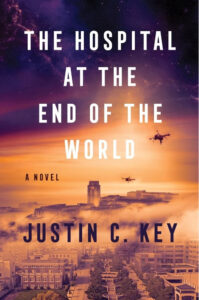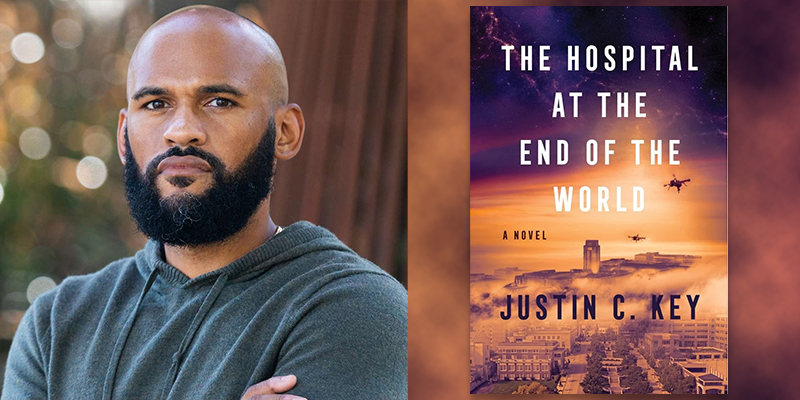
When I thought of the idea of a hold-out hospital fighting against our future AI overlords, the ingredients for a medical thriller that pays homage to the late and great Michael Crichton were already there: AI, medicine, and the race to find a cure. But these elements mean nothing if the main character doesn’t feel the danger.
Lucky for me, four years of medical school and four more years of residency training taught me well.
Being a Student Doctor is like living in a thriller. You come in with high hopes and high expectations. Life is good, everyone is proud, and then, BAM! Things get real. Every day becomes a battle. You’re constantly fighting fatigue, self-doubt, competition for limited spots, and the hospital’s culture of hierarchy. And this is all before factoring in the weight of human lives in human hands!
Most of the daily battles are small scale. Studying an inhuman amount of information for that next exam. Stuck on that rotation with what we called a ‘gunner’: a medical student determined to come out on top, no matter who they stepped over. Navigating that one surgeon’s ridiculous line of anatomy questioning that has nothing to do with the current operation. The heartrate rises, fear plateaus, the moment passes—scars are accounted for—the heartrate falls. That primal part of your brain thinks you just escaped a saber-toothed tiger. Live to fight another day.
While these brief adrenaline rushes can be varied and at times unpredictable, I’d argue there are two fears most trainees perpetually have running in the background: making a fatal patient mistake and ruining one’s own career before it even starts.
In the real world, these fears—big and small, daily and existential—can largely be attributed to anxiety. Most will do well on the tests they agonized over. Most will find that mistakes don’t happen in a vacuum: the hospital and the training programs are designed to withstand novice shortcomings. Most will never stumble into the moral conundrum my main character did (more on that soon!).
That’s because Student Doctors are careful. We all heard that horror story of a medical student expelled weeks before graduation for forging rotation attendance sheets or that doctor reported to the board for smuggling medications (or worse). Despite the very real God complex that can plague the profession, a vast majority of us wouldn’t think about jeopardizing our licenses. Not intentionally. What worries us is the ‘what if’ of an accidental scandal.
What if I accidentally email patient records to the wrong person? What if I unknowingly match with a patient on a dating app? What if I forget to renew one of my many licenses and inadvertently break the law? What if . . . what if . . . what if . . . Some spiral. Some cope by burying themselves in the work.
Others process by writing a novel! But pure anxiety isn’t fun to read. It needed . . . translating.
Enter Pok, the main character of The Hospital at the End of the World. He’s a wrongly accused fugitive that fled his Manhattan life and has nowhere else to go. New Orleans is the only city that will protect him and Hippocrates Medical School is the only home he can hope to regain. The weight of all this pushes heavy on every night of studying, every test, every interaction. For him, failure would be more than disappointment, more than ‘figuring out his next step.’ It could very well be a death sentence.
Right as he’s navigating being an outsider thrust into the unforgiving reality of medical school, LITERARY BAM: in comes Jerry, a slick-talking drug lord who also owns one of the city’s two main news outlets. Jerry threatens Pok’s reputation, his career, and his life, all at once. With the scene now set, I could tap into the years of anxiety, worry, and catastrophizing. The feeling that every ‘urgent’ email was other shoe dropping for some misstep I just knew all along was possible, the dread of every performance review finally outing me as the imposter I always suspected, the brief pause before signing every order, hoping I didn’t miss anything. My writer’s brain was ripe for crafting a medical student’s worst-case scenario.
And how did Pok respond? He did the unthinkable, the thing every medical student and trainee has nightmares about but would never actually do: he put his career on the line. Forced or not, he created a prime position to be expelled and have his lifelong dream of being a physician like his father turned into a nightmare of exile and survival.
The fun part about thrillers–from the writing to the reading–is how the heck does the main character get out of this mess? I knew I needed a scene, something over the top, that pushed Pok to the next level. Simultaneously taking care of his situation in the short term but upping the stakes in the long. In doing this, I gleefully broke the constraints of the hierarchy I so abhorred during training. Instead of being the glorified shadower I was as a first-year medical student, I got to put Pok in the driver’s seat.
Was it hard to take this leap? Yes and no. My inner medical student cried out ‘he can’t do that!’ But I had already crossed into the realm of the fantastic, an impossible situation that only existed (for me, anyway) in my imagination. Pok had already crossed a line I never would. He might as well cross more to save himself.
But what came easy for me was a terrible time for my main character. My son, just shy of twelve, read the novel and afterward commented: you were really mean to Pok! I grinned and said, “Of course I was!” Oh, the fun I had putting him through the ringer. Which is dangerous as a writer. Fun isn’t the emotion I was going for, not at the height of the thrill. I had to remember what it felt like to be a scared medical student. Heart racing, senses heightened, expecting danger at every turn. Ah, there we go. Take me back to that moment when I showed up at the completely wrong rotation and would now be inexcusably late. Those were the emotional beats I needed to tap into.
I’m glad to find out that, after all these years, the reason I endured it was to put it on the page and pass it on to you. You’re welcome.
***