In the best murder mystery novels, the killer is always the person you least suspect. It’s never the obvious villains who did it. It’s always someone you failed to notice or forgot about, until the final scene, when the detective reveals that it was the quiet housekeeper all along.
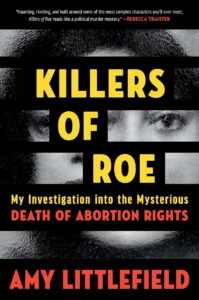
I didn’t intend to write a murder mystery. I’m an abortion reporter and I intended to write a book about the death of Roe v. Wade. The idea to frame it as a whodunit started as a way to entice myself to tell an upsetting story filled with unpleasant characters. I was in the fog of new motherhood when it became clear we were going to lose the constitutional right to abortion. The only books I could handle at the time were the Agatha Christie novels I had loved as a teenager. Murder mysteries were a comforting escape for me as a new mom and also as a journalist who had spent a decade covering the slow death of abortion rights and was now watching the Supreme Court deal the fatal blow.
As I began research for the book that would become Killers of Roe, I used my murder mystery reader’s instincts to look beyond the usual suspects, and discovered this format was the ideal container for the story I needed to tell. Because the killers behind some of the deadliest anti-abortion policies in U.S. history were the equivalent of the quiet housekeeper. They were the people you would least suspect.
The book told the story of the wider death of a constitutional right, but I framed each section around a real woman who had died from anti-abortion policies. Then I channeled my favorite Christie sleuth, the unassuming old lady Miss Marple, to try to listen my way to an understanding of the behind-the-scenes figures who played a quiet role in those deaths. I started in the 1970s with Rosie Jimenez, a 27-year-old Mexican-American woman with a four-year-old daughter who was studying to be a teacher in McAllen, Texas. She sought an unsafe abortion when her Medicaid card would no longer cover a safe one and died in agony of an infection in October 1977. The known culprit for her death was the Hyde Amendment, named for the late Rep. Henry Hyde of Illinois, which banned federal funding of abortion in most circumstances. (This ban was also the first major culprit in the death of Roe itself; to this day, it requires Medicaid patients in most states to pay for their abortions out of pocket.) When I dug into the history, I found the most unlikely suspects. One was a retired IRS attorney who had written an early draft of the ban and who would spend hours trying to convert me to Catholicism. Another was a former Congressman whose career had ended when he was accused of soliciting sex from a teenage boy. He had spent the years since penning treatises on offshore tax avoidance.
I kept going. The next death in the story was that of a white teenager named Becky Bell. She loved horses and had a Marilyn Monroe poster on her wall and she died of pneumonia caused by a massive infection brought on by a back-alley abortion. The culprit was a 1984 law requiring parental consent for abortion in her home state of Indiana. (Bell had told a friend she loved her parents too much to disappoint them by confiding that she needed an abortion.) Behind that law, I found a 92-year-old former Indiana state lawmaker aging in obscurity in Kokomo. He had a fondness for Trump and a penchant for dressing up like Abraham Lincoln.
These old men were shuffling around to church and the grocery store without anyone noticing they had blood on their hands. Unmasking them was every bit as satisfying in real life. But once I’d found them, the murder mystery paradigm began to fail. In each interview, there was a moment that should have felt like the detective’s final reveal, a moment when I confronted the suspects with the stories of their victims. I described how these young women had died terrible and preventable deaths from the policies these men had promoted. Then I held my breath and waited.
In an Agatha Christie novel, these revelations prompted confessions.
In real life, it doesn’t happen that way.
I kept trying. I pushed for a confession with the anti-abortion militants whose extreme rhetoric helped fuel the murder of abortion providers in the 1990s. I pressed for a confession with Mark Lee Dickson, the pastor who sowed the seeds for the six-week ban in Texas that ProPublica revealed had contributed to the death of Josseli Barnica in 2021. She was a 28-year-old mother who prayed for 40 hours for doctors to save her life and let her go home to her one-year-old daughter. But she was told it would be a “crime” to treat her miscarriage.
These men did not confess. They defended their actions. And the dead women stood among us like ghosts.These men did not confess. They defended their actions. And the dead women stood among us like ghosts.
I think there’s a reason many of us find murder mystery novels so comforting, especially right now, in this terrible political moment. It’s not just the serene pastoral settings or the knowledge that the truth will be revealed in the end. It’s the sense of retribution that comes with seeing a killer feel remorse and face consequences for their actions.
In the real world, especially these days, there don’t seem to be consequences anymore.
I didn’t prompt any confessions with my reporting. But I did find a new way to think about history that I found almost as comforting as an Agatha Christie ending. As I went along, interviewing dozens of people on both sides of the abortion rights struggle, I saw that history itself is shaped not only by the people in the foreground, the larger-than-life suspects, the flamboyant villains. It is shaped by smaller acts in the shadows by the quiet housekeepers. And those people exist on the right side of history, too. After the Supreme Court overturned the national right to abortion, people in city council chambers and state legislatures passed a record-breaking number of policies to shore up abortion rights. Medical providers and community activists began mailing and circulating abortion pills, offering a safe option to tens of thousands of people and preventing more deaths.
Now is the era of the quiet housekeepers, the reporters in bathrobes filming federal agents on the streets of Minneapolis, the dads in their minivans looking after their immigrant neighbors. These days, the people you least suspect are getting involved in the work of justice.
It turns out, we don’t need a confession from the killers. Quietly, slowly, in the background of history, people make justice themselves.
And maybe there’s a kind of retribution in that.
***